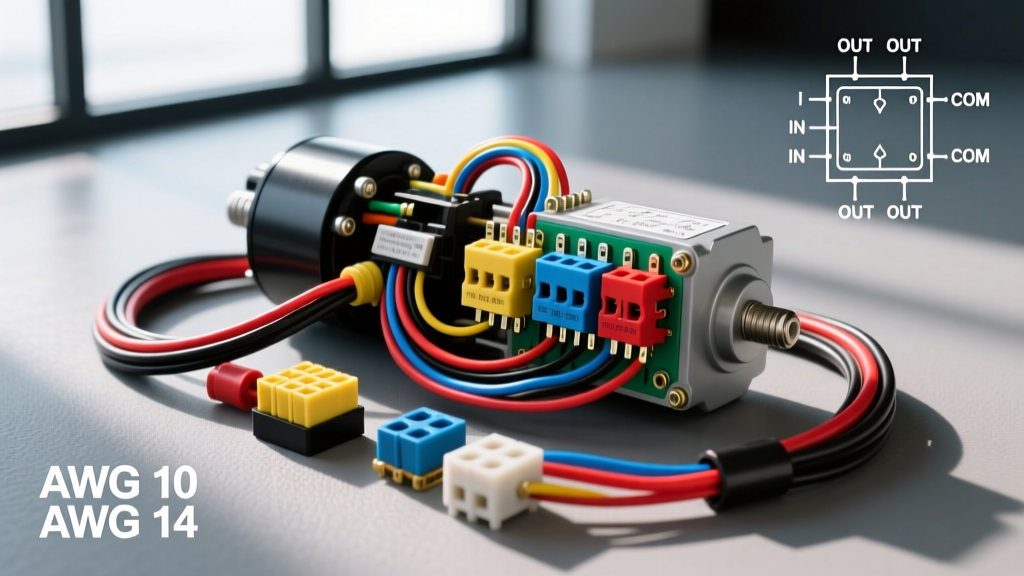
Introduction: Selecting the Right Boat Lift Motor System
When outfitting a marine dock, trailer-based hoist, or off-grid boat lift, selecting the correct electric motor and understanding the corresponding wiring diagram for boat lift motor applications is critical for safety and longevity. Unlike standard automotive accessories, boat lift motors operate under extreme load conditions, often drawing massive inrush currents while hoisting thousands of pounds of hull weight out of the water. For mobile setups, remote docks, or trailer-mounted winch systems, 12V and 24V DC motors are the industry standard, leveraging heavy-duty automotive and marine electrical principles.
This comprehensive product comparison and selection guide breaks down the electrical requirements of 12V DC versus 24V DC boat lift motors. We will provide exact solenoid pinouts, AWG wire sizing charts, and integration methods for linking your lift motor to a tow vehicle's electrical system via a 7-way RV connector. All recommendations align with ABYC E-11 AC & DC Electrical Systems standards and SAE J1128 Primary Cable specifications.
Product Comparison: 12V DC vs. 24V DC vs. 120V AC Lift Motors
Before pulling wire, you must select the motor architecture that fits your environment. While 120V AC motors (like those from ShoreMaster or Hewitt) are common on fixed residential docks with grid power, DC motors are mandatory for trailer setups, solar-powered remote lifts, and vehicle-integrated systems.
| Motor Type | Avg. Amp Draw (Under Load) | Best Application | Wiring Complexity |
|---|---|---|---|
| 12V DC Series-Wound | 45A - 70A | Trailer winches, portable lifts, truck-powered | Moderate (Requires heavy AWG, high-amp solenoids) |
| 24V DC Series-Wound | 25A - 35A | Heavy-duty off-grid lifts, dual-battery marine setups | High (Requires series battery bank, isolated charging) |
| 120V AC Induction | 10A - 15A | Fixed residential docks with grid shore power | Low (Standard NEC wiring, GFCI protected) |
Selection Verdict: If your boat lift is mounted on a custom trailer or you need to power the lift remotely using your truck's auxiliary battery, a 12V DC motor is the most practical choice. If you are building a permanent off-grid solar lift, a 24V DC motor reduces voltage drop and allows for thinner, more manageable wire gauges.
Wiring Diagram for Boat Lift Motor: 12V DC Solenoid Configuration
The most common failure point in 12V boat lift wiring is the use of undersized relays. Standard 30A automotive relays will melt under the 60A inrush current of a lifting motor. You must use a heavy-duty continuous-duty solenoid, such as the Cole Hersee 24059 or a Trombetta 12V marine solenoid.
12V DC Solenoid Pinout & Control Circuit
The standard 4-pin heavy-duty solenoid uses the following terminal configuration to safely route high amperage to the lift motor:
- Terminal 30 (High Amp Input): Connects directly to the positive battery post via a 150A marine-rated circuit breaker or ANL fuse. Use 4 AWG tinned copper wire.
- Terminal 87 (High Amp Output): Connects to the positive terminal on the boat lift motor. Use 4 AWG tinned copper wire.
- Terminal 85 (Control Ground): Connects to the vehicle chassis or negative battery bus bar using 12 AWG wire.
- Terminal 86 (Control Power): Connects to the momentary UP/DOWN toggle switch. The switch receives 12V from a fused 14 AWG ignition or auxiliary circuit.
Expert Tip: Always install a reverse-polarity diode across terminals 85 and 86 (cathode to 86, anode to 85) to absorb the inductive voltage spike when the solenoid disengages. This prevents arcing across your toggle switch contacts.
Wiring Diagram for Boat Lift Motor: 24V DC Dual-Battery Setup
For larger vessels exceeding 5,000 lbs, 24V DC lift motors (such as those used in heavy-duty commercial marine railways) are preferred. A 24V system cuts the amperage in half, drastically reducing voltage drop over long wire runs from the battery bank to the lift motor.
The Series Wiring Configuration:
- Connect two 12V deep-cycle AGM marine batteries in series (Positive of Battery 1 to Negative of Battery 2).
- The remaining Negative on Battery 1 becomes your 24V System Ground.
- The remaining Positive on Battery 2 becomes your 24V System Power.
- Route 24V Power through an 80A ANL fuse to Terminal 30 on a 24V-rated continuous solenoid.
- Route Terminal 87 to the 24V lift motor positive post using 6 AWG marine wire.
12V Accessory Tap Warning: Never ground a 12V accessory (like a dock light or winch control module) to the center-tap junction of the two batteries. This creates an unbalanced discharge that will rapidly sulfate and ruin the 12V battery being tapped. Always use a DC-to-DC isolated step-down converter to derive 12V from a 24V bank.
Wire Gauge (AWG) Selection Chart & Voltage Drop
Boat lift motors are highly sensitive to voltage drop. If the voltage at the motor terminals drops below 10.5V (on a 12V system) during the lifting cycle, the motor will overheat, the gearbox will bind, and the internal windings may short. According to ABYC standards, voltage drop on critical motor circuits should not exceed 3%. Because SAE J1128 automotive wire has thinner insulation and higher resistance than marine wire, always use Type 3 UL 1426 tinned marine wire for lift applications.
| Motor Amp Draw | One-Way Wire Run Distance | Required Wire Gauge (AWG) | Crimp Terminal Type |
|---|---|---|---|
| 30A (24V System) | Under 10 ft | 8 AWG | Heat-Shrink Ring Terminal (5/16'') |
| 30A (24V System) | 10 ft - 20 ft | 6 AWG | Heat-Shrink Ring Terminal (5/16'') |
| 60A (12V System) | Under 10 ft | 4 AWG | Hydraulic Crimp Lug (1/4'') |
| 60A (12V System) | 10 ft - 25 ft | 2 AWG or 1/0 AWG | Hydraulic Crimp Lug (3/8'') |
Trailer Integration: Powering the Lift via Tow Vehicle
A major advantage of 12V DC boat lift motors is the ability to power them directly from your tow vehicle's alternator and battery system when launching or loading at remote ramps. This is achieved by integrating the lift motor's control circuit with the standard 7-way RV trailer connector.
7-Way Blade Pinout for Lift Integration:
- Pin 4 (12V Auxiliary Power): On most modern trucks (Ford F-150, Ram 2500, Chevy Silverado), Pin 4 provides a direct link to the vehicle's battery, often controlled by a relay in the under-hood fuse box that only activates when the engine is running. This prevents the lift motor from draining the truck's starting battery while parked.
- Pin 1 (Ground): Connects to the trailer chassis and the lift motor's negative return path.
Crucial Warning: The factory wiring for Pin 4 on most trucks is only 10 AWG or 12 AWG, which is insufficient for a 60A boat lift motor. You must upgrade the tow vehicle's Pin 4 feed wire to 4 AWG, bypassing the factory harness and running directly to the battery via a 150A breaker, or use the truck's Pin 4 solely to trigger a secondary relay mounted on the trailer itself, powered by a dedicated trailer-mounted marine battery.
Troubleshooting Common Lift Motor Electrical Failures
When a boat lift motor fails to raise the vessel, the issue is rarely the motor itself; it is almost always a voltage drop or connection failure in the wiring harness. Use this diagnostic tree to isolate the fault:
- Symptom: Solenoid clicks loudly, but motor does not turn.
Cause: High resistance on the high-amp circuit (Terminals 30 or 87).
Fix: Perform a voltage drop test across the solenoid while pressing the switch. If you read more than 0.2V across the solenoid, the internal contacts are pitted. Replace the solenoid. Check for corrosion under the ring terminals. - Symptom: Motor hums, draws massive current, but lift doesn't move.
Cause: Mechanical binding or undersized wiring causing severe voltage drop at the motor.
Fix: Measure voltage directly at the motor posts while under load. If voltage drops below 10.5V, upgrade the AWG wire size. Inspect the winch drum and cable for binding. - Symptom: 150A Circuit Breaker trips immediately upon engaging switch.
Cause: Short to ground, seized motor armature, or locked gearbox.
Fix: Disconnect the motor from the gearbox. If the motor spins freely on the bench, the mechanical lift assembly is seized. If the motor still draws over 150A and trips the breaker on the bench, the internal armature windings are shorted and the motor must be rebuilt or replaced.
By selecting the correct DC architecture, adhering to strict AWG sizing guidelines, and utilizing marine-grade continuous solenoids, your boat lift motor wiring will provide years of reliable, high-torque service in harsh marine environments.