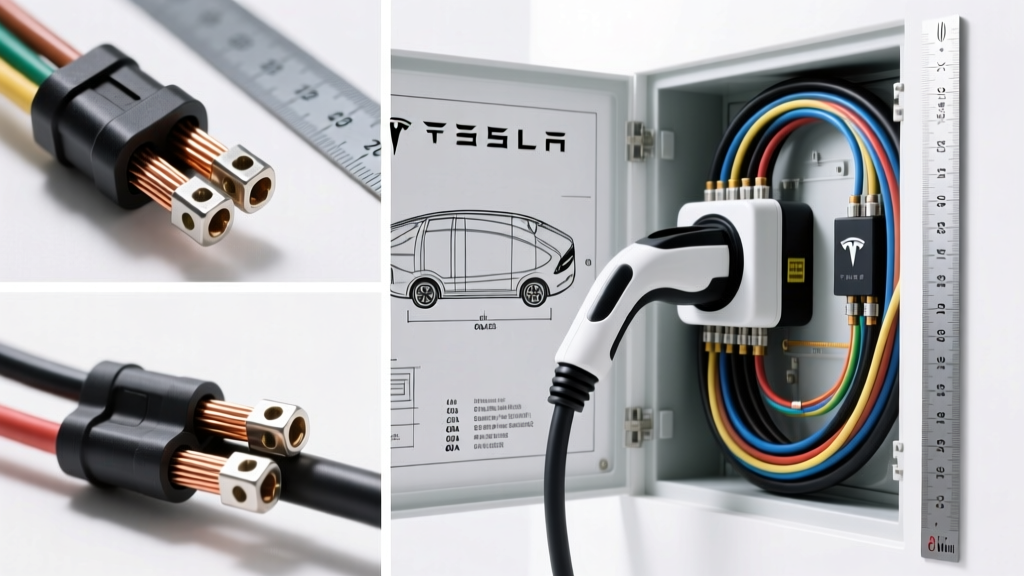
Introduction to EVSE Wire Sizing and the 60A Standard
Installing a Level 2 Electric Vehicle Supply Equipment (EVSE) system requires strict adherence to electrical codes and precise material selection. When determining the correct tesla wall charger wire gauge, installers and DIYers must navigate the intersection of National Electrical Code (NEC) requirements, material costs, and specialized tooling. The Tesla Gen 3 Wall Connector is capable of delivering up to 48 Amps of continuous current. Under NEC Article 625.41, EV charging is classified as a continuous load, meaning the branch circuit must be rated for 125% of the maximum continuous load. Therefore, a 48A charge rate mandates a 60-Amp breaker and appropriately sized conductors.
This guide provides a comprehensive cost and tool requirements analysis for sizing, pulling, and terminating the correct wire gauge for a Tesla Wall Connector, contrasting hardwired 60A setups with 50A NEMA 14-50 receptacle alternatives.
Tesla Wall Charger Wire Gauge Specifications
Selecting the wrong gauge or wire type is a leading cause of thermal runaway in EV charging setups. Below is the definitive specification chart for Gen 3 Wall Connector installations based on circuit amperage and run length.
| Circuit Breaker | Max Continuous Load | Min. Copper AWG (THHN) | Min. Aluminum AWG | Min. Conduit Size | Installation Type |
|---|---|---|---|---|---|
| 60 Amp | 48 Amps | 6 AWG | 4 AWG | 3/4 inch | Hardwired Only |
| 60 Amp (Long Run >60ft) | 48 Amps | 4 AWG | 2 AWG | 1 inch | Hardwired Only |
| 50 Amp | 40 Amps | 8 AWG | 6 AWG | 1/2 inch | Hardwired or 14-50 |
Note: While 6 AWG NM-B (Romex) is sometimes mistakenly used for 60A circuits, NEC 334.80 limits 6 AWG NM-B to 55 Amps. For a full 60A/48A Tesla setup, THHN/THWN-2 conductors in conduit are strictly required.
Material Cost Breakdown: Copper, Aluminum, and Run Lengths
The cost of your tesla wall charger wire gauge selection scales exponentially with run length and material type. For a standard 50-foot run from the main service panel to the garage, here is the comparative material cost analysis.
Option A: 6 AWG Copper THHN (Standard 60A Hardwired)
- Wire Cost: ~$1.60 per foot per conductor. For a 3-wire setup (L1, L2, Ground), expect to spend roughly $240 for 50 feet.
- Conduit & Fittings: 50 feet of 3/4" EMT conduit, couplings, and sweep bends will add approximately $85.
- Termination: Hardwiring directly into the Gen 3 terminal block saves the $60 cost of a heavy-duty 14-50 receptacle.
- Total Material Estimate: $385 (excluding breaker and labor).
Option B: 4 AWG Aluminum XHHW (Cost-Saving 60A Alternative)
- Wire Cost: Aluminum is significantly cheaper, averaging $0.55 per foot per conductor. Total wire cost for 50 feet drops to ~$82.
- Upgrades Required: Aluminum requires 4 AWG to achieve the same ampacity as 6 AWG copper. You must upgrade to 1-inch conduit ($130) and purchase anti-oxidant paste (e.g., Noalox) to prevent galvanic corrosion at the copper terminal lugs inside the Tesla unit.
- Total Material Estimate: $235.
The Hidden Cost of Voltage Drop
According to the Southwire Voltage Drop Calculator, a 50-foot run of 6 AWG copper at 48 Amps and 240 Volts yields a voltage drop of roughly 2.0%. This is well within the NEC recommended 3% maximum. However, if your panel is 110 feet away, 6 AWG copper will experience a 4.4% drop, causing the Tesla's internal contactors to work harder, generate excess heat, and potentially degrade the vehicle's onboard charger over time. Upsizing to 4 AWG copper for long runs adds roughly $150 to the material cost but prevents thousands of dollars in long-term automotive electrical wear.
Essential Tool Requirements for EVSE Termination
High-amperage automotive and EVSE electrical systems are unforgiving of poor workmanship. The tools required for terminating a tesla wall charger wire gauge extend far beyond standard household wiring kits.
1. Calibrated Torque Screwdriver
The Gen 3 Wall Connector terminal block requires precise torque, typically specified around 45 in-lbs (5 Nm). Under-torquing creates micro-gaps that lead to arc tracking and terminal melting. Over-torquing strips the captive screws or crushes the stranded wire, reducing the effective cross-sectional area and creating a localized hot spot. A calibrated torque screwdriver (e.g., CDI or Wiha) costs between $80 and $150, but it is non-negotiable for EVSE installations.
2. Ratcheting Wire Strippers and Cutters
Stripping 6 AWG or 4 AWG THHN requires specialized ratcheting strippers. Using a standard utility knife to score the insulation often nicks the copper strands beneath. In a 48A continuous load scenario, a nicked strand creates a point of high resistance. Over months of daily charging cycles, this resistance generates heat, eventually melting the insulation and tripping the breaker. Invest in heavy-duty ratcheting strippers designed for 8-2 AWG wire.
3. Conduit Bending and Fish Tapes
If utilizing THHN in EMT or PVC conduit, you will need a conduit bender, a fine-tooth hacksaw, and a reamer to ensure no sharp edges slice the wire insulation during the pull. A fiberglass fish tape and specialized pulling lubricant (like Polywater) are required to pull three 6 AWG wires through 3/4" conduit without exceeding the maximum pulling tension, which can stretch the copper and alter its resistance properties.
Hardwired vs. NEMA 14-50 Receptacle: Cost and Tool Implications
Many installers opt for a NEMA 14-50 receptacle for flexibility. However, this fundamentally changes the wire gauge requirements and tooling.
- Breaker & Gauge Limit: A 14-50 receptacle is rated for exactly 50 Amps. You must install a 50A breaker and use 8 AWG copper (or 6 AWG aluminum). Furthermore, you must open the Tesla Wall Connector and adjust the internal rotary dip-switch to the 50A setting, limiting your vehicle's charge rate to 40 Amps.
- Neutral Wire Requirement: While a hardwired 240V Gen 3 setup only requires L1, L2, and Ground (3 wires), a 14-50 receptacle mandates a Neutral wire (4 wires). This increases your wire cost by 33% and requires a larger conduit or heavier NM-B cable.
- Receptacle Cost: You must purchase an industrial-grade 14-50 receptacle (e.g., Hubbell or Bryant, costing $40-$60). Cheap, residential-grade 14-50 receptacles found in big-box stores are notorious for melting under continuous 40A EV loads due to poor internal brass tension.
Common Failure Modes from Improper Gauge Selection
As an automotive electrical resource, we frequently diagnose EV charging failures that originate at the wall, not the vehicle. Understanding these failure modes justifies the upfront cost of proper gauge selection and tooling.
- Thermal Runaway at Terminal Blocks: Caused by using 8 AWG wire on a 60A breaker, or failing to use a torque screwdriver. The heat generated melts the plastic housing of the Wall Connector, triggering its internal thermal sensors to halt charging.
- Nuisance Breaker Tripping: If wire gauge is undersized or runs are too long without upsizing, voltage sag occurs when the vehicle's onboard charger ramps up to 48A. The resulting amperage spike can trip standard thermal-magnetic breakers. EVSE installations should ideally use high-quality breakers (like Square D QO or Eaton BR) designed for continuous high-heat environments.
- Galvanic Corrosion: When mixing aluminum wire with the Tesla's copper terminal lugs without applying Noalox anti-oxidant paste, an electrochemical reaction occurs. This creates a high-resistance oxide layer within 6 to 12 months, leading to voltage drops and burnt lugs.
Conclusion
Determining the correct tesla wall charger wire gauge is an exercise in balancing NEC compliance, material science, and long-term reliability. While 6 AWG Copper THHN in a 3/4" conduit remains the gold standard for 60A hardwired setups, the true cost of the installation lies in the specialized tooling—specifically torque calibration and proper stripping techniques. By investing in the correct AWG, conduit, and termination tools, you ensure maximum charging efficiency for your vehicle's onboard systems while eliminating the fire risks associated with high-amperage continuous loads. For further reading on EV charging standards, consult the Tesla Home Charging Installation Guide and your local jurisdiction's adopted electrical codes.