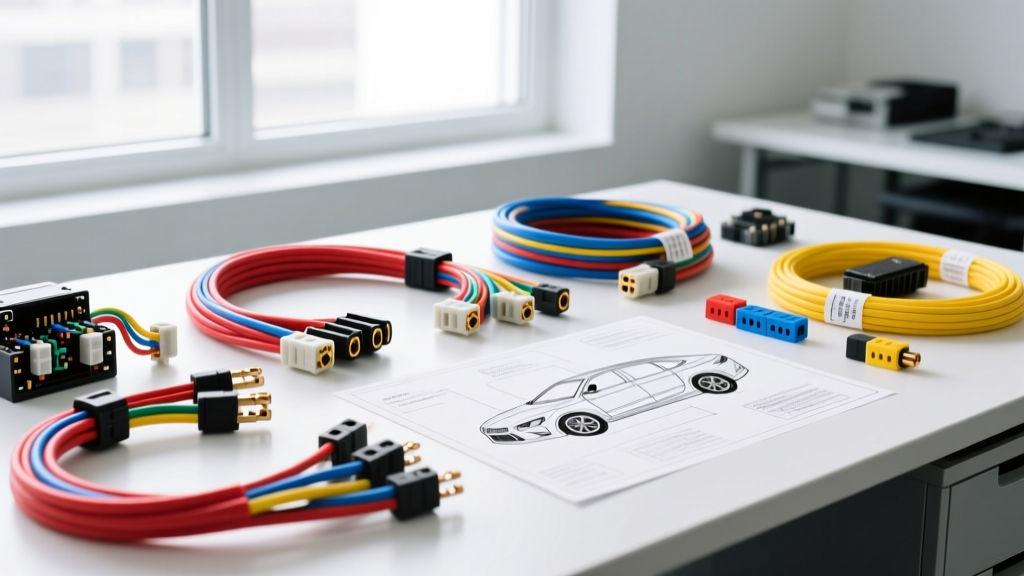
The Reality Behind the DC Wire Gauge Calculator Output
Every major automotive electrical project—whether you are wiring a 12,000-lb winch, installing a dual-battery overland system, or integrating a 3000W inverter for a camper conversion—begins with the same critical step: sizing the conductors. Most enthusiasts punch their amperage and cable run length into a dc wire gauge calculator and stop at the AWG recommendation. However, knowing that your specific application requires 1/0 AWG cable is only the first fraction of the engineering and financial reality.
The output of a dc wire gauge calculator tells you the minimum cross-sectional area required to keep voltage drop below an acceptable threshold (typically 3% for sensitive electronics and 5% for heavy inductive loads). What it does not tell you is the capital expenditure required to properly terminate, protect, and route that heavy-gauge wire. Sizing 1/0 AWG or 2/0 AWG battery cable introduces significant tooling and material costs that standard wiring guides frequently ignore. This analysis breaks down the true cost and tool requirements for executing a high-amperage DC automotive wiring project based on real-world calculator outputs.
Case Study: 200-Amp Overland Inverter & Auxiliary Battery Setup
To provide a concrete cost and tooling analysis, we will use a standard high-draw overlanding scenario. You are wiring a 2400W pure sine wave inverter and an auxiliary AGM battery.
The Calculator Parameters
- System Voltage: 12V DC (13.2V operating)
- Continuous Draw: 200 Amps
- One-Way Cable Run: 10 feet
- Acceptable Voltage Drop: 3%
When you input these parameters into a standard dc wire gauge calculator, the result dictates a minimum of 1/0 AWG (0 AWG) pure copper wire. At 200 amps, a 10-foot run of 1/0 AWG copper will experience a voltage drop of approximately 0.30V, well within the safe margin for inverter operation.
Wire Procurement: Pure Copper vs. The CCA Trap
The most significant line item in your budget will be the wire itself. For automotive and marine high-amperage applications, you must source cable that meets the SAE J1128 Battery Cable Standard, specifically Type SGT or HDT. Type SGT uses Class K or Class M stranding, meaning a single 1/0 AWG cable is composed of over 4,200 individual strands of 30 AWG bare copper. This extreme flexibility is mandatory for routing thick cables through the tight firewalls and chassis grommets of modern vehicles.
The CCA Cost Illusion
When shopping for 1/0 AWG wire, you will inevitably encounter Copper-Clad Aluminum (CCA). CCA wire is typically 40% cheaper than pure copper (averaging $1.50 to $2.00 per foot compared to $4.50 to $6.00 per foot for pure copper). However, CCA has roughly 60% higher electrical resistance than pure copper. If you use CCA, your dc wire gauge calculator's output is invalidated; you would actually need to step up to 2/0 or 3/0 AWG to achieve the same voltage drop, negating the cost savings and creating severe routing headaches.
Furthermore, CCA is highly susceptible to galvanic corrosion when mated with copper or brass terminals in the presence of moisture—a guaranteed failure mode in under-hood or off-road automotive environments. Expert Rule: Never use CCA for high-current DC automotive applications. Budget strictly for 99.9% pure oxygen-free copper (OFC).
Tooling Requirements: Crimping 1/0 AWG Like a Pro
Standard wire strippers and needle-nose pliers are useless when dealing with the massive diameter of 1/0 AWG cable (which features an outer diameter of roughly 13.5mm with insulation). To create a gas-tight, millivolt-drop-free connection, specialized tooling is required.
Wire Stripping Tools
Stripping 1/0 AWG SGT cable requires a heavy-duty rotary blade stripper or a specialized ratcheting cable cutter with a stripping notch. Using a utility knife to score the insulation often nicks the underlying copper strands, creating a localized hot spot that will melt the insulation under a 200-amp load. Expect to invest $30 to $50 in a proper heavy-gauge rotary stripper.
Manual vs. Hydraulic Crimpers
Mechanical ratcheting crimpers max out around 2 AWG. For 1/0 AWG and larger, you must use a 12-ton manual hydraulic crimper. These tools use interchangeable hexagonal or indent dies to compress thick-walled copper lugs onto the wire strands. A quality 12-ton hydraulic crimper kit with AWG-specific dies ranges from $70 to $150.
Crimp Profile: For automotive battery cables, a hex crimp is generally preferred over an indent crimp. A hex crimp applies uniform radial pressure, cold-welding the copper strands to the terminal barrel and maximizing the surface area for current transfer. This is critical for minimizing resistance and heat generation at the termination point.
Termination, Protection, and Hidden Costs
The dc wire gauge calculator only accounts for the wire. The ecosystem required to safely terminate and protect that wire adds substantial cost.
Terminals and Adhesive Heat Shrink
Heavy-duty copper compression lugs (ring terminals) with a 3/8-inch stud hole are standard for high-amp busbars and inverter inputs. More importantly, you must seal the termination. Standard thin-wall heat shrink will allow moisture to wick into the copper strands via capillary action. You must use 3:1 shrink ratio, dual-wall adhesive-lined heat shrink. When heated, the inner polyamide adhesive melts and flows between the wire strands, creating a waterproof environmental seal.
Circuit Protection: Class T vs. ANL Fuses
According to the Blue Sea Systems Circuit Protection Guide, standard ANL fuses are insufficient for modern high-current setups, particularly those involving lithium iron phosphate (LiFePO4) batteries which can deliver massive fault currents. A Class T fuse (rated at 225A for a 200A continuous circuit) is required. Class T fuses offer an interrupting capacity of 20,000 amps at 125VDC, ensuring the fuse safely extinguishes the arc during a dead short before the 1/0 AWG wire can catch fire. A Class T fuse and the accompanying terminal block will add roughly $65 to your project budget.
Comprehensive Automotive Wiring Budget Table
The following table outlines the true cost breakdown for a 20-foot round-trip (10ft positive, 10ft ground) 1/0 AWG inverter wiring project, assuming the purchase of necessary tooling and premium materials.
| Component / Tool | Specification / Detail | Estimated Cost (USD) |
|---|---|---|
| Pure Copper SGT Cable | 1/0 AWG, Red & Black, 20 ft total | $110.00 |
| Compression Lugs | 1/0 AWG to 3/8" Stud, Copper, Qty 4 | $16.00 |
| Adhesive Heat Shrink | 3:1 Ratio, Dual-Wall, 1/2" diameter | $15.00 |
| Class T Fuse & Block | 225A, 125VDC Interrupting Capacity | $65.00 |
| 12-Ton Hydraulic Crimper | Manual press with hex dies (8AWG - 250MCM) | $85.00 |
| Heavy-Duty Cable Cutter | Ratcheting, flush-cut for up to 1/0 AWG | $35.00 |
| Split Loom & Grommets | 1/2" nylon loom, firewall pass-through grommets | $25.00 |
| Total Project Investment | Wire, Protection, and Lifetime Tooling | $351.00 |
Installation Nuances: Torque and Routing
Budgeting for the materials is only half the battle; proper installation dictates the longevity of the system. When terminating your 1/0 AWG lugs to a busbar or inverter terminal, you must use a calibrated torque wrench. A standard 3/8-inch stainless steel or brass stud requires a torque spec of 18 to 22 ft-lbs. Under-torquing leads to micro-movements, increased resistance, and catastrophic thermal runaway. Over-torquing can strip the aluminum threads on cheaper inverter busbars.
Furthermore, 1/0 AWG wire has a massive bend radius. Forcing the cable into tight 90-degree bends near the battery terminals will cause mechanical stress on the internal copper strands and the terminal crimp barrel. Always use a heat gun to gently warm the cable jacket before bending it into position, and utilize heavy-duty adhesive-backed cable clamps every 12 inches to prevent chassis vibration from fatiguing the wire over time.
Conclusion: Beyond the Calculator
A dc wire gauge calculator is an indispensable engineering tool, but it represents only the theoretical baseline of your project. By anticipating the true costs of SAE-compliant pure copper wire, hydraulic crimping tooling, and high-interrupt circuit protection, you can budget accurately and avoid the dangerous shortcuts—like CCA wire and undersized fuses—that lead to electrical fires and stranded vehicles. Invest in the correct tooling and materials the first time, and your high-amperage automotive electrical system will perform flawlessly for the life of the vehicle.