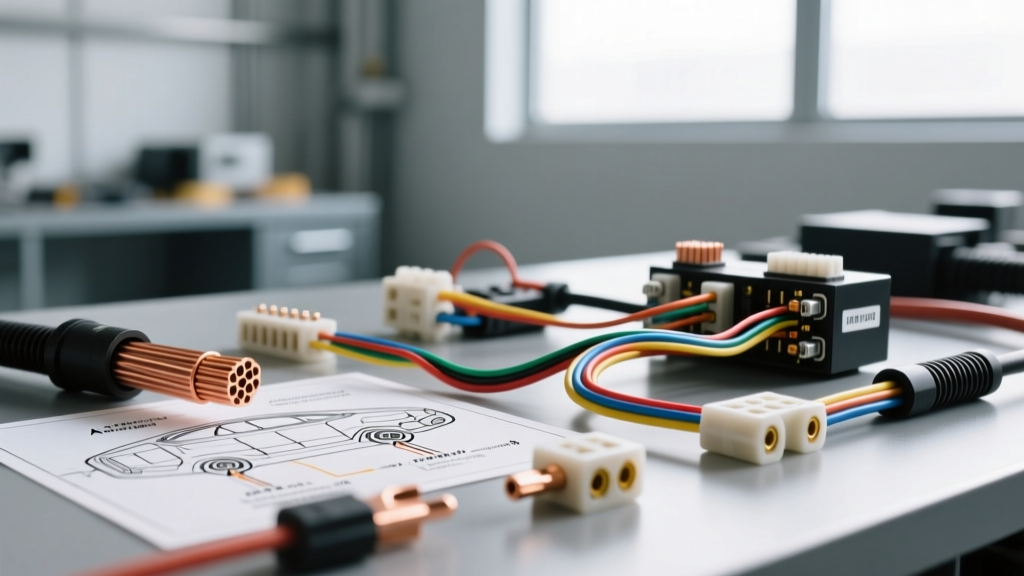
Introduction: What Do Wire Gauges Mean in Automotive Diagnostics?
When automotive technicians and DIY enthusiasts ask, 'what do wire gauges mean,' they are usually staring at a melted wiring harness or a component that refuses to draw enough current. In the context of 12V DC automotive electrical systems, wire gauge refers to the physical diameter and cross-sectional area of the conductive metal, standardized by the American Wire Gauge (AWG) system. Crucially, the AWG scale is inverse: a smaller numerical gauge indicates a thicker wire with lower electrical resistance and higher ampacity (current-carrying capacity).
Understanding what wire gauges mean is not just academic; it is the foundation of electrical troubleshooting. A factory 16 AWG wire (approx. 1.31 mm²) might safely carry 22 amps in a cool cabin environment, but if routed through a 180°F engine bay, its ampacity derates significantly. If an aftermarket electric cooling fan drawing 35 amps is wired using this 16 AWG circuit, the wire will act as a resistor, generating excessive heat, melting the PVC or XLPE insulation, and potentially causing a chassis fire.
The Core Concept: AWG, Ampacity, and Resistance
Before diving into the diagnostic flow, we must establish the baseline specifications for Oxygen-Free Copper (OFC) automotive primary wire, specifically conforming to SAE J1128 standards (GXL or TXL insulation types). Resistance per foot dictates voltage drop, while ampacity dictates thermal limits.
| AWG Size | Cross-Section (mm²) | Max Ampacity (Chassis)* | Resistance (Ohms/1000ft) |
|---|---|---|---|
| 18 AWG | 0.82 mm² | 16 Amps | 6.385 Ω |
| 16 AWG | 1.31 mm² | 22 Amps | 4.016 Ω |
| 14 AWG | 2.08 mm² | 32 Amps | 2.525 Ω |
| 12 AWG | 3.31 mm² | 41 Amps | 1.588 Ω |
| 10 AWG | 5.26 mm² | 57 Amps | 0.998 Ω |
| 8 AWG | 8.37 mm² | 90 Amps | 0.628 Ω |
*Note: Ampacity ratings assume single wires in free air at 25°C. Bundled wires in a loom or routed through high-heat zones (engine bay) require a 20-30% derating factor.
Step-by-Step Troubleshooting Flow: Diagnosing Gauge-Related Faults
Use this decision-tree flow to isolate whether a circuit failure is caused by an improper wire gauge, excessive circuit length, or a degraded connection.
Step 1: Symptom Identification (The Trigger)
- Symptom A: Wire insulation is melted, brittle, or emitting a burning odor, but the fuse has NOT blown.
- Symptom B: Component underperforms (e.g., fuel pump whines, headlights are dim, window motor operates slowly).
- Symptom C: Fuses blow repeatedly immediately upon circuit activation.
Step 2: Verification via Voltage Drop Testing
Set your digital multimeter (DMM) to DC Volts. Place the red probe on the battery positive terminal and the black probe on the component's positive input pin while the circuit is under load. According to Bosch Automotive Electrics guidelines, acceptable voltage drop limits are:
- Power Side (12V+): Maximum 0.2V drop for standard circuits; 0.1V for high-current/ECU feeds.
- Ground Side: Maximum 0.1V drop.
Diagnostic Branch: If your voltage drop exceeds these thresholds, the wire gauge is too small for the distance/load, or there is severe corrosion increasing resistance.
Step 3: Trace the Circuit and Verify Wire Gauge
Strip back the corrugated loom and identify the factory wire gauge. In many GM and Ford vehicles, wire size is sometimes printed on the insulation (e.g., '14 GXL'). If not, use a wire gauge stripping tool or calipers to measure the bare copper diameter. Compare this to the AWG chart above.
Step 4: Calculate Actual Load vs. Wire Ampacity
Use a DC clamp meter around the wire to measure real-time amperage under load. If a 14 AWG wire (rated for 32A) is pulling 45A to feed an aftermarket off-road light bar, you have identified the root cause. The continuous load exceeds the thermal limit of the gauge.
Real-World Case Study: Upgrading an Electric Cooling Fan Circuit
Let us apply this troubleshooting flow to a common scenario: a 1998 Chevrolet C/K 1500 where the owner installed a dual 16-inch aftermarket electric cooling fan kit drawing 45 amps combined.
The Fault: The installer wired the fans directly through a 30A inline fuse using 12 AWG wire. After 10 minutes of idling, the 12 AWG wire becomes too hot to touch, the voltage at the fan motors drops to 10.2V, and the fans slow down, causing the engine to overheat.
The Diagnosis: What does the wire gauge mean in this context? 12 AWG wire is rated for roughly 41 amps in ideal conditions. However, the engine bay ambient temperature is 160°F+, requiring a derating of the wire's ampacity by at least 20%. The effective ampacity of the 12 AWG wire is now ~32 amps. Pushing 45 amps through it causes massive resistance and voltage drop (V = I × R).
The Fix: We must upgrade the wire gauge and implement a relay harness.
- Run 8 AWG OFC wire directly from the alternator output stud to a heavy-duty relay mounted on the core support.
- Use a Delphi Weather-Pack 4-way connector to interface with a standard ISO 5-pin automotive relay.
- Relay Pinout Configuration:
- Pin 30: 8 AWG Red wire from Battery/Alternator (fused at 60A with a Mega-Fuse).
- Pin 87: 10 AWG Red wire to the dual fan positive terminals.
- Pin 86: 16 AWG Black wire to a clean chassis ground (sanded to bare metal).
- Pin 85: 18 AWG Yellow wire to the factory fan trigger signal (switched 12V from the PCM).
By understanding what wire gauges mean regarding voltage drop and thermal capacity, the upgraded 8 AWG feed wire handles the 45A inrush and continuous draw with a voltage drop of less than 0.05V, ensuring the fans spin at 100% capacity.
Common Gauge Mistakes in Aftermarket Wiring
When troubleshooting, always verify the conductor material. Many cheap aftermarket wiring kits use Copper Clad Aluminum (CCA). CCA wire has roughly 40% higher resistance than pure OFC copper. A 10 AWG CCA wire will perform electrically closer to a 12 AWG or 14 AWG pure copper wire, leading to phantom voltage drops and melted insulation that defy standard AWG charts. Always strip a small section of the wire; if the center is silver/white instead of solid copper, discard it for high-current automotive use.