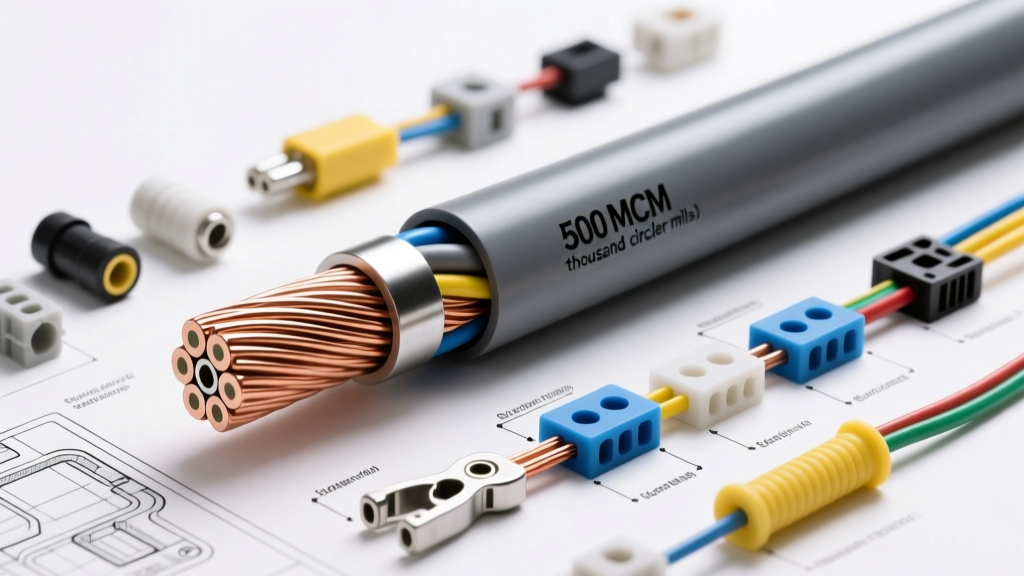
The "500 Gauge Wire" Myth: What Beginners Need to Know
If you are building a competition-level car audio system, designing a high-output marine battery bank, or wiring a heavy-duty EV conversion, you have likely found yourself searching for 500 gauge wire. There is just one problem: in the world of electrical engineering and automotive wiring, "500 gauge" does not actually exist.
Beginners often confuse the American Wire Gauge (AWG) system with circular mil measurements, or they mistakenly assume that a wire rated for 500 amps is called "500 gauge." In reality, the AWG system tops out at 4/0 AWG (often written as 4/0 or 0000). Once wire exceeds the physical dimensions of 4/0 AWG, the industry switches to measuring the cross-sectional area in MCM (thousands of circular mils) or kcmil.
When you need a cable capable of handling massive amperage—such as 400 to 500+ amps in a chassis wiring application—you are actually looking for 500 MCM (or 500 kcmil) wire. In this beginner-friendly guide, we will break down the exact specifications, ampacity ratings, and real-world automotive applications for this massive cable, ensuring your high-amperage build is safe, efficient, and up to code.
AWG vs. MCM/kcmil: Clearing Up the Confusion
The American Wire Gauge (AWG) system is logarithmic and counterintuitive: the smaller the number, the thicker the wire. However, once you reach the thickest standard AWG size (4/0 AWG), the naming convention changes. MCM stands for "Mille Circular Mils" (where *mille* is Latin for thousand). Therefore, a 500 MCM wire has a cross-sectional area of 500,000 circular mils.
To understand just how massive 500 MCM wire is compared to standard automotive gauges, review the crossover chart below:
| Wire Size | Cross-Sectional Area (mm²) | Approx. Bare Diameter (inches) | Typical Chassis Ampacity (12V DC) |
|---|---|---|---|
| 2/0 AWG | 67.4 mm² | 0.365" | 200A - 250A |
| 4/0 AWG | 107.2 mm² | 0.460" | 300A - 350A |
| 250 MCM | 126.7 mm² | 0.500" | 350A - 400A |
| 500 MCM (kcmil) | 253.3 mm² | 0.707" | 450A - 550A+ |
As noted by the SAE J1128 standard for low-tension primary automotive cables, once you exceed 4/0, flexibility and strand count become critical factors in DC power delivery.
500 MCM (kcmil) Wire Technical Specifications
When sourcing 500 MCM wire for automotive, marine, or welding applications, you are typically looking at highly flexible, fine-strand copper cable. Standard solid-core 500 MCM wire is used in commercial AC power grids and is entirely unsuitable for vehicles due to vibration fatigue and bending radius limitations.
Core Specifications for Automotive/Chassis 500 MCM Cable:
- Stranding: Often features 1,200+ strands of 30 AWG bare or tinned copper (similar to premium welding cable) to ensure extreme flexibility.
- Insulation Types:
- SGT (PVC): Rated for 105°C. Standard for general battery and starter cables.
- SGX (Cross-Linked Polyethylene): Rated for 125°C. Required for high-heat environments like engine bays, near exhaust headers, or in high-performance marine applications.
- Weight: Approximately 1.5 to 1.6 lbs per foot (including insulation).
- Resistance: ~0.0258 ohms per 1,000 feet at 20°C.
Real-World Automotive & Marine Applications
Do you actually need 500 MCM wire? For 99% of daily driven vehicles, even those with upgraded 250-amp alternators, 4/0 AWG or dual 2/0 AWG runs are more than sufficient. However, 500 MCM becomes mandatory in specific extreme-duty scenarios:
1. Competition Car Audio & DSP Systems
If you are wiring a vehicle with multiple high-output amplifiers pushing 10,000+ watts RMS, your electrical system will demand upwards of 800 amps at peak draw. While many installers use multiple runs of 4/0 AWG, running a single 500 MCM main power trunk line from a massive lithium-titanate battery bank to a front-of-vehicle distribution block minimizes voltage drop and reduces physical clutter.
2. Marine House Banks & Winching Systems
The American Boat and Yacht Council (ABYC) mandates strict voltage drop limits (under 3% for critical systems) for marine DC wiring. For heavy-duty electric windlasses, mega-yacht house battery banks, or commercial tow-truck winching setups pulling 500+ amps, 500 MCM tinned copper marine cable prevents catastrophic voltage sag that could stall the winch motor mid-pull.
3. EV Conversions and High-Current DC-DC Links
When converting classic cars to EV powertrains, or building custom off-grid solar arrays, the low-voltage (12V/24V) accessory battery banks that power hydraulic pumps, steering racks, and braking boosters require massive cable runs to handle the continuous high-amperage draw without overheating.
Termination: How to Crimp 500 MCM Wire Properly
The most common failure point in heavy-gauge automotive wiring is not the wire itself, but the termination. You cannot solder 500 MCM wire with standard automotive equipment; the copper mass acts as a giant heatsink, wicking the solder away and leaving a brittle, high-resistance joint. You must use mechanical crimping.
Step-by-Step Termination Guide:
- Stripping the Insulation: Standard wire strippers will not fit a 0.707-inch cable. Use a specialized heavy-duty cable skinning knife or a rotary cable stripper to score and remove exactly the length of insulation required by your lug's barrel depth (usually around 1.25 inches).
- Selecting the Lug: Use ETP (Electrolytic Tough Pitch) copper lugs rated for 500 MCM. Ensure the stud hole matches your battery terminal or busbar (typically 3/8" or 1/2" for heavy-duty marine terminals). Tinned lugs are highly recommended to prevent galvanic corrosion.
- Hydraulic Crimping: A manual hand-crimper will not generate enough force. You need a 12-ton hydraulic crimping tool equipped with a 500 MCM hexagonal or indenter die. Position the die squarely on the barrel, avoiding the inspection hole, and pump until the hydraulic bypass valve engages.
- Sealing the Joint: Slide a piece of adhesive-lined marine heat shrink (with a 3:1 or 4:1 shrink ratio) over the cable before crimping. After crimping, apply heat evenly until the inner meltable adhesive oozes out the ends, creating a 100% waterproof seal against battery acid and road salt.
Troubleshooting: Voltage Drop and Hot Lugs
Even with 500 MCM wire, beginners often report melting battery terminals or severe headlight dimming. This is almost always caused by one of two issues:
Issue 1: The "False Crimp" (Undersized Dies)
If you use a 4/0 AWG die on a 500 MCM lug because it "looked close enough," the copper strands will not be compressed tightly enough. This leaves microscopic air gaps between the strands. Under a 400-amp load, these air pockets create massive electrical resistance, turning the lug into a literal heating element. Fix: Always verify the die size matches the exact MCM rating stamped on the lug barrel.
Issue 2: Ignoring the NEC Chassis vs. Raceway Distinction
According to NFPA 70 (National Electrical Code), the ampacity of 500 kcmil copper in a bundled raceway is roughly 380A (at 75°C). However, automotive chassis wiring operates in "free air" over very short distances (usually under 15 feet). In free air, the thermal dissipation is vastly superior, allowing 500 MCM to safely carry 500A+ for the short bursts required by starter motors or audio capacitors. If you bundle 500 MCM tightly inside a sealed conduit with 10 other wires, it will overheat. Keep heavy DC cables isolated and well-ventilated.
Final Thoughts on Sourcing Heavy Cable
When shopping for your project, stop searching for "500 gauge wire" and start requesting 500 kcmil (or 500 MCM) flexible welding or marine battery cable. Verify that the copper is 99.9% pure OFC (Oxygen-Free Copper) rather than CCA (Copper-Clad Aluminum). CCA wire is significantly lighter and cheaper, but it possesses higher resistance and is prone to snapping under engine bay vibrations. By understanding the transition from AWG to MCM, and utilizing proper hydraulic terminations, your high-amperage automotive electrical system will deliver reliable, voltage-stable power for years to come.