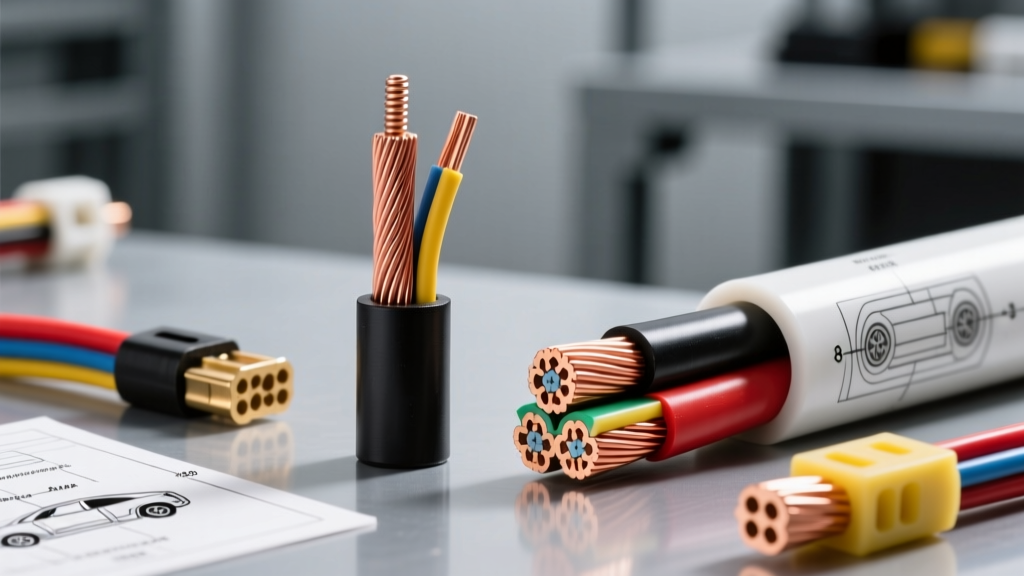
Decoding the '8mm' Terminology in Automotive Wiring
When sourcing high-current cable for automotive electrical upgrades, the term '8mm wire gauge' frequently causes confusion in the garage. In the automotive aftermarket, '8mm' can refer to two entirely different products: 8mm² (square millimeter) cross-sectional power wire used for battery feeds and alternator upgrades, or 8mm outer diameter silicone ignition wire used for spark plug routing. This guide focuses strictly on the 8mm² metric power wire standard, comparing it directly to the American Wire Gauge (AWG) equivalent, and providing a comprehensive selection matrix for high-draw vehicle builds.
European and Asian OEM manufacturers (following ISO standards) utilize the metric cross-sectional area system, while North American manufacturers and aftermarket brands largely rely on SAE AWG standards. Understanding the exact dimensional differences, stranding classes, and ampacity ratings between an 8mm² metric cable and an 8 AWG cable is critical for preventing voltage drop and thermal failures in high-amperage circuits like EV battery buses, winch solenoids, and high-output alternator feeds.
8mm² Metric vs. 8 AWG: Specification Matrix
While 8mm² and 8 AWG are often used interchangeably by parts counter staff, they are not mathematically identical. An 8 AWG wire actually possesses a slightly larger cross-sectional area than a strict 8mm² metric wire. Below is the technical breakdown based on Engineering Toolbox copper resistance data and standard automotive stranding configurations.
| Specification | Metric 8mm² (ISO 6722) | 8 AWG (SAE J1128) |
|---|---|---|
| Nominal Area | 8.00 mm² | 8.37 mm² |
| Strand Count (Class 6 Flex) | ~104 strands of 0.32mm | ~168 strands of 0.25mm |
| Conductor OD (Approx) | 3.70 mm | 3.80 mm |
| Resistance @ 20°C | 2.23 mΩ/m | 2.14 mΩ/m |
| Max Ampacity (Chassis)* | 70 Amps | 73 Amps |
| Common Automotive Use | OEM Sensor/Module Feeds, EV Aux | Aftermarket Amps, Cooling Fans, Winch |
*Ampacity ratings assume a single conductor routed in engine bay free air at an ambient temperature of 25°C. Bundling multiple wires or routing through enclosed firewalls requires a 20-30% derating.
Insulation Jacket Selection Guide
Choosing the correct 8mm wire gauge is only half the battle; the insulation jacket dictates the wire's survival in the harsh automotive environment. According to the ISO 6722-1 road vehicle cable standard, modern automotive wiring must withstand extreme thermal cycling, fluid exposure, and mechanical abrasion.
PVC (Polyvinyl Chloride) - Standard Duty
- Temperature Rating: 85°C to 105°C
- Best For: Interior cabin routing, trunk-mounted audio amplifiers, and low-heat environments.
- Failure Mode: PVC becomes brittle when exposed to continuous under-hood temperatures exceeding 100°C, leading to micro-cracks and short circuits against the chassis.
XLPE (Cross-Linked Polyethylene) - Heavy Duty
- Temperature Rating: 125°C to 150°C
- Best For: Engine bay routing, alternator upgrades, and proximity to exhaust manifolds.
- Advantage: XLPE offers superior abrasion resistance and will not melt if it briefly contacts a hot exhaust component. It is the industry standard for modern OEM battery cables.
Silicone (High-Flex) - Specialty Duty
- Temperature Rating: Up to 200°C
- Best For: Racing applications, tight firewall bends, and high-vibration motor mounts.
- Drawback: Silicone is highly susceptible to tearing and requires split-loom or braided sleeve protection when routed through sheet metal pass-throughs.
The CCA Trap: Why Material Purity Matters
When shopping for 8 AWG or 8mm² wire, you will inevitably encounter Copper Clad Aluminum (CCA) marketed as a budget-friendly alternative to Oxygen-Free Copper (OFC). Never use CCA for critical automotive power circuits. CCA wire features an aluminum core with a thin copper electroplating. While it may pass a basic continuity test, CCA exhibits 40% higher electrical resistance than pure OFC. In a high-draw scenario—such as a 60A electric cooling fan pulling through a relay—CCA wire will generate excessive heat, causing premature voltage drop and potentially melting the relay socket. Furthermore, when CCA is exposed to moisture at the crimp terminal, severe galvanic corrosion occurs between the aluminum core and the copper ring terminal, resulting in a high-resistance open circuit.
Real-World Application: High-Output Alternator & Cooling Fan Upgrades
Let's apply the 8mm wire gauge to a common scenario: upgrading a classic GM truck with a 220A aftermarket alternator and dual 30A electric cooling fans. While the main alternator output to the battery requires 2/0 AWG welding cable due to the 15-foot round-trip distance, the 8mm² (8 AWG) wire is the perfect specification for the alternator sense wire and the dual fan relay feeds.
Pinout and Routing for Dual Fan Relays
- Power Feed (Red 8 AWG): Routed from the main fuse block (150A Mega Fuse) to Pin 30 on two separate 40A Bosch-style relays.
- Load Output (Blue 8 AWG): Routed from Pin 87 on the relays directly to the high-current input terminals on the fan motors.
- Ground (Black 8 AWG): Fan motor ground to the chassis. Must be terminated on bare, unpainted metal using a star washer to ensure a zero-resistance path.
Using 8mm² metric wire for these specific 30A-40A continuous draw branches ensures that voltage drop remains below 0.2V, keeping the fan motors spinning at optimal RPM during idle and stop-and-go traffic.
Termination: Crimping, Torque, and Environmental Sealing
The most common point of failure in an 8 AWG / 8mm² circuit is not the wire itself, but the termination. Adhering to SAE J1128 termination guidelines ensures mechanical and electrical integrity.
Heavy-Duty Lug Torque Specifications
When terminating 8mm² wire to a high-amperage busbar, fuse block, or alternator B+ terminal, proper torque is non-negotiable. Under-torquing leads to arcing and heat; over-torquing strips the stud or crushes the lug barrel.
- M6 (1/4 inch) Stud: 9 - 12 Nm (80 - 106 in-lbs)
- M8 (5/16 inch) Stud: 18 - 22 Nm (160 - 195 in-lbs)
- M10 (3/8 inch) Stud: 30 - 35 Nm (265 - 310 in-lbs)
Crimping and Sealing Protocol
For 8 AWG and 8mm² wire, use heavy-duty closed-barrel copper lugs. Strip exactly 14mm of insulation. Crimp using a hex-pattern hydraulic or heavy ratcheting crimper (typically the blue or yellow die marked '8'). After crimping, seal the connection using dual-wall adhesive-lined heat shrink. The inner meltable adhesive layer creates a waterproof barrier that prevents battery acid and road salt from wicking up into the copper strands via capillary action.
Troubleshooting Voltage Drop in 8mm Circuits
If your high-draw accessory is underperforming, use a digital multimeter (DMM) to perform a voltage drop test across the 8mm wire gauge circuit. Place the red probe on the battery positive terminal and the black probe on the accessory's positive input pin. With the circuit under load (e.g., fans running), a reading higher than 0.3V indicates excessive resistance. Common culprits include:
- Undersized ring terminal holes causing a pinched stud connection.
- Oxidation inside the crimp barrel due to missing adhesive heat shrink.
- Use of CCA wire masquerading as OFC, leading to thermal resistance buildup.
By strictly adhering to OFC material selection, proper XLPE insulation ratings, and precise torque specifications, your 8mm² and 8 AWG wiring harnesses will provide reliable, loss-free power delivery for the life of the vehicle.