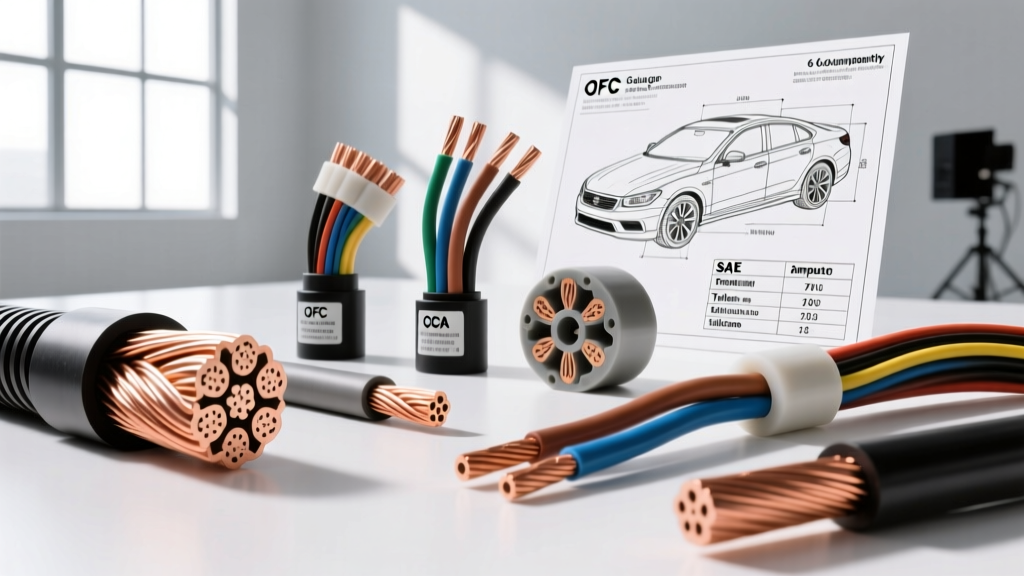
The True Cost of 6 AWG Automotive Wiring: Beyond the Price Tag
When planning high-current automotive electrical upgrades—such as EV battery conversions, heavy-duty winch installations, or high-output alternator routing—the 6 gauge wire cost is often the first metric buyers evaluate. However, in automotive electrical systems, the initial price per foot is only a fraction of the total system cost. Choosing wire based solely on the lowest upfront price frequently leads to catastrophic voltage drop, insulation melt-downs near exhaust manifolds, and intermittent electrical gremlins that cost hundreds of dollars in diagnostic time.
As an automotive electrical specialist, I evaluate wiring not just by its American Wire Gauge (AWG) designation, but by its strand composition, insulation thermal rating, and compliance with SAE J1128 standards. This guide breaks down the real-world cost versus quality matrix of 6 AWG wire, helping you select the exact specification for your vehicle's high-amperage demands.
Material Science: Why 6 Gauge Wire Cost Varies So Wildly
If you have ever searched for 6 AWG wire and noticed a 400% price discrepancy between two seemingly identical spools, you are witnessing the difference between Oxygen-Free Copper (OFC) and Copper Clad Aluminum (CCA). Understanding this distinction is critical for automotive applications where vibration and thermal cycling are constant.
Oxygen-Free Copper (OFC) vs. Copper Clad Aluminum (CCA)
- OFC (Pure Copper): The industry standard for reliable automotive wiring. OFC offers superior conductivity, higher tensile strength, and excellent resistance to galvanic corrosion. A true 6 AWG OFC wire contains roughly 13.3 mm² of conductive cross-sectional area.
- CCA (Aluminum Core): To reduce the 6 gauge wire cost, manufacturers extrude a thin layer of copper over an aluminum core. Aluminum has only 61% of the conductivity of copper. To match the current-carrying capacity of 6 AWG OFC, you would technically need a 4 AWG CCA wire. Furthermore, aluminum suffers from 'cold flow' (creep) under the constant pressure of ring terminal crimps, leading to loose connections, arcing, and eventual fires in high-vibration environments like engine bays.
Insulation Types: PVC, GXL, and XLPE
The jacket material drastically alters both the price and the safety profile of the wire. Standard hardware store PVC is rated for 105°C. In an engine bay, ambient temperatures near the firewall or exhaust headers can easily exceed this, causing PVC to become brittle, crack, and short against the chassis. Premium automotive wires use Cross-Linked Polyethylene (XLPE) or GXL/TXL insulation, which are rated for 125°C to 150°C and feature thinner walls, allowing for easier routing through tight factory grommets. While GXL wire increases the initial 6 gauge wire cost by roughly 20-30%, it is mandatory for under-hood routing.
Technical Specifications & Ampacity Reference Chart
Automotive wiring operates in a harsh environment, meaning we cannot rely on the National Electrical Code (NEC) charts designed for static residential wiring. We must refer to SAE standards which account for higher ambient temperatures and tighter bundling. Below is the technical baseline for high-quality 6 AWG OFC automotive wire.
| Specification | SAE J1128 (GXL/TXL) | Standard AWG (PVC) |
|---|---|---|
| Cross-Sectional Area | 13.5 mm² | 13.3 mm² |
| Strand Count (Typical) | 133 x 0.32mm | 133 x 0.0100" |
| Max Conductor Temp | 125°C (GXL) / 150°C (TXL) | 105°C |
| Resistance @ 20°C | 1.32 Ω / km (0.40 Ω / 1000ft) | 1.30 Ω / km (0.395 Ω / 1000ft) |
| Max Ampacity (Engine Bay) | 85A Continuous | 65A Continuous |
| Max Ampacity (Chassis/Free Air) | 120A Surge / 95A Cont. | 100A Surge / 75A Cont. |
Note: Ampacity ratings assume a single conductor in free air. Bundling multiple wires inside a split-loom conduit reduces heat dissipation and requires a 15-20% derating of the maximum continuous current.
Product Comparison: Budget vs. Premium 6 AWG Selection
To contextualize the 6 gauge wire cost, let us compare three common tiers of wire available on the market for a standard 20-foot battery relocation or high-amperage accessory run.
Tier 1: The Budget CCA Import (Low Cost)
- Cost Estimate: $0.40 - $0.60 per foot.
- Best For: Static, indoor, low-vibration applications (e.g., home theater subwoofers). Not recommended for automotive use.
- Failure Mode: The aluminum core snaps under engine vibration. The thin copper cladding flakes off when crimped with a hex-die, exposing aluminum to moisture, resulting in rapid galvanic corrosion and high resistance.
Tier 2: Standard Marine/Automotive OFC (Mid-Range)
- Cost Estimate: $1.10 - $1.50 per foot.
- Best For: Car audio amplifiers, trunk-mounted battery relocations, and cabin-routed accessory power.
- Specs: 100% Copper, Type 3 stranding (flexible), 105°C PVC insulation. Excellent conductivity but the thick PVC jacket makes it difficult to pull through tight factory firewall grommets alongside existing harnesses.
Tier 3: SAE GXL/TXL High-Temp OFC (Premium)
- Cost Estimate: $1.80 - $2.50 per foot.
- Best For: Engine bay alternator upgrades, EV high-current DC routing, and winch solenoid feeds.
- Specs: 100% Copper, cross-linked insulation. The thin-wall design of GXL wire reduces the outer diameter, making it significantly easier to route through complex chassis pathways while offering superior heat and chemical resistance (oil, brake fluid, coolant).
Real-World Automotive Applications & Fusing
Selecting the right wire is only half the battle; protecting it is where the true expertise lies. 6 AWG wire requires specific overcurrent protection and termination strategies to handle the loads it is typically assigned.
1. High-Output Alternator Upgrades
When upgrading from a stock 120A alternator to a 250A+ unit (common in diesel trucks or heavy-overland vehicles), the factory 8 or 10 AWG charge wire will melt. A 6 AWG GXL wire is required for the run from the alternator B+ terminal to the main distribution block. Fusing: Install a 150A Class T fuse within 7 inches of the battery positive terminal to protect the wire in the event of a dead short against the engine block.
2. Electric Winch Solenoid Feeds
Winches can draw 300A+ under stall load, but the run to the solenoid is very short (usually under 5 feet). 6 AWG is acceptable for the solenoid control side or for light-duty 8,000 lb winches, provided the run is kept under 4 feet. For the main motor feeds, 2 AWG or 1/0 AWG is preferred to prevent voltage drop that starves the winch motor of torque.
3. High-Power Car Audio
For a multi-amplifier setup drawing a continuous 80A, 6 AWG OFC is the perfect main trunk-line. Termination: Use Anderson Powerpole SB50 connectors (gray housing) at the battery isolation point. This allows for quick disconnect during vehicle servicing and prevents accidental shorting of exposed ring terminals.
Termination: The Hidden Cost of Poor Crimping
You can buy the most expensive, premium 6 AWG wire on the market, but if you terminate it with a cheap hammer-crimper or solder-only joint, you have wasted your money. Solder is brittle and will crack under the harmonic vibration of a vehicle chassis, leading to high-resistance hotspots. According to experts at MAD Enterprises, proper mechanical crimping creates a cold-weld that is actually stronger than the wire itself.
For 6 AWG wire, you must use a dedicated hex-crimp tool with the correct die size (typically 15mm² or 16mm² depending on the terminal brand). Follow the crimp with a 3:1 or 4:1 shrink ratio adhesive-lined heat shrink tube. The adhesive melts and flows into the wire strands, creating a watertight seal that prevents capillary action from drawing moisture under the insulation jacket—a common cause of green copper corrosion near battery terminals.
Calculating Voltage Drop: When 6 AWG is Not Enough
Before finalizing your purchase based on 6 gauge wire cost, you must calculate the voltage drop for your specific run length. Automotive 12V systems operate between 13.8V and 14.4V. Most ECU-controlled accessories and high-end audio amplifiers will trigger low-voltage protection shut-offs if the supply drops below 12.5V.
The Formula: Voltage Drop = (Current × 2 × Length × Resistance per ft) / 1000
Example: You are running a 15-foot circuit (30 feet total round-trip) to a rear-mounted auxiliary fuse block drawing a continuous 60A.
- Current: 60A
- Length: 30 ft (round trip)
- Resistance of 6 AWG: 0.0004 Ω/ft
- Calculation: 60 × 30 × 0.0004 = 0.72V Drop
A 0.72V drop is perfectly acceptable (roughly 5% of a 14.4V system). However, if your continuous draw was 100A, the drop would be 1.2V, leaving only 13.2V at the accessory. In that scenario, despite the higher cost, you must step up to 4 AWG or 2 AWG wire to maintain system efficiency.
Expert Purchasing Checklist
When sourcing your wire, verify the following on the product spec sheet or packaging:
- Material Verification: Does it explicitly state '100% OFC' or 'Pure Copper'? If it says 'CCA' or lacks a material claim, assume it is aluminum.
- SAE Compliance: Look for 'SAE J1128' or 'GXL/TXL' printed on the jacket. This ensures the insulation can survive under-hood temperatures.
- Strand Count: Higher strand counts (e.g., 133 or 259 strands) offer better flexibility, making it easier to route through tight chassis bends without the wire 'springing back' and stressing the crimp joints.
- Jacket Thickness: Thin-wall (GXL/TXL) is superior for automotive routing, while thick-wall (SGT) is better for heavy abrasion zones like battery trays.
Ultimately, the true 6 gauge wire cost is measured in reliability and safety. Investing an extra $15-$20 per spool for SAE-compliant, pure copper, high-temp wire ensures your high-current automotive systems perform flawlessly for the life of the vehicle, saving you from the hidden costs of electrical failures and voltage starvation.