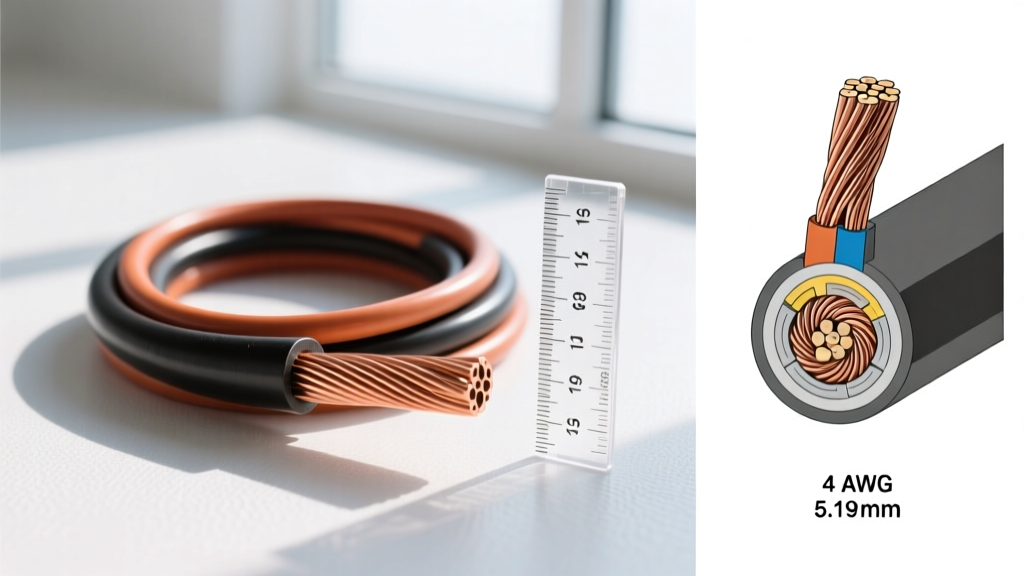
The Short Answer: Physical Dimensions of 4 AWG
When beginners first dive into automotive electrical work, one of the most common questions is: how big is 4 gauge wire? In the American Wire Gauge (AWG) system, 4 AWG wire has a bare copper diameter of 0.2043 inches (5.189 millimeters). This gives it a cross-sectional area of approximately 21.15 square millimeters.
To visualize this, a bare 4 AWG copper conductor is slightly thinner than a standard wooden pencil and roughly the same thickness as a heavy-duty USB charging cable. However, once you add the automotive-grade PVC or XLPE (cross-linked polyethylene) insulation, the outer diameter (OD) typically swells to between 0.300 and 0.350 inches (7.6mm to 8.9mm), depending on the insulation thickness and whether it is a stranded or solid core wire.
In automotive applications, 4 AWG is almost exclusively sold as highly stranded wire (often 133 to 294 individual copper strands). Solid core wire of this thickness is far too rigid for a vehicle; the constant vibration, engine movement, and thermal expansion would cause solid 4 AWG to work-hardened, snap, or tear through its insulation, leading to catastrophic short circuits.
Understanding the AWG System: Why Smaller Numbers Mean Bigger Wire
The American Wire Gauge system can be deeply counterintuitive for beginners. The system is based on the number of drawing dies the copper rod is pulled through during manufacturing. A lower gauge number means the wire was pulled through fewer dies, leaving it thicker. Therefore, 4 AWG is significantly thicker than 8 AWG, but thinner than 1/0 AWG (which is pronounced 'one-aught' and represents a wire so large it exceeds the standard 0-40 AWG numbering scale).
Because 4 gauge wire has over 60% more copper cross-section than 8 gauge wire, it can handle substantially more current with far less electrical resistance. According to the SAE J1128 standard for low-tension primary automotive cables, maintaining low resistance is critical to preventing voltage drop, which can starve sensitive ECU modules, fuel pumps, and ignition coils of the voltage they need to operate correctly.
4 Gauge Wire Ampacity & Voltage Drop Chart
Ampacity (amperage capacity) is not a fixed number; it changes based on wire length, ambient temperature, and whether the wire is bundled with other cables. In a 12V DC automotive system, the primary enemy is voltage drop. A 3% voltage drop rule is standard for critical electronics, meaning you cannot afford to lose more than 0.36V over the length of the circuit.
The chart below outlines the safe continuous current limits for 4 AWG Oxygen-Free Copper (OFC) wire in a standard 12V automotive environment, based on Blue Sea Systems DC ampacity guidelines and marine/automotive crossover standards.
| Wire Length (One-Way Run) | Max Amps (Non-Critical / 10% Drop) | Max Amps (Critical Electronics / 3% Drop) | Common Automotive Application |
|---|---|---|---|
| 5 Feet | 160 Amps | 120 Amps | Alternator to Battery (Big 3 Upgrade) |
| 10 Feet | 120 Amps | 80 Amps | High-Output Audio Amplifier Power |
| 15 Feet | 95 Amps | 55 Amps | Secondary Battery Relocation (Trunk) |
| 20 Feet | 75 Amps | 40 Amps | Electric Cooling Fans / Winch Relay Feed |
Note: Always calculate your total circuit length (positive run + ground return run) when using voltage drop calculators. A 10-foot run from the battery to the trunk is actually a 20-foot electrical circuit when the ground return is factored in.
Real-World Automotive Applications for 4 AWG
Knowing how big 4 gauge wire is only solves half the puzzle; knowing where to use it is where true automotive electrical expertise lies. Here are the most common scenarios where 4 AWG is the perfect specification:
1. The 'Big 3' Wiring Upgrade
Modern vehicles with high-amperage aftermarket alternators (150A to 250A+) often suffer from bottlenecked factory wiring. Factory alternator output wires are frequently undersized 8 AWG or 6 AWG cables designed only for the stock 90A alternator. Upgrading the alternator output to the battery positive, the battery negative to the chassis, and the engine block to the chassis using 4 AWG wire ensures the massive current generated by a Powermaster or Mechman alternator actually reaches your vehicle's electrical bus without melting factory harnesses.
2. High-Power Car Audio Systems
For car audio enthusiasts running a mono-block amplifier pushing 1,000 to 1,500 Watts RMS, 4 AWG is the minimum acceptable power wire. A 1,500W amplifier drawing from a 12.5V charging system will pull roughly 120 Amps continuously at full output, with peak transient bursts exceeding 150 Amps. Using 4 AWG OFC wire prevents the amplifier from going into 'protect mode' due to undervoltage during heavy bass transients.
3. Off-Road Winches and Hydraulics
A standard 12,000 lb electric winch can draw upwards of 400 Amps under maximum stall load. While 4 AWG wire cannot handle 400 Amps continuously, winch pulls typically last less than 60 seconds. For short, direct runs from the battery to a heavy-duty solenoid contactor (usually under 6 feet), 4 AWG stranded winch cable is highly flexible, resistant to abrasion, and perfectly rated for the high transient loads of off-road recovery.
The CCA vs. OFC Trap: What Beginners Must Know
When shopping for 4 gauge wire, beginners are often lured by cheap, heavy-looking cables labeled as 'Copper.' In reality, these are often CCA (Copper-Clad Aluminum). CCA wire features an aluminum core with a microscopic layer of copper electroplated on the outside.
Aluminum has roughly 61% the conductivity of copper. Therefore, a 4 AWG CCA wire performs electrically like a 6 AWG or even 8 AWG pure copper wire. In high-amperage automotive applications, CCA wire will run significantly hotter, suffer from severe voltage drop, and is highly prone to galvanic corrosion when crimped into copper or brass terminals. Always inspect the cut end of your wire; if the center is silvery-white, it is CCA. Always demand OFC (Oxygen-Free Copper) or bare copper tinned wire for automotive electrical systems, as verified by reputable manufacturers like Painless Performance and KnuKonceptz.
Terminating 4 AWG: Tools, Connectors, and Torque Specs
Because 4 AWG wire carries massive amounts of DC current, sloppy terminations will generate intense heat, potentially leading to electrical fires. You cannot simply strip 4 AWG wire, twist it, and shove it under a battery post.
- Stripping: Use a dedicated heavy-duty cable stripper. Scoring the copper strands with a utility knife weakens the wire and creates a localized hot-spot for resistance.
- Crimping: Avoid cheap 'indent' crimpers that simply smash the terminal. Invest in a hex-crimp tool designed for 4 AWG to 1/0 AWG terminals. A hex crimp compresses the copper strands and the terminal barrel into a uniform, gas-tight hexagonal shape, eliminating air pockets where moisture and corrosion can infiltrate.
- Terminals: Use tinned copper ring terminals with adhesive-lined, dual-wall heat shrink tubing (3:1 shrink ratio). When the heat gun melts the inner adhesive, it seals the connection against undercarriage water and road salt.
- Torque Specifications: When securing a 4 AWG ring terminal to a standard top-post automotive battery stud or an ANL fuse block, torque the stainless steel hardware to 8 to 12 ft-lbs. Under-torquing causes arcing and heat; over-torquing can strip the soft brass or lead threads of the battery terminal.
Summary
So, how big is 4 gauge wire? At 0.2043 inches in diameter, 4 AWG is a heavy-duty, high-amperage conductor that serves as the backbone for serious automotive electrical upgrades. Whether you are wiring a 200-Amp alternator, feeding a massive car audio amplifier, or setting up a winch solenoid, understanding the physical size, ampacity limits, and termination requirements of 4 AWG ensures your vehicle's electrical system remains safe, efficient, and reliable for years to come.