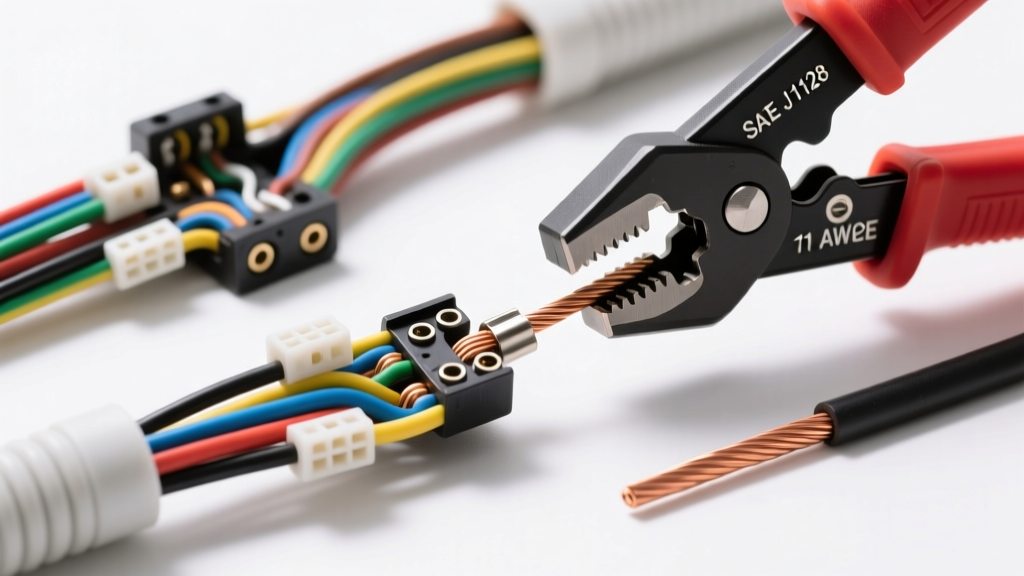
The Engineering Anomaly of 11 AWG in Automotive Systems
When designing or repairing automotive electrical circuits, technicians and engineers rely on standardized wire gauges to ensure safety, predict voltage drop, and maintain manufacturing efficiency. However, encountering a specification for 11 gauge wire (11 AWG) in an automotive context is an immediate red flag that requires careful analysis. While 11 AWG is a mathematically valid size in the American Wire Gauge system—featuring a bare diameter of 0.0907 inches (2.30 mm) and a cross-sectional area of 8,234 circular mils (4.17 mm²)—it is virtually non-existent in standard automotive primary wire manufacturing.
According to the SAE International J1128 standard, which governs low-tension primary cables (GXL, TXL, SXL) for surface vehicle applications, standard AWG sizes typically step from 12 AWG directly to 10 AWG. Manufacturing an 11 AWG wire with cross-linked polyethylene (XLPE) insulation requires custom extrusion runs, drastically altering the economics of a wiring project. Consequently, when a repair manual, aftermarket blueprint, or imported schematic calls for 11 gauge wire, it is almost always the result of a metric-to-imperial translation error or a highly specialized industrial battery cable requirement.
This guide provides a comprehensive cost and tooling analysis for 11 AWG wire, explores the economic reality of sourcing it, and details the precise crimping and stripping tools required if you are forced to work with this intermediate gauge.
Cost & Sourcing Analysis: 11 AWG vs. Standard Alternatives
Because 11 AWG is skipped in standard automotive GXL (General Cross-Linked) and TXL (Thin Cross-Linked) production runs, sourcing it requires turning to industrial THHN (building wire), custom-drawn battery cables, or marine-grade tinned copper. The cost implications of strictly adhering to an 11 AWG specification are severe compared to stepping up to the universally available 10 AWG.
| Specification | 11 AWG (Custom/Industrial) | 10 AWG GXL (SAE J1128) | 4mm² Metric (ISO 6722) |
|---|---|---|---|
| Cross-Sectional Area | 4.17 mm² | 5.16 mm² | 4.00 mm² |
| Approx. Cost per Foot | $0.85 - $1.40 (Custom Spool) | $0.35 - $0.55 (Bulk) | $0.45 - $0.65 (Bulk) |
| Sourcing Lead Time | 2-4 Weeks (Special Order) | Immediate (Off-the-Shelf) | Immediate (European Suppliers) |
| Insulation Types Available | THHN, PVC Marine | GXL, TXL, SXL, HDT | FLR-A, FLR-B (PVC/XLPE) |
| Temperature Rating | 90°C (THHN) / 105°C (Marine) | 125°C (GXL) / 150°C (SXL) | 105°C (FLR-B) |
Cost Analysis Verdict: Specifying 11 gauge wire for a custom automotive harness will increase material costs by up to 250% and introduce severe supply chain delays. Furthermore, standard automotive insulation (GXL) offers superior abrasion resistance and higher temperature thresholds (125°C continuous) compared to the PVC insulation typically found on off-the-shelf 11 AWG THHN wire. Stepping up to 10 AWG GXL provides a larger safety margin for ampacity and drastically reduces project overhead.
Tooling Matrix: Stripping, Crimping, and Terminating 11 AWG
If your project absolutely mandates the use of 11 AWG wire—such as repairing a legacy piece of industrial machinery or fulfilling a strict military-spec contract—your standard automotive terminal tools will likely fail. The bare diameter of 11 AWG (2.30 mm) sits awkwardly between standard 12 AWG (2.05 mm) and 10 AWG (2.58 mm) tooling notches.
1. Precision Stripping Requirements
Using standard automatic wire strippers calibrated for 12-10 AWG often results in the blades either slipping off the 11 AWG insulation or nicking the copper strands. Nicking 11 AWG wire reduces its tensile strength and creates a localized hot spot due to increased electrical resistance.
- Recommended Tool: Use a manual, adjustable-dial stripper (e.g., Knipex MultiStrip 10) or a thermal wire stripper. Thermal stripping melts the PVC or XLPE insulation without mechanically scoring the copper, preserving the full 8,234 circular mils of conductivity.
- Strip Length: For standard closed-barrel terminals, strip exactly 5/16" (8mm). For open-barrel (stamped) connectors, strip to the exact length of the wire crimp zone plus 1mm for the bellmouth inspection window.
2. Crimping Force and Terminal Compatibility
Crimping 11 AWG requires a precise compression ratio. Under-crimping leads to high-resistance connections and voltage drop; over-crimping fractures the copper strands. According to Pacer Group Technical Resources, a proper crimp must achieve a specific pull-out force and electrical millivolt drop threshold.
- Closed-Barrel Terminals: Standard yellow vinyl-insulated ring terminals (rated 12-10 AWG) have an internal barrel diameter of roughly 2.8mm. While the 2.30mm bare 11 AWG wire will fit inside, the insulation grip may fail if the outer diameter of the 11 AWG wire (including its specific insulation) exceeds the terminal's bellmouth. You must use a ratcheting crimp tool with a 4-6mm² die, such as the IWISS IWS-16, to ensure the terminal wraps tightly around the conductor without crushing the insulation.
- Open-Barrel (Deutsch/Amp) Terminals: If terminating into a sealed connector housing (like a Deutsch DT or AMP Superseal 1.5), you will face severe limitations. The Deutsch Size 12 pin is strictly rated for 14-18 AWG. The Size 8 pin is rated for 10-14 AWG. Attempting to crimp 11 AWG into a Size 8 open-barrel pin requires a precise core crimp die of 2.8mm and an insulation crimp die of 3.6mm. Standard ratcheting crimpers like the Astro Pneumatic 18211 must be calibrated specifically to the 4mm² notch to avoid deforming the terminal mating pin.
Metric Translation Errors: When 11 Gauge Actually Means 4mm²
The most common reason an automotive technician searches for 11 gauge wire is due to misinterpreting European wiring diagrams. Under the ISO 6722-1 standard, European vehicles (Volkswagen, BMW, Audi) utilize metric wire sizing based on cross-sectional area. The closest metric equivalent to 11 AWG is 4mm² wire (which is actually slightly smaller than 11 AWG's 4.17mm²).
When repairing a European CAN-bus power feed, a high-current fuel pump circuit (e.g., BMW N54 HPFP relay feed), or an alternator sense wire, the factory schematic will call for FLR-B 4mm² wire. Translating this directly to AWG charts often leads hobbyists to 11 AWG. The Fix: Do not order 11 AWG. Purchase standard 4mm² automotive primary wire (often available in standard colors like Black/Red for 30R, Green/Yellow for 30G). Using the correct metric wire ensures the factory sealed connector housings (like TE Automotive MQS or AMP Junior Power Timer) will accept the terminal and seal properly, maintaining the IP67 waterproof rating of the harness.
Application Profiling & Voltage Drop Calculations
If you are engineering a custom 12V automotive circuit and genuinely need the ampacity of 11 AWG (rated for approximately 41 Amps in free air, though SAE automotive derating limits continuous chassis wiring to roughly 30-35 Amps depending on bundle size), you must calculate voltage drop to ensure ECU and sensor viability.
According to the Engineering Toolbox AWG Data, 11 AWG copper wire has a resistance of 1.21 ohms per 1,000 feet at 20°C.
Voltage Drop Scenario: 30A Continuous Accessory Feed
- Current (I): 30 Amps
- One-Way Wire Length: 12 feet (Total circuit length = 24 feet)
- Resistance (R): 24 ft × (1.21 Ω / 1000 ft) = 0.02904 Ω
- Voltage Drop (V = I × R): 30A × 0.02904 Ω = 0.87 Volts
In a 12V nominal system (running at 13.8V with the alternator charging), a 0.87V drop leaves 12.93V at the load. This is acceptable for resistive loads like lighting or heating elements, but falls dangerously close to the 3% maximum voltage drop threshold (0.41V) required for sensitive automotive ECUs, fuel injectors, and ABS modules. If the circuit powers an ECU, you must step up to 10 AWG or 8 AWG, as 11 AWG will induce logic faults and ECU resets under peak load conditions.
Expert Verdict: Should You Use 11 Gauge Wire?
From a cost, tooling, and reliability standpoint, 11 gauge wire has no place in modern automotive wiring. The SAE J1128 standard intentionally bypasses this size because the 0.38 mm² difference between 11 AWG and 10 AWG offers no meaningful thermal or conductive advantage to justify separate manufacturing tooling and inventory costs.
If you are holding a schematic that demands 11 AWG, verify the origin of the document. If it is European, source 4mm² metric wire. If it is an American aftermarket blueprint, substitute 10 AWG GXL to gain superior ampacity, access standard off-the-shelf crimp dies, and ensure your ratcheting tools achieve a perfect, gas-tight crimp every time. Never compromise a vehicle's electrical integrity by forcing a non-standard gauge through standard automotive terminals.