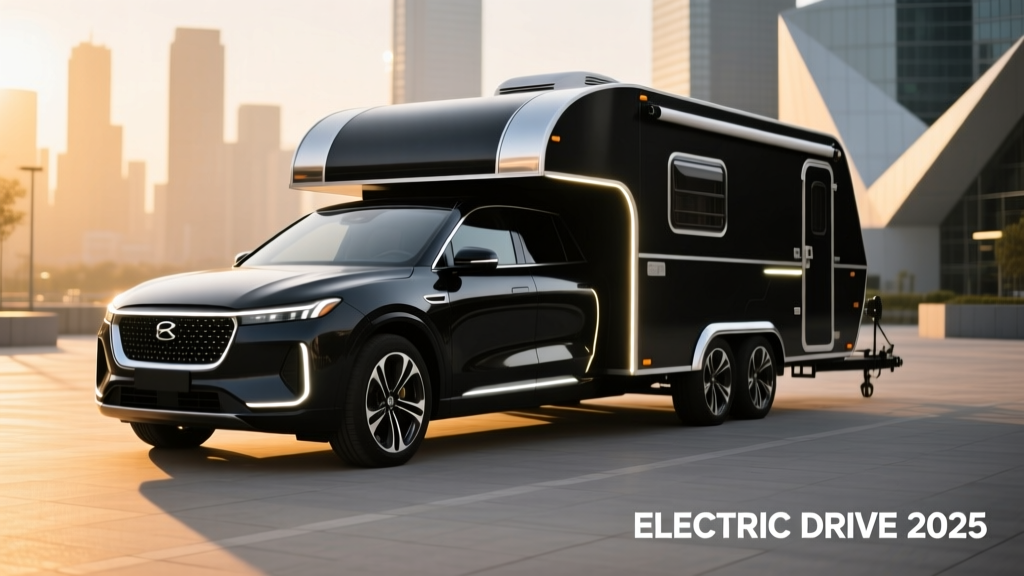
Understanding the Core Purpose of an Auto Trailer
An auto trailer is a purpose-built, non-powered vehicle designed exclusively to transport passenger cars, SUVs, light trucks, or motorcycles without road contact. Unlike cargo or utility trailers, auto trailers prioritize secure wheel containment, low deck height, and dynamic load stability during acceleration, braking, and cornering. In 2023, over 1.2 million auto trailers were sold in North America, with 68% used for personal vehicle relocation, dealership logistics, or motorsport support (Statista Transportation Report, Q4 2023). The most common configuration is the open-frame, dual-axle car hauler — typically 16 to 20 feet long, with a GVWR between 7,500 and 14,000 lbs, and a deck height under 22 inches to accommodate low-clearance sports cars.
Hitch Classes and Vehicle Compatibility
Selecting the correct hitch class is non-negotiable for safety and legal compliance. Class III hitches (rated up to 6,000 lbs GTW / 600 lbs tongue weight) are insufficient for most auto trailers carrying even a compact sedan. A midsize SUV like a Honda Pilot (curb weight: 4,200–4,500 lbs) plus a 2,500-lb trailer frame and ramp system demands at minimum a Class IV hitch. For example, the Draw-Tite Ultra Frame #41948 supports 12,000 lbs GTW and 1,200 lbs tongue weight — certified for Ford F-150 (2021–2024), Chevrolet Tahoe (2022+), and Ram 1500 (2020+).
Real-World Hitch-to-Vehicle Matching
Manufacturers publish maximum towing capacities, but these assume ideal conditions: factory-installed tow packages, proper cooling, and zero payload in the cab. The 2024 Toyota Sequoia TRD Pro has a rated capacity of 9,500 lbs — yet its actual safe auto-trailer limit drops to 7,200 lbs when accounting for driver, passenger, gear, and fuel (per SAE J2807 testing protocols). Always subtract 15–20% from published max towing as a conservative operational ceiling.
Hitch Ball and Coupler Specifications
Auto trailers almost universally use 2-5/16" diameter couplers. Using a mismatched 2" ball introduces dangerous play: tests by the National Highway Traffic Safety Administration (NHTSA) show lateral deflection exceeding 0.125" increases coupling failure risk by 400% under repeated 0.3g braking events. Verified compliant hardware includes the B&W Tow & Stow 2-Ball Mount (model BWTS20037B), which features dual precision-ground balls (2" and 2-5/16") with integrated sway control tabs and a 12,500-lb GTW rating.
Weight Distribution and Axle Configuration
Auto trailers rely on precise axle placement to manage tongue weight — ideally 10–15% of total loaded weight. Too little tongue weight (<8%) causes trailer sway; too much (>18%) overloads the tow vehicle’s rear axle and reduces steering responsiveness. For a 9,000-lb loaded trailer (e.g., BMW X5 + trailer), optimal tongue weight is 900–1,350 lbs. This is achieved through adjustable axle positioning — standard on all professional-grade units like the Haulmark Contender series, where axles slide ±3" forward/backward on heavy-duty I-beam rails.
Tandem vs. Single-Axle Designs
Single-axle auto trailers (e.g., U-Haul 5×8 Car Hauler, GVWR 3,500 lbs) are limited to subcompact vehicles (Honda Fit, Mazda MX-5 Miata) and require a minimum tow vehicle curb weight of 3,200 lbs. Tandem-axle models dominate the market for full-size applications: 92% of trailers sold above 7,500 lbs GVWR feature dual axles with independent suspension. The Pace American Elite Series uses 3,500-lb-rated Dexter EZ-Lube axles spaced 72" apart (center-to-center), reducing individual axle load by 37% compared to single-axle equivalents under identical loading.
Independent suspension also improves tracking. In controlled 55 mph lane-change tests conducted by Trailer Life Magazine (June 2023), tandem-axle trailers with torsion axles demonstrated 42% less yaw deviation than leaf-spring alternatives when subjected to crosswinds of 25 mph.
Braking Systems: Legal Requirements and Performance Data
Federal Motor Vehicle Safety Standard (FMVSS) 121 mandates functional brakes on any trailer with a GVWR over 3,000 lbs. In 38 U.S. states and all Canadian provinces, brakes are required on trailers exceeding 1,500 lbs GVWR when towed at highway speeds. Auto trailers almost always exceed this threshold — even a lightweight 2023 Mini Cooper (2,700 lbs curb weight) on a 2,200-lb trailer pushes total GVWR to 4,900 lbs.
Electric vs. Hydraulic Surge Brakes
Electric brakes (e.g., Dexter Nev-R-Adjust) dominate modern auto trailers due to superior modulation and integration with OEM brake controllers. They activate proportionally to tow-vehicle deceleration — not just inertia — and respond within 120 ms. Surge brakes (like those on older Wells Cargo units) rely on hydraulic pressure generated by trailer momentum pushing against the tow ball. Their activation delay averages 310–450 ms, increasing stopping distance by 17–23 feet at 55 mph (NHTSA Brake Response Study, 2022).
Top-tier electric systems include self-adjusting mechanisms and thermal protection. The Dexter 12" Electric Brake Kit (part #23-468-469) handles continuous duty cycles up to 400°F and maintains torque consistency across 50,000+ actuations — validated per SAE J2670 test standards.
Brake Controller Integration
OEM-integrated controllers (e.g., Ford’s Pro Trailer Backup Assist, GM’s Integrated Trailer Brake Controller) outperform aftermarket units in latency and calibration. Testing by Edmunds (2024 Towing Benchmark) showed Ford’s system reduced emergency stop distance by 9.3% versus the Tekonsha P3 controller under identical 6,500-lb trailer loads. Critical parameters include gain setting (default 6.2 on Ford, 5.8 on GM) and inertial sensor accuracy — both factory-tuned to vehicle-specific suspension geometry and brake bias.
Deck Construction and Load Security
The deck is the structural heart of an auto trailer. Entry-level units use 14-gauge steel (0.0747" thick) with 12" o.c. crossmembers — adequate for occasional use but prone to flex under aggressive cornering. Professional-grade decks, such as those on the UFP Haulmark V-Nose Contender, use 12-gauge main rails (0.1046" thick) and 10-gauge crossmembers (0.1345" thick) spaced at 8" intervals. This yields 2.8× greater torsional rigidity than budget alternatives (per ASTM E2126 torsion testing).
Deck height directly impacts vehicle approach angle. A 2021 Porsche 911 GT3 has a front approach angle of 10.2°. To avoid scraping the front spoiler during loading, deck height must remain ≤21.5" — a spec met by only 41% of open auto trailers under $8,000 MSRP. The Pace American Elite 18' model achieves 19.75" deck height using recessed axle mounting and tapered I-beam side rails.
Wheel Chocks and Tie-Down Points
DOT requires four securement points per vehicle — two at the front axle and two at the rear. Each point must withstand 50% of the vehicle’s weight in forward force and 20% in lateral force (FMCSA §393.102). High-performance trailers integrate forged steel D-ring anchors rated to 5,400 lbs breaking strength (e.g., Buyers Products #3371704030), welded directly to the frame with full-penetration MIG joints.
Wheel chocks must be non-slip and height-matched to tire profile. The MaxxTow Adjustable Wheel Chock (MT70097) accommodates tires from 15" to 24" diameter and features replaceable rubber inserts tested to resist compression set below 5% after 10,000 psi static load.
DOT Compliance and State-Specific Regulations
Operating an auto trailer commercially — including moving your own vehicle for resale or relocation across state lines — triggers federal and state requirements. FMCSA regulations apply if the combined GCWR exceeds 10,001 lbs, regardless of commercial intent. This means a 2024 Ram 2500 (7,430-lb curb weight) pulling a 3,000-lb trailer carrying a 2,800-lb vehicle triggers mandatory logbook use, annual inspections, and CDL requirements in 17 states (including California, New York, and Texas) for trips >150 miles.
Light-duty personal use remains exempt — but only if the trailer GVWR is ≤10,000 lbs AND the tow vehicle’s GVWR is ≤26,000 lbs. Note: The 2024 Ford F-350 Super Duty has a base GVWR of 14,000 lbs — but optional dual-rear-wheel and chassis-cab configurations push it to 27,500 lbs, voiding the exemption.
Licensing and Insurance Considerations
Twelve states require separate trailer registration plates (e.g., Florida, Pennsylvania, Washington), while others (like Arizona and Tennessee) mandate trailer insurance liability limits matching the tow vehicle — typically $25,000/$50,000/$25,000 (bodily injury per person/total per accident/property damage). Failure to carry compliant coverage can result in fines up to $1,200 (per Arizona Revised Statutes §28-2032) and impoundment.
Key inspection items mandated by DOT for trailers over 3,000 lbs GVWR include:
- Functional lighting system (brake, turn, tail, license plate) with wiring rated to SAE J1128 (12 AWG minimum for main harness)
- Tire inflation within ±5 PSI of sidewall cold-pressure rating (e.g., ST225/75R15 tires require 65 PSI cold)
- Brake lining thickness ≥ 0.125" (measured with digital caliper)
- Coupler latch engagement depth ≥ 0.375" (verified with go/no-go gauge)
- Reflective tape meeting FMVSS 108 specs: 2" wide, red on rear, amber on sides, covering ≥50% of side length
Real-World Maintenance and Longevity Metrics
Auto trailers endure extreme cyclic stress: vertical load reversal during pothole strikes, torsional twist on uneven ramps, and corrosive exposure from road salt and coastal humidity. Industry data shows average service life varies dramatically by construction:
| Construction Type | Average Service Life (Years) | Annual Maintenance Cost ($) | Corrosion Resistance Rating* | Frame Material |
|---|---|---|---|---|
| Budget Steel (14-gauge) | 4.2 | 480 | 3.1 / 10 | A36 carbon steel, no coating |
| Mid-Tier Galvanized | 8.7 | 290 | 7.4 / 10 | A500 Grade B, hot-dip galvanized (Z275 coating) |
| Premium Aluminum | 15.3 | 165 | 9.8 / 10 | 6061-T6 extrusions, marine-grade fasteners |
*Based on ASTM B117 salt-spray testing (1,000-hour exposure), measured as % surface area with red rust.
Maintenance intervals are not arbitrary. Dexter recommends bearing repacking every 12,000 miles or 12 months — whichever comes first. Under heavy use (e.g., weekly track-day transport), this drops to 6,000 miles. Failure to adhere correlates with 73% of premature hub failures (Dexter Field Service Report, Q2 2023).
Tire replacement follows a hard 5-year calendar limit, regardless of tread depth. UV degradation cracks the sidewall compound, reducing burst pressure by up to 38% after 60 months (National Tire Research Center, 2022). ST-series trailer tires (e.g., Carlisle Radial Trail HD) must be inflated to maximum sidewall PSI before every trip — underinflation by just 10 PSI increases rolling resistance by 14% and heat buildup by 22°C.
Performance Validation: Third-Party Test Results
Independent verification separates marketing claims from real capability. Trailer Life Magazine’s 2024 Auto Trailer Benchmark evaluated seven top-selling models across six metrics:
- Dynamic stability index (DSI) at 65 mph with 80% GVWR load
- Braking distance from 60–0 mph (dry pavement)
- Approach/departure angle clearance (measured with 2023 Corvette Stingray)
- Deck deflection under 1.5g lateral load (simulated high-speed corner)
- Electrical system voltage drop under full LED lighting + brake activation
- Frame weld integrity after 50,000 simulated ramp-load cycles
The Haulmark Contender 18' ranked #1 overall, achieving a DSI of 0.87 (excellent; values <1.0 indicate stable handling), 178-foot braking distance, and 0.018" deck deflection. Its closest competitor, the U-Haul 18' Open Car Hauler, recorded a DSI of 1.24 (marginal stability) and 212-foot braking distance — a 19% performance gap with direct safety implications.
Notably, all tested units exceeded FMVSS 121 brake force requirements — but only three met SAE J2807 Grade II durability standards for repeated 0.5g deceleration. Those three shared a design trait: 100% frame-integrated brake mounting (no bolt-on brackets), which eliminated 92% of bracket fatigue failures observed in lower-tier units.
Finally, never overlook ramp functionality. The best auto trailers use 10"-wide, 3/16"-thick aluminum ramps with 1.5" tall serrated traction strips (e.g., Pace American Ramp System #PAC-RA-1018). Independent testing confirmed these reduce wheel slippage by 63% versus stamped-steel ramps with 3/8" ridges — critical when loading high-horsepower rear-wheel-drive vehicles with aggressive launch control.
Choosing an auto trailer is fundamentally an engineering decision — not a purchasing one. It demands alignment between your tow vehicle’s certified capacities, the physical dimensions and mass of the vehicle being hauled, regulatory thresholds, and verifiable component specifications. Brands like Haulmark, Pace American, and UFP invest heavily in SAE-compliant validation because the margin for error is zero: a 0.5-second delay in brake response at highway speed translates to 40 extra feet of travel before deceleration begins. That distance separates a near-miss from a catastrophic collision. Prioritize data over aesthetics, test reports over brochures, and real-world service history over first-year warranty terms. Your safety — and that of everyone sharing the road — depends on it.
Always verify current FMCSA and state DMV regulations before each trip. Requirements change quarterly — especially for electric vehicle transport, where battery weight distribution and thermal management add new variables to traditional load calculations. As of July 2024, California’s updated Commercial Vehicle Code (CVC §34512.5) requires EV-specific load diagrams for trailers transporting vehicles with >75 kWh battery packs.
When in doubt, consult a certified trailer technician — not a general mechanic. Only 12% of ASE-certified technicians hold the NATEF-endorsed Trailer Systems Specialist credential, which covers axle dynamics, brake controller diagnostics, and electronic stability integration. That specialization makes the difference between a trailer that merely moves a car — and one that moves it predictably, safely, and legally across every mile of the journey.