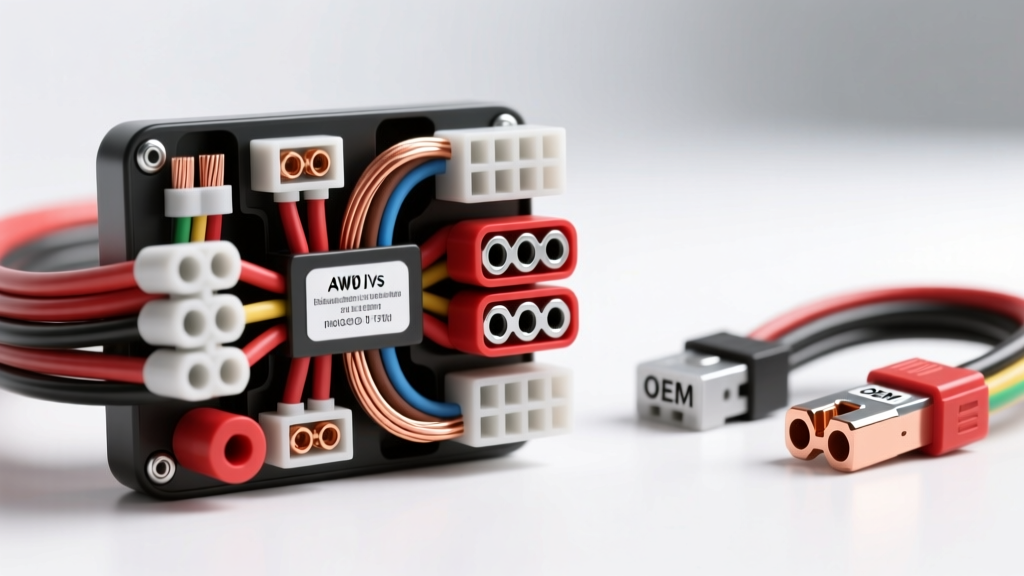
Decoding the Wiring Harness Replacement Cost
When evaluating the wiring harness replacement cost for modern vehicles, technicians, fleet managers, and restoration specialists must look far beyond the retail sticker price. The true expense of an automotive electrical harness is dictated by raw material specifications, connector density, shielding requirements, and routing complexity. A generic chassis harness might cost $300, while a late-model OEM engine control harness with integrated shielded CAN-bus pairs and high-temperature Tefzel insulation can easily exceed $1,800. Understanding the technical specifications that drive these prices is essential for making informed purchasing and repair decisions.
Technical Cost Matrix by Harness Sub-System
The price variance between harness types is directly correlated to pin count, copper mass, and environmental protection requirements. Below is a baseline cost matrix comparing OEM and high-quality aftermarket options.
| Harness Sub-System | Avg Pin Count | Primary AWG | Avg OEM Cost | Avg Aftermarket Cost |
|---|---|---|---|---|
| Engine Management (PCM) | 80-120 | 16-20 AWG | $1,200 - $2,500 | $450 - $850 |
| Chassis/Body (BCM) | 40-60 | 14-18 AWG | $600 - $950 | $250 - $400 |
| Dash/Instrument Cluster | 100+ | 18-22 AWG | $1,500 - $3,200 | N/A (OEM Only) |
| Transmission (TCM) | 12-24 | 16-18 AWG | $350 - $650 | $150 - $280 |
Material Specifications Driving the Price
Conductor Mass and AWG Distribution
Copper commodity prices directly impact the baseline wiring harness replacement cost. According to the SAE J1128 Standard for Low Tension Primary Cable, automotive wire must meet strict strand count, diameter, and conductivity tolerances. An OEM engine harness utilizes a precise distribution of wire gauges: 18 AWG (approx. 0.82mm²) for sensitive sensor circuits (e.g., MAF, O2 sensors), 16 AWG for injector drivers, and 10 to 12 AWG for main power feeds.
Aftermarket "universal" harnesses often cut costs by using Copper Clad Aluminum (CCA) or by reducing strand counts within the same AWG rating. While this lowers the manufacturing cost, it significantly increases voltage drop over long runs to the PCM. For example, in a GM E38 PCM X1 connector, Pins 1-10 handle high-current injector drivers using 16 AWG wire, while Pins 11-30 route low-amperage sensor signals via 20 AWG. Substituting 18 AWG for the sensor lines in an aftermarket replacement to save copper weight can result in erratic 5V reference signals and skewed sensor data.
Insulation Polymers and Temperature Ratings
Standard Polyvinyl Chloride (PVC) insulation melts at lower temperatures and becomes brittle in sub-zero climates, leading to micro-cracks. Premium OEM harnesses routed through engine bays use Cross-Linked Polyethylene (XLPE) or Fluoropolymers (Tefzel), rated for continuous 150°C operation. The chemical extrusion and irradiation process for XLPE adds roughly 20% to the manufacturing cost. However, it prevents the insulation from shrinking back from the crimp barrel—a common failure mode in cheap PVC wire that exposes bare copper to moisture and accelerates corrosion.
Connector Density and Proprietary Tooling
The plastic connector housings and terminal seals represent up to 40% of the total assembly cost. OEM manufacturers rely on proprietary, high-precision molds from tier-one suppliers. For instance, a standard 38-way PCM connector utilizes micro-timer terminals with specific silicone mat seals designed to withstand high-pressure engine washing. Sourcing these exact TE Connectivity Automotive Connectors requires expensive injection molding and rigorous tolerance testing.
Aftermarket kits often substitute these proprietary connectors with generic Weather-Pack, Metri-Pack, or Deutsch DT connectors. While this drastically reduces the part cost and simplifies inventory, it requires the installer to cut, repin, and adapt the factory harness pigtails, thereby shifting the cost from the part price to the labor column.
Ultrasonic Welding vs. Mechanical Crimping
OEM harnesses increasingly use ultrasonic welding for splicing multiple ground wires into a single 10 AWG ring terminal. This creates a solid-state metallurgical bond with virtually zero electrical resistance. Aftermarket replacement harnesses typically rely on mechanical open-barrel crimps. While crimping is cheaper and faster to produce, it is susceptible to loosening under extreme thermal cycling. This technological gap justifies the premium cost of OEM replacement units for critical ground nodes, such as the main engine block ground or PCM chassis ground.
Shielding and High-Speed Data Networks
Modern vehicles rely heavily on CAN-bus, LIN, and FlexRay networks. The wiring harness replacement cost spikes significantly when dealing with shielded twisted pairs. A standard CAN High (often Dark Green) and CAN Low (Dark Blue) circuit requires a precise twist rate (typically 1 inch per twist) to maintain 120-ohm impedance and reject electromagnetic interference (EMI).
Furthermore, the harness must include a dedicated 18 AWG bare copper drain wire wrapped in Mylar foil or braided copper shielding. If an aftermarket harness omits this shielding to save on material costs, the vehicle will experience phantom U-codes (e.g., U0100 Lost Communication with ECM) the moment the alternator introduces AC ripple into the data lines. Properly manufacturing shielded twisted pairs requires specialized twister machinery and continuous impedance testing, which is reflected in the higher price of OEM-compliant harnesses.
Labor Time Estimates Based on Routing Complexity
The physical installation labor is often the largest portion of the final invoice. Harness routing dictates the teardown required, and technicians must adhere to ISO 6722 Road Vehicles cable standards regarding bend radii and firewall sealing.
- Engine Bay Harness: 6-10 hours. Requires lifting the vehicle, removing the alternator, and disconnecting the PCM. Firewall grommets must be carefully manipulated with silicone lubricant to avoid tearing the primary insulation.
- Dash/Body Harness: 18-30 hours. Requires complete removal of the dashboard, HVAC assembly, steering column, and sometimes the windshield cowl. This is the most expensive harness to replace due to sheer labor time.
- Transmission Internal Harness: 4-6 hours. Requires dropping the transmission pan, filtering the fluid, and removing the valve body to access the TCM solenoid connectors.
Diagnostic Justification: When to Replace vs. Repair
Before committing to a full harness replacement, verify if a targeted repair kit is sufficient. Full replacements should be reserved for specific, catastrophic failure modes.
Capillary Wicking in Sensor Circuits
If moisture enters a damaged pigtail (such as a cracked O2 sensor connector), capillary action can wick fluid under the insulation of an 18 AWG wire all the way back to the PCM connector. If you remove the PCM and see green copper oxide (verdigris) at the connector pins (e.g., Pin 12 for the 5V Reference), the entire branch of the harness is internally compromised. Cleaning the PCM pins will only provide a temporary fix; the harness must be replaced to prevent the copper oxide from acting as a semiconductor and skewing sensor voltages.
Terminal Fretting Corrosion
Engine vibration causes micro-movements between the male and female terminals, wearing away the tin plating and creating an oxide layer that spikes resistance. This is incredibly common in alternator charge harnesses and heavy-duty injector pigtails. If your voltage drop test across the harness exceeds 0.2V under load, and the terminals show dark grey fretting dust upon extraction, the harness ends are ruined. While individual pigtail repairs are possible, widespread fretting across a 60-pin connector justifies the cost of a complete replacement harness to ensure long-term reliability.