The Complexity of Freightliner Multiplexed Electrical Systems
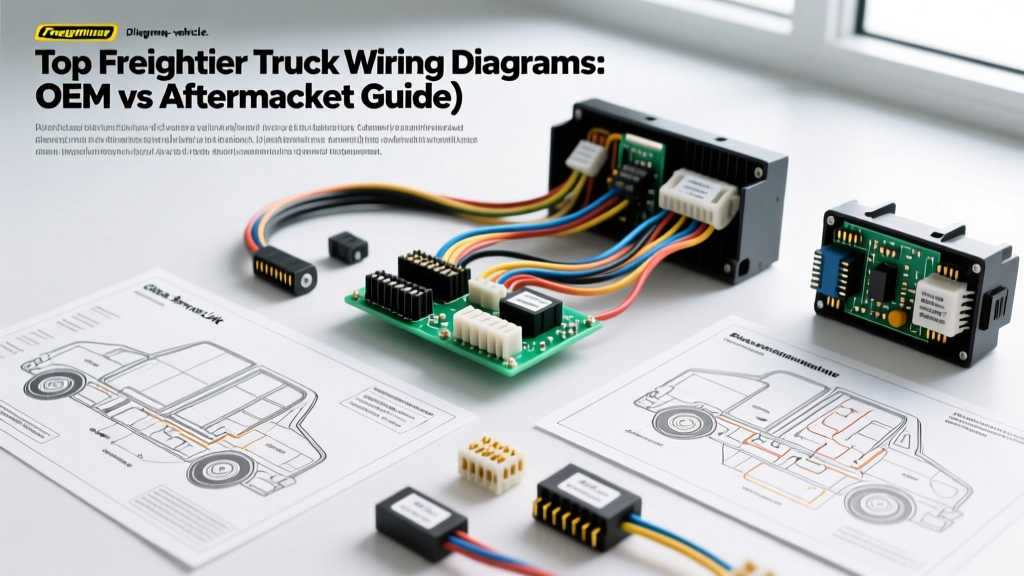
Modern commercial vehicles rely on highly complex, multiplexed electrical architectures. When troubleshooting a Freightliner Cascadia, Columbia, or M2 106, accessing accurate Freightliner truck wiring diagrams is not just helpful—it is mandatory. Unlike legacy trucks that used simple point-to-point 12V DC wiring, modern Freightliners utilize a System Application Module (SAM) network. The Chassis SAM and Cab SAM communicate via J1939 and J1587 data links to control high-current loads using solid-state relays and Pulse Width Modulation (PWM).
Because mid-year running changes are common in commercial truck manufacturing, a generic schematic can lead to misdiagnosed faults, blown fuses, or damaged Electronic Control Units (ECUs). This guide compares the top resources for sourcing Freightliner schematics, breaking down the technical depth, cost, and usability of OEM versus aftermarket solutions, while providing critical pinout and wire gauge references for heavy-duty applications.
Evaluating Sources for Freightliner Truck Wiring Diagrams
1. DTNA OEM ServiceLink (The Gold Standard)
Daimler Trucks North America (DTNA) provides DTNA ServiceLink, the official OEM portal for Freightliner dealerships and certified independent repair facilities. ServiceLink generates 'as-built' wiring diagrams based on the specific Vehicle Identification Number (VIN). This is crucial because Freightliner frequently updates bulkhead connector pinouts and SAM software configurations mid-production year.
- Pros: 100% accurate to the specific VIN; includes SAM configuration parameters and exact OEM wire color codes.
- Cons: Requires a paid commercial subscription; generally restricted to verified business entities and dealerships.
2. Mitchell 1 TruckSeries (Best Aftermarket Software)
For independent heavy-duty shops, Mitchell 1 TruckSeries is the premier aftermarket alternative. It provides comprehensive wiring diagrams for the Freightliner Cascadia, M2, and Coronado lines. Mitchell 1 redrawing the OEM schematics into a standardized, easy-to-read format with interactive circuit tracing.
- Pros: User-friendly interface; integrates wiring diagrams with diagnostic trouble code (DTC) troubleshooting trees and torque specifications.
- Cons: May lag behind DTNA by a few weeks on mid-year running changes; generic schematics might require cross-referencing cab options.
3. Chilton / Haynes Commercial Manuals & PDF Bundles
For owner-operators and legacy models (pre-2010 Freightliner Century or Columbia), physical manuals and aftermarket PDF bundles offer a cost-effective entry point. However, these resources often lack the depth required for multiplexed SAM diagnostics.
- Pros: Low cost; offline accessibility; excellent for basic power distribution, lighting, and starter circuits.
- Cons: Virtually useless for diagnosing CAN bus network faults or SAM node failures; lacks specific connector cavity views.
Technical Reference: Freightliner Data Link & Power Pinouts
Regardless of the diagram source you choose, understanding the foundational data links and power distribution standards is critical. Freightliner relies heavily on the SAE J1939 CAN bus network for high-speed module communication (e.g., MCM to ABS module) and J1587/J1708 for legacy data transmission. Below is a reference table for the standard 9-pin and 6-pin diagnostic connectors found in the cab.
| Pin / Circuit | Protocol / Function | Standard Wire Color | AWG Size | Notes & Specifications |
|---|---|---|---|---|
| Pin C (9-Pin) / Pin A (6-Pin) | J1939 CAN High | Yellow | 18 AWG | Must be twisted with CAN Low; 60 ohms across H/L. |
| Pin D (9-Pin) / Pin B (6-Pin) | J1939 CAN Low | Green | 18 AWG | Shield drain wire must be grounded at ONE end only. |
| Pin A (9-Pin) | J1587 Data Link | Blue | 18 AWG | Legacy protocol; check for 4.0V - 4.5V resting state. |
| Pin B (9-Pin) | J1587 Ground | White | 18 AWG | Reference ground for J1587 data transmission. |
| Pin F (9-Pin) | Unswitched Battery (+) | Red | 12 AWG | Provides constant 12V to diagnostic tools and telematics. |
| Pin G (9-Pin) | Chassis Ground (-) | Black | 12 AWG | Must have less than 0.1V drop to battery negative post. |
Note: Always verify wire colors against your specific VIN diagram, as aftermarket harness repairs or upfitter modifications frequently alter OEM color coding. For in-depth network topology standards, refer to the SAE J1939 Network Standard documentation.
Decoding the SAM (System Application Module) Schematics
When reading Freightliner truck wiring diagrams for a Cascadia, you will notice that switches in the cab do not directly carry the high-amperage load for headlights or wipers. Instead, a switch sends a low-current multiplexed signal or a simple 12V logic signal to the Cab SAM. The Cab SAM then communicates with the Chassis SAM via a dedicated CAN link to trigger a solid-state relay.
PWM Lighting Circuits
Modern Freightliner diagrams will show Pulse Width Modulated (PWM) outputs for exterior lighting. This allows the SAM to monitor current draw in real-time. If a 14 AWG headlight wire shorts to ground, the SAM detects the current spike and shuts down the circuit instantly, eliminating the need for traditional thermal circuit breakers. When troubleshooting a 'Headlight Out' fault with no blown fuse, your wiring diagram will direct you to check the SAM diagnostic LED blink codes rather than testing for continuity at the fuse panel.
Comparison Matrix: Selecting Your Diagram Provider
| Resource | Best Suited For | Cost Structure | Diagram Accuracy | Multiplex/SAM Depth |
|---|---|---|---|---|
| DTNA ServiceLink | Dealerships, Heavy-Duty Specialists | High (Annual Subscription) | Exact (VIN Specific) | Excellent (Includes SAM logic) |
| Mitchell 1 TruckSeries | Independent Truck Repair Shops | Medium (Monthly/Annual) | High (Model Year Specific) | Very Good |
| OEM Service Manuals (Print/PDF) | Fleet Maintenance, Owner-Operators | Low (One-time purchase) | Medium (Base Model) | Poor (Lacks software updates) |
Real-World Troubleshooting: Bulkhead & MCM Failures
Even with the best wiring diagrams, physical inspection is required to validate schematic data. Two of the most common failure points on Freightliner trucks involve the bulkhead connector and the Motor Control Module (MCM) harness.
The Bulkhead Connector Corrosion Issue
The main bulkhead connector routes the engine harness through the firewall into the cab. On older Cascadia models, water intrusion leads to severe galvanic corrosion on the 120-pin connector. When using your wiring diagram to trace a loss of communication with the instrument cluster, always inspect the bulkhead. Repair Protocol: Clean pins with electrical contact cleaner, apply a heavy coat of dielectric grease (e.g., Nyogel 760G), and torque the central retaining bolt to 45 in-lbs. Over-torquing will crack the plastic housing, guaranteeing future water intrusion.
MCM Harness Chafing
The MCM (Engine ECM) is typically mounted on the passenger side of the Detroit Diesel DD13 or DD15 engine block. The 120-pin connector harness is notorious for chafing against the engine lift bracket or the starter solenoid heat shield. Wiring diagrams will show the 5V reference signals (usually 18 AWG, Gray or Light Blue wires) sharing a cavity block with high-current injector driver wires. If the insulation wears through, the 5V reference pulls to ground, causing the engine to immediately derate or stall. Always use split-loom tubing and high-temp friction tape when rerouting these harnesses post-repair.
Conclusion
Selecting the right source for Freightliner truck wiring diagrams depends entirely on your operational needs. For dealership-level accuracy and SAM module programming, DTNA ServiceLink is unmatched. For independent shops requiring a balance of cost, usability, and technical depth, Mitchell 1 TruckSeries remains the industry standard. Regardless of the software you use, always pair your schematic analysis with rigorous physical testing, verifying AWG load capacities, checking CAN bus terminating resistors, and adhering to OEM torque specifications to ensure a lasting repair.