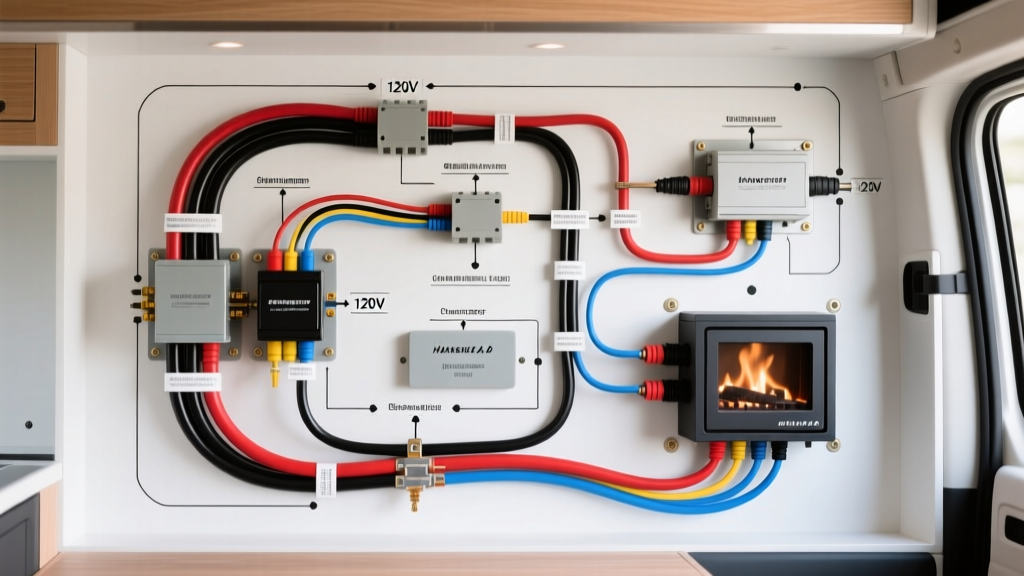
The Challenge of 120V Heating Loads in Mobile Platforms
Integrating residential comforts into Class B camper vans and overland motorhomes has pushed the boundaries of mobile electrical engineering. Among the most demanding accessories is the 120V AC electric fireplace. Unlike 12V DC diesel heaters, a standard residential electric fireplace relies on a high-wattage ceramic heating element and a DC-powered blower motor, requiring a robust DC-to-AC inversion system. When interpreting a wiring diagram for electric fireplace integration in a vehicle, the primary concern is managing the massive transient and continuous current draw on the DC side while maintaining clean, code-compliant AC power on the branch circuit.
This complete walkthrough details the exact wiring schematics, AWG specifications, and overcurrent protection requirements for safely routing a 1500W electric fireplace from a 12V lithium battery bank through a Pure Sine Wave inverter and into an RV-rated AC subpanel.
Load Calculations: DC vs. AC Current Draw
Before routing a single cable, we must calculate the electrical load. A standard 120V AC electric fireplace draws approximately 1500W on its highest heat setting.
- AC Side (120V): 1500W / 120V = 12.5 Amps continuous.
- DC Side (12V Nominal): Inverters are not 100% efficient. Assuming a 90% efficiency rate and a low-voltage cutoff threshold of 11.5V, the DC draw is calculated as: (1500W / 0.90) / 11.5V = 144.9 Amps.
This massive DC current draw dictates that the electric fireplace cannot be wired to a standard 1000W inverter. You must utilize a minimum 2000W (preferably 3000W) Pure Sine Wave inverter/charger, supported by a high-discharge Lithium Iron Phosphate (LiFePO4) battery bank equipped with a Battery Management System (BMS) rated for at least 150A continuous discharge.
Phase 1: The DC Supply (Battery to Inverter)
The foundation of the wiring diagram for electric fireplace reliability lies in the DC cabling. Voltage drop on the DC side is the leading cause of inverter low-voltage alarms and fireplace control board resets.
1. Cable Sizing and Routing
For a 3000W inverter, we mandate the use of 2/0 AWG (70mm²) fine-strand pure copper welding cable. Standard THHN stranded wire is too rigid for vehicle vibration and can fracture inside the lugs over time. According to Victron Energy's cable sizing guidelines, 2/0 AWG cable keeps voltage drop under 2% for runs up to 5 meters (16 feet) round-trip at 150A.
2. Overcurrent Protection
Install a 250A Class T fuse on the positive DC cable. Per ABYC E-11 and NFPA 70 standards, this fuse must be located within 7 inches of the battery bank's positive terminal. Class T fuses offer a high Ampere Interrupting Capacity (AIC) of 20,000A, which is critical for limiting fault currents in high-output lithium battery banks.
3. Termination and Torque
Crimp the 2/0 AWG cables using heavy-duty copper lugs (M8 or M10 ring terminals depending on your inverter busbar). Use a hydraulic crimper with the correct hex die to ensure a cold-weld crimp. Seal the crimp barrel with adhesive-lined 3:1 heat shrink tubing to prevent moisture ingress and copper oxidation. Torque the inverter busbar nuts to the manufacturer's specification (typically 10-12 Nm) using a calibrated torque wrench.
Phase 2: The AC Subpanel and Branch Circuit
Once the DC power is safely inverted to 120V AC, the output must be routed through an RV-rated AC distribution panel before reaching the fireplace receptacle.
1. Inverter to Subpanel Routing
The AC output from the inverter is routed to the main lugs of the AC subpanel using 6 AWG THHN/THWN copper wire (Black for Line, White for Neutral, Green for Ground). This wire must be run through flexible liquid-tight metallic conduit to protect against chassis chafing and rodent damage.
2. The Fireplace Branch Circuit
The electric fireplace requires a dedicated 20A branch circuit. From the subpanel, run 12 AWG Romex (NM-B) or 12 AWG THHN in conduit to the fireplace installation cavity.
- Breaker: 20A Single-Pole GFCI Breaker. The National Electrical Code (NEC) and NFPA 70 Article 551 (Recreational Vehicles) mandate GFCI protection for 120V receptacles located in areas prone to moisture or where portable appliances are used. Even though the fireplace is built-in, the initial plug-in connection requires GFCI protection.
- Receptacle: 20A Tamper-Resistant (TR) Duplex Receptacle. Ensure the fireplace plug (usually a NEMA 5-15P) is plugged directly into this dedicated outlet, avoiding extension cords which introduce severe fire hazards in confined van walls.
Technical Specifications & Component Matrix
| System Segment | Component / Material | Specification / Rating | Purpose |
|---|---|---|---|
| DC Main Positive | Welding Cable | 2/0 AWG, Fine Strand Copper | Handles 150A+ DC draw with minimal voltage drop |
| DC Overcurrent | Class T Fuse & Block | 250A, 20kA AIC | Protects against catastrophic lithium short circuits |
| Inverter | Pure Sine Wave Inverter | 3000W Continuous / 12V DC | Provides clean AC power to prevent board failure |
| AC Branch Wire | THHN / NM-B Romex | 12 AWG Copper (Black/White/Grn) | Rated for 20A continuous AC load |
| AC Protection | GFCI Circuit Breaker | 20A, 120V Single Pole | Ground fault protection per RVIA / NEC Article 551 |
| Terminations | Ring Terminals | M8/M10 Copper, Adhesive Heat Shrink | Vibration-resistant, corrosion-proof connections |
Real-World Failure Modes & Diagnostic Troubleshooting
When installing high-draw resistive heating elements in a vehicle, several unique failure modes emerge. Use this decision tree to diagnose common electric fireplace wiring issues.
Symptom 1: Fireplace Control Board Resets Randomly
- Cause: Modified Sine Wave (MSW) Inverter. MSW inverters output a choppy, stepped waveform that causes severe harmonic distortion. The sensitive microcontrollers inside modern electric fireplaces interpret this distortion as a power fault and shut down to protect themselves.
- Fix: Upgrade to a true Pure Sine Wave inverter. The AC waveform must mimic grid power perfectly (Total Harmonic Distortion < 3%).
Symptom 2: Inverter Alarms 'Low Voltage' When Heater Kicks On
- Cause: Severe DC voltage drop. When the 1500W heating element engages, the DC current spikes to 145A. If the DC cables are undersized (e.g., 4 AWG instead of 2/0 AWG) or if a crimp is loose, the voltage at the inverter terminals will sag below the 11.5V low-voltage cutoff threshold, triggering an alarm and shutting off the AC output.
- Fix: Perform a loaded voltage drop test. Use a multimeter to measure voltage directly at the battery terminals, then at the inverter busbars while the fireplace is running on 'High Heat'. If the drop exceeds 0.5V, replace the cables with 2/0 AWG and re-crimp all lugs using a hydraulic tool.
Symptom 3: GFCI Breaker Trips Immediately Upon Inversion
- Cause: Neutral-to-Ground Bonding Conflict. Many off-grid inverters feature an internal relay that bonds the AC Neutral to the Chassis Ground when in inversion mode. If your AC subpanel also has a physical neutral-ground bonding strap installed, it creates a parallel path for neutral current to flow on the ground wire, which the GFCI breaker detects as a ground fault.
- Fix: Consult your inverter manual and the RV Industry Association (RVIA) standards. Typically, in mobile applications with a dedicated inverter subpanel, the subpanel neutral and ground bars must remain isolated (floating), allowing the inverter's internal relay to manage the bond dynamically.
Code Compliance and Safety Standards
Automotive and RV electrical systems are subject to rigorous safety standards. Always ensure your wiring diagram for electric fireplace installations complies with NFPA 70 (NEC) Article 551 regarding Recreational Vehicles, specifically sections pertaining to low-voltage wiring separation from 120V AC wiring. DC and AC cables must never share the same conduit or loom, and must maintain a minimum separation distance of 2 inches to prevent electromagnetic interference and inductive heating. By adhering to these AWG specifications, torque settings, and overcurrent protection protocols, your 120V electric fireplace will operate safely and efficiently for years on the road.