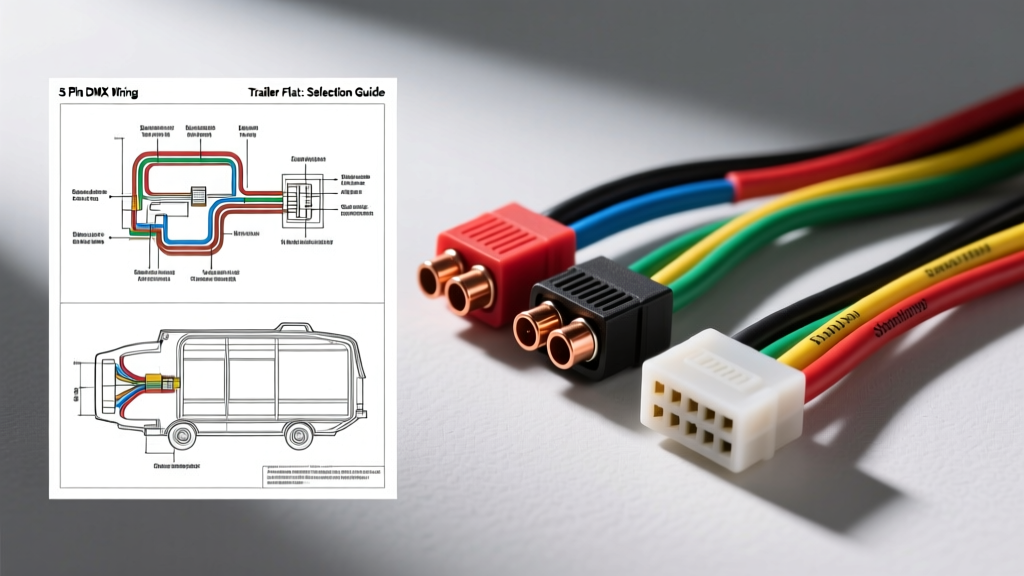
The Dual-Wiring Challenge for Mobile Event Trailers
When outfitting mobile stage trailers, parade floats, and mobile DJ rigs, builders frequently search for a 5 pin dmx wiring diagram alongside standard DOT trailer lighting schematics. Because both systems utilize 5-pin connectors, confusion is common. However, mixing 12V DC automotive trailer wiring with low-voltage DMX512 data protocols can result in catastrophic data loss, signal reflection, or severe electrical shorts.
This product comparison and selection guide breaks down the critical differences between the standard 5-pin flat trailer connector (used for DOT-compliant lighting and reverse lockout) and the 5-pin XLR connector (the industry standard for DMX512 stage lighting control). We will cover exact pinouts, wire gauge requirements, impedance specifications, and integration strategies for custom event trailers.
System Comparison Chart: 5-Pin Flat vs. 5-Pin XLR (DMX)
| Feature | 5-Pin Flat (Trailer) | 5-Pin XLR (DMX512) |
|---|---|---|
| Primary Use | DOT Trailer Lighting & Reverse Lockout | Stage Lighting & Effects Control Data |
| Connector Type | Molded Rubber/Plastic Flat Blade | Metal XLR (Cannon) Circular |
| Voltage / Signal | 12V DC Power (Up to 15A per circuit) | RS-485 Differential Data (2-5V) |
| Wire Gauge (AWG) | 16 AWG (Lights) / 12 AWG (Ground) | 24 AWG or 22 AWG (Twisted Pair) |
| Impedance | Not Specified (Untwisted) | Strict 110-Ohm Twisted Pair |
| Shielding | Unshielded | Foil/Braid Shielded (Drain Wire) |
Standard 5-Pin Flat Trailer Wiring Diagram & Specs
The 5-pin flat connector is an extension of the standard 4-pin flat, adding a fifth wire typically used for reverse lockout (to disengage hydraulic surge brakes when backing up) or auxiliary 12V power. According to CURT Manufacturing and SAE light-duty standards, the color codes and pin assignments are strictly regulated to ensure interoperability between tow vehicles and trailers.
5-Pin Flat Pinout Reference
- Pin 1 (White): Ground Return. Must be 12 AWG stranded copper (SGT or GXL jacket). Torque ring terminal to bare chassis metal at 10-12 ft-lbs to prevent ground loops.
- Pin 2 (Yellow): Left Turn / Stop Lamp. 16 AWG.
- Pin 3 (Green): Right Turn / Stop Lamp. 16 AWG.
- Pin 4 (Brown): Tail / Running / Marker Lights. 16 AWG.
- Pin 5 (Blue): Reverse Lockout / Auxiliary. 16 AWG. Connects to the reverse light circuit on the tow vehicle via a relay or direct tap.
Selection Tip: For mobile stage trailers exposed to heavy road debris, select a harness with a heavy-duty PVC jacket and integrated molded strain reliefs. Avoid cheap, unjacketed parallel wire harnesses, as they will degrade rapidly when routed through trailer A-frames.
5-Pin DMX (XLR) Wiring Diagram for Event Trailers
DMX512 (Digital Multiplex) is the universal protocol for controlling stage lighting, fog machines, and moving heads. While 3-pin XLR is common in budget gear, the ESTA DMX512 Standard strictly mandates the use of 5-pin XLR connectors to prevent accidental cross-patching with analog audio lines. When building an event trailer, you must route DMX data from the external control booth to the internal lighting rig.
5-Pin DMX XLR Pinout Reference
- Pin 1: Signal Common / Shield (Drain Wire). Connects to the cable shield and XLR shell.
- Pin 2: Data 1 - (Primary Data Inverted).
- Pin 3: Data 1 + (Primary Data True).
- Pin 4: Data 2 - (Secondary / Optional).
- Pin 5: Data 2 + (Secondary / Optional).
Critical Warning: You cannot use standard 5-pin trailer wire for DMX data. DMX relies on RS-485 differential signaling, which requires a strict 110-ohm impedance and twisted-pair geometry to prevent signal reflection. Using unshielded, untwisted automotive wire will cause capacitance buildup, resulting in erratic flickering, strobe lockups, and complete data dropout at the end of the daisy chain.
Product Selection: Bulkheads and Harness Integration
For a professional mobile stage trailer, you must pass both 12V DC power and DMX data through the trailer's exterior wall. Here is how to select the right components for your build:
1. Exterior Bulkhead Connectors
Do not rely on dangling cables that can be snagged or crushed by the trailer door. Install flush-mount bulkhead panels.
- Trailer Side: Use a weatherproof 5-pin flat receptacle (e.g., Pollak PK11404) mounted in a sealed junction box on the tongue.
- DMX Side: Install a Neutrik NA3MD6C or equivalent 5-pin XLR bulkhead feed-through. These feature weatherproof rubber gaskets and D-style mounting flanges that seal tightly against corrugated trailer siding.
2. Internal Cable Routing & Conduit
Route your 110-ohm DMX cable (such as Belden 9841 or Gepco DMX22) inside flexible nylon loom or split-loom tubing. Keep DMX data lines at least 6 inches away from 12V DC power lines and 120V AC shore power lines to prevent Electromagnetic Interference (EMI) and Radio Frequency Interference (RFI).
3. DMX Termination
Every DMX daisy chain inside the trailer must end with a 120-ohm termination resistor connected across Pins 2 and 3 of the final fixture's XLR output. This absorbs the RS-485 signal and prevents it from bouncing back down the line, which is a common cause of 'ghost' triggering in moving head lights.
Troubleshooting Decision Tree: Signal & Power Failures
When integrating automotive and stage lighting systems on a single trailer, use this diagnostic tree to isolate faults:
Symptom: DMX Lights Flicker Randomly or Lose Position Data
- Cause 1: Incorrect cable used (Microphone cable or trailer wire instead of 110-ohm DMX cable). Fix: Replace with Belden 9841 or equivalent.
- Cause 2: Missing termination resistor at the end of the chain. Fix: Insert a 120-ohm XLR terminator plug into the last fixture.
- Cause 3: EMI from trailer running lights (Brown wire). Fix: Reroute DMX cables away from the 12V trailer harness; ensure DMX shield (Pin 1) is grounded only at the console, not at multiple fixtures (Ground Loop).
Symptom: Trailer Running Lights Dim When Brake is Applied
- Cause: Voltage drop due to undersized ground wire or poor chassis ground. Fix: Upgrade the White ground wire to 10 AWG. Sand away paint and rust at the chassis grounding point, apply dielectric grease, and torque securely.
Symptom: Surge Brakes Lock Up When Reversing
- Cause: Pin 5 (Blue) reverse lockout circuit is not receiving 12V from the tow vehicle. Fix: Verify the blue wire is connected to the tow vehicle's reverse light circuit via a 10A relay. Check for blown fuses in the tow vehicle's reverse lighting module.
Final Integration Best Practices
Building a reliable event trailer requires respecting the physics of both systems. The 5-pin flat connector handles high-current, noisy 12V DC power essential for highway safety and DOT compliance. The 5-pin XLR handles fragile, high-speed digital data essential for theatrical performance. By utilizing dedicated bulkheads, proper AWG sizing, 110-ohm twisted pair cables, and strict physical separation of the harnesses, your mobile rig will deliver flawless lighting and safe towing for years to come. For heavy-duty commercial trailers requiring air brakes and ABS, consult the SAE International J560 7-pin standard instead of the light-duty 5-pin flat configuration.