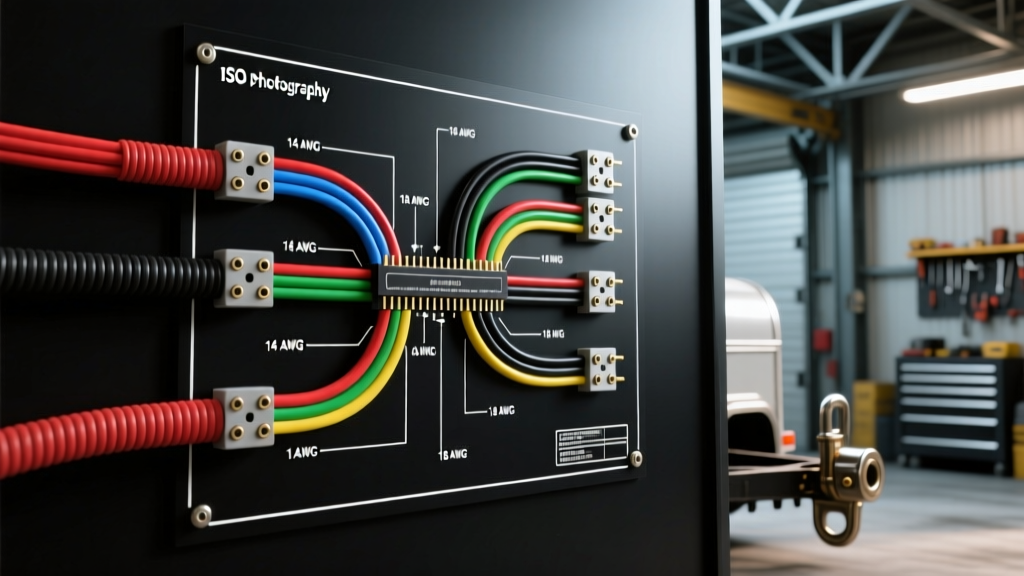
Introduction to 16-Pin ISO Commercial Trailer Connectors
When outfitting heavy-duty commercial fleets and specialized transport trailers, standard lighting connections are rarely sufficient. While the 15-pin ISO 12098 connector is the baseline for European and international heavy transport, modern trailers equipped with Electronic Braking Systems (EBS), advanced telemetry, and CAN-bus networks require expanded circuitry. This is where the 16 pin ISO wiring diagram becomes critical. The 16-pin configuration builds upon the ISO 12098 foundation by adding a dedicated 16th pin for proprietary telemetry, reverse lockout solenoids, or secondary CAN-bus channels as outlined in ISO 11992.
Selecting the correct wiring harness for a 16-pin application requires understanding wire gauge specifications, shielding requirements for data lines, and environmental sealing ratings. This guide compares the top harness configurations available for heavy-duty commercial towing, providing fleet mechanics and trailer builders with the technical data needed to make an informed selection.
Complete 16 Pin ISO Wiring Diagram & Pinout Specifications
Before comparing harness products, it is essential to understand the baseline pinout. The 16-pin connector utilizes a heavy-duty circular housing (often Amphenol or Ermax style) with IP69K waterproofing. Below is the standard pin assignment, integrating ISO 12098 lighting/ABS circuits with the extended 16th pin.
| Pin | Function | ISO Color Code | Cross-Section (mm²) | AWG Equivalent |
|---|---|---|---|---|
| 1 | Ground (Main) | Black | 4.0 mm² | 11 AWG |
| 2 | ABS/EBS Power (Constant 24V) | Red | 2.5 mm² | 13 AWG |
| 3 | Left Turn Signal | Yellow | 1.5 mm² | 16 AWG |
| 4 | Right Turn Signal | Green | 1.5 mm² | 16 AWG |
| 5 | Tail, Marker, & License Lights | Brown | 1.5 mm² | 16 AWG |
| 6 | Stop Lights | Red/White | 1.5 mm² | 16 AWG |
| 7 | Reverse Lights / Lockout | Blue | 1.5 mm² | 16 AWG |
| 8 | CAN-H (ISO 11992) | Shielded White | 0.75 mm² | 18 AWG |
| 9 | CAN-L (ISO 11992) | Shielded Brown | 0.75 mm² | 18 AWG |
| 10 | Auxiliary 1 (Liftgate/PTO) | Pink | 1.5 mm² | 16 AWG |
| 11 | Auxiliary 2 | Grey | 1.5 mm² | 16 AWG |
| 12 | Axle Lift / Suspension | Purple | 1.5 mm² | 16 AWG |
| 13 | Rear Fog Lights | Orange | 1.5 mm² | 16 AWG |
| 14 | Clearance / Outline Markers | White | 1.5 mm² | 16 AWG |
| 15 | Auxiliary 3 | Black/White | 1.5 mm² | 16 AWG |
| 16 | EBS Telemetry / Proprietary CAN | Blue/White | 1.0 mm² | 18 AWG |
Note: Always consult the specific OEM trailer manual, as proprietary manufacturers (like Wabco or Knorr-Bremse) may utilize Pin 16 for specific EBS diagnostic handshakes.
Product Comparison: Selecting the Right 16-Pin Harness
Not all 16-pin harnesses are built for the same environment. Below is a comparison of the three primary harness categories available on the commercial market.
Option A: Premium EBS/CAN-Bus 16-Pin Harness (OEM Replacement)
Best For: Modern European heavy-haul trailers, Volvo/Scania fleets, and EBS-equipped tankers.
Construction: These harnesses utilize FLRYY (jacketed thin-wall) cabling. Crucially, Pins 8, 9, and 16 feature a braided copper shield with a dedicated drain wire to prevent electromagnetic interference (EMI) from the 24V ABS power lines.
Connector Type: Molded TPU (Thermoplastic Polyurethane) plug with IP69K rating, capable of withstanding high-pressure, high-temperature steam washing.
Pros: Direct plug-and-play for modern EBS systems; superior data integrity.
Cons: High cost; overkill for non-ABS agricultural or low-speed trailers.
Option B: Heavy-Duty 16-Pin Military/NATO Adapter Kit
Best For: Defense contractors, off-road heavy equipment transport, and extreme environment towing.
Construction: Built to STANAG 4007 and military specifications. Instead of standard PVC or TPU, the cable jacket is typically a ruggedized, abrasion-resistant elastomer (like Neoprene or Hypalon). The 16th pin is often repurposed for blackout drive circuits or convoy telemetry rather than standard commercial EBS.
Connector Type: Machined aluminum shell with anodized finishes and heavy-duty bayonet locking mechanisms.
Pros: Unmatched physical durability; crush-resistant pins.
Cons: Extremely stiff cable routing; incompatible with standard commercial CAN-bus networks without a protocol converter.
Option C: Universal 15-to-16 Pin ISO Adapter Harness
Best For: Retrofitting older 15-pin ISO 12098 trucks to tow modern 16-pin trailers.
Construction: A Y-split harness that maps the 15 standard pins and leaves the 16th pin either unconnected, jumpered to an auxiliary circuit, or wired to a standalone RF telemetry module on the truck cab.
Connector Type: Standard molded rubber with a secondary pigtail for the 16th pin.
Pros: Cost-effective bridging solution for mixed fleets.
Cons: Does not support true high-speed ISO 11992 CAN-bus communication between the tractor and trailer.
Wire Gauge & Material Selection Guide
When building or repairing a 16-pin ISO harness, selecting the correct wire type is just as important as the pinout. North American SXL/GXL wire is not always compatible with European metric connector cavities. Refer to the SAE J2691 Heavy-Duty Electrical Standards for cross-border compatibility guidelines.
| Wire Type | Insulation | Wall Thickness | Best Application |
|---|---|---|---|
| FLRY-B (Metric) | PVC | Thin (0.24mm) | Standard European trailer OEM builds; fits tight 16-pin cavities. |
| FLRYY (Metric) | PVC Jacket | Medium | Exposed harness runs requiring abrasion resistance. |
| GXL (SAE) | XLPE | Thin | North American heavy-duty builds; high temp resistance (125°C). |
| Shielded Twisted Pair | PE/PVC | Variable | Mandatory for Pins 8, 9, and 16 to maintain CAN-bus impedance. |
Installation & Termination Best Practices
The 16th pin on an ISO connector is highly sensitive to voltage drops and signal degradation. Follow these expert installation protocols:
- Crimp vs. Solder: Never solder pins in a heavy-duty 16-pin circular connector. The thermal shock and vibration of commercial towing will fracture solder joints. Use a precision pneumatic crimp tool with the correct die for metric ferrules (e.g., 1.5mm² and 0.75mm² dies).
- Cavity Sealing: If your specific application does not utilize all 16 pins (e.g., Pin 10 and 11 are unused), you must insert silicone cavity bungs (blanking plugs) into the empty sockets. Failure to do so will allow moisture ingress, leading to galvanic corrosion across the entire pin block.
- CAN-Bus Termination: Pins 8 and 9 (CAN-H and CAN-L) require a 120-ohm terminating resistor at each end of the network bus. If you are extending the harness, ensure the shield drain wire is grounded at one end only to prevent ground loops that will trigger false ABS/EBS fault codes.
Troubleshooting the 16th Pin & EBS Faults
When diagnosing trailer faults related to the 16 pin ISO wiring diagram, use this symptom-cause-fix decision tree:
- Symptom: Trailer EBS module fails to initialize; dashboard shows 'Trailer Data Link Error'.
Cause: Pin 16 telemetry wire is broken, or CAN-bus impedance is out of spec.
Fix: Measure resistance between Pin 8 and Pin 9 at the trailer socket. It should read exactly 60 ohms (two 120-ohm resistors in parallel). If it reads 120 ohms, a terminator is missing. If it reads infinite, the twisted pair is severed. - Symptom: Pin 2 (ABS Power) shows adequate voltage at the truck, but low voltage at the trailer ECU.
Cause: Undersized wire gauge or corrosion on the main ground (Pin 1).
Fix: Perform a voltage drop test across Pin 1 under load. Clean the socket with electrical contact cleaner and apply a thin layer of dielectric grease. Ensure Pin 1 wire is a minimum of 4.0mm² (11 AWG). - Symptom: Intermittent reverse lockout engagement (Pin 7).
Cause: Cross-talk from the unshielded Pin 16 telemetry wire.
Fix: Verify that the Pin 16 wire is routed away from high-current inductive loads like the liftgate solenoid (Pin 10) and is properly shielded.
Authoritative References & Further Reading
For fleet managers and electrical engineers designing custom 16-pin harnesses, always cross-reference your schematics with official governing bodies. The ISO 12098 Standard Documentation provides the foundational 15-pin layout, while the Truck Trailer Manufacturers Association (TTMA) offers vital technical bulletins on North American adaptations of international ISO connectors, including environmental sealing requirements and wire routing best practices for EBS systems.