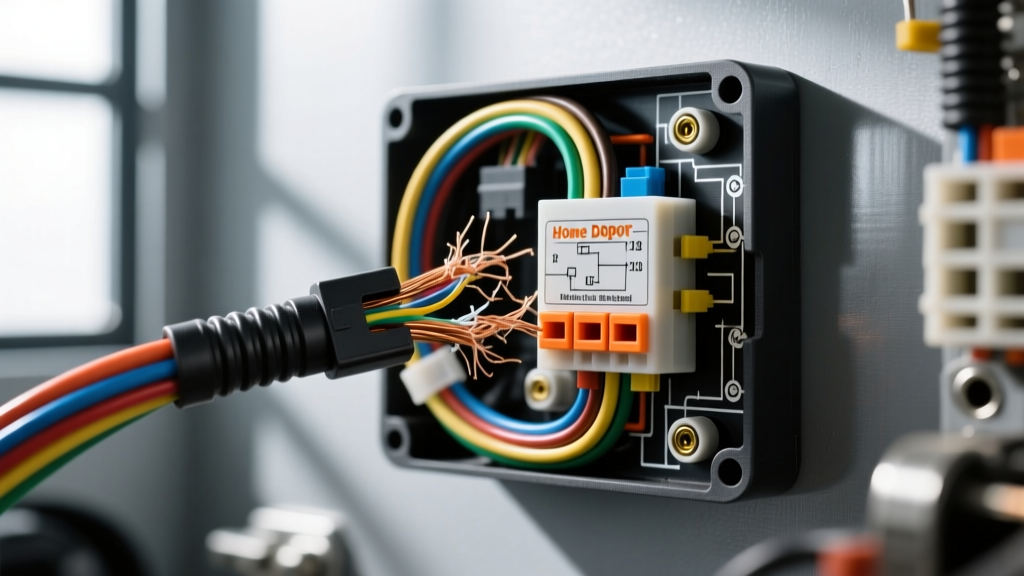
The Hidden Danger of Home Depot 12 Gauge Wire in Vehicles
When DIY enthusiasts and amateur mechanics tackle high-draw automotive electrical upgrades, a common and potentially dangerous shortcut is purchasing residential wiring from a local hardware store. Using Home Depot 12 gauge wire—typically THHN (Thermoplastic High Heat-resistant Nylon-coated) or standard Romex solid-core building wire—in a vehicle violates fundamental automotive engineering principles. While a 12 AWG copper conductor carries the same baseline ampacity (roughly 20-25 amps for chassis wiring) regardless of where it is manufactured, the physical construction, insulation chemistry, and stranding architecture of residential wire are entirely unsuited for the harsh, high-vibration, high-heat environment of an automobile.
Residential wire is designed to be pulled through stationary PVC conduit and secured to wooden studs. Automotive wire, governed by the SAE J1128 standard, must withstand continuous chassis vibration, extreme thermal cycling, and exposure to road salts, oils, and solvents. When builders use hardware store wire for fuel pumps, headlight relays, or car audio power feeds, they inevitably face intermittent failures, voltage drops, and in worst-case scenarios, electrical fires. This guide provides a step-by-step troubleshooting flow to diagnose failures caused by improper wire selection and outlines the exact remediation protocols required to restore circuit integrity.
Diagnostic Decision Tree: Troubleshooting 12 AWG Circuit Failures
If you are experiencing dimming lights, fuel pump starvation under load, or melted fuse holders, follow this diagnostic flow to determine if your wiring is the culprit.
Node 1: Visual and Tactile Inspection (The Vibration & Stranding Test)
- Step 1: Locate the 12 AWG wire in question and physically bend it back and forth near the terminal crimp.
- Step 2: Strip back a small section of the insulation to inspect the conductor.
- Decision: Is the wire a single, solid copper core? If YES, the circuit is a catastrophic failure waiting to happen. Solid core wire work-hardens and fractures under automotive vibration, leading to internal arcing inside the insulation. Action: Replace immediately.
- Decision: Is the wire stranded, but the strands are thick and few (e.g., 7-strand building wire)? If YES, it lacks the flexibility required for loom routing and vibration resistance. Action: Plan for replacement with 19-strand or 65-strand automotive GXL/TXL.
Node 2: Insulation Thermal Degradation Check
- Step 1: Trace the wire routing, paying close attention to areas near the exhaust manifold, turbocharger, or engine block.
- Step 2: Inspect the outer jacket. Hardware store THHN wire uses a PVC base with a thin nylon skin.
- Decision: Is the insulation sticky, melting, or cracked? PVC insulation begins to soften and degrade at temperatures exceeding 90°C (194°F). Engine bays routinely exceed this. If the nylon skin is scraped off from pulling through sheet metal, the underlying PVC will melt and short to the chassis. Action: Reroute and replace with Cross-Linked Polyethylene (XLPE) automotive wire, rated for 125°C to 150°C.
Node 3: Voltage Drop Testing Under Load (The True Measure of 12 AWG)
Many retail 'automotive' wire spools sold in big-box stores are actually CCA (Copper Clad Aluminum), not pure OFC (Oxygen-Free Copper). CCA has significantly higher resistance, leading to severe voltage drop on long runs.
- Set your digital multimeter (DMM) to DC Volts.
- Connect the black probe to the battery negative terminal and the red probe to the ground point of your load (e.g., fuel pump ground ring terminal).
- Turn the circuit ON to place it under full load.
- Diagnostic Threshold: A healthy ground circuit should show less than 0.10V drop. If you read >0.20V, your 12 AWG wire is either CCA, corroded, or too long for the amperage draw.
- Repeat on the positive side (Red probe to Battery Positive, Black probe to Load Positive). Acceptable drop is < 0.50V. Anything higher indicates undersized wire or high-resistance crimps.
Technical Specifications: Building Wire vs. Automotive 12 AWG
Understanding the metallurgical and chemical differences is critical for proper wire gauge selection. Below is a direct comparison between standard hardware store wire and proper automotive wire.
| Specification | Home Depot THHN 12 AWG | Automotive SAE J1128 GXL 12 AWG |
|---|---|---|
| Conductor Stranding | Solid or 7-Strand (Coarse) | 19 to 65+ Strands (Fine/Flexible) |
| Insulation Material | PVC with Nylon Jacket | Cross-Linked Polyethylene (XLPE) |
| Max Temperature | 90°C (Dry Location Only) | 125°C (Continuous) / 150°C (Spike) |
| Chemical Resistance | Poor (Degrades with oil/gas) | Excellent (Resists solvents, oils, acids) |
| Outer Diameter (OD) | Thicker (Harder to route through grommets) | Thinner (High-density cross-linking) |
| Vibration Tolerance | Fails (Work-hardening and snapping) | Passes (Flexes without fatigue) |
Common 12 AWG Automotive Applications and Failure Points
When troubleshooting, it helps to know where 12 AWG wire is typically mandated and how hardware store wire fails in these specific circuits.
Fuel Pump Upgrades (e.g., Walbro 450 / AEM 340)
High-flow fuel pumps draw 15 to 25 amps under peak load. The feed wire from Relay Pin 87 to the fuel pump sender must be 12 AWG pure copper. Failure Mode: If a builder uses solid-core Romex or THHN wire routed along the frame rail, chassis flex and road vibration will cause the solid copper to snap internally. The vehicle will crank but not start, or the fuel pump will intermittently cut out under heavy throttle, causing dangerous lean conditions. Always use SAE GXL stranded wire and seal the connections at the tank with adhesive-lined marine heat shrink to prevent capillary action from drawing fuel vapors into the wire strands.
Headlight Relay Harnesses (H4 / H7 Bulbs)
Upgrading to high-wattage halogens or running multiple HID ballasts requires dedicated 12 AWG power feeds directly from the battery to a relay block. Failure Mode: Hardware store wire insulation is highly susceptible to UV degradation and under-hood heat. The PVC jacket will become brittle, crack, and expose the copper to moisture. Furthermore, if the builder used CCA wire disguised as 12 AWG, the higher resistance (CCA requires a larger gauge to match copper ampacity) will result in a 1.5V to 2.0V drop, leaving your headlights dim and triggering 'bulb out' warnings on CANBUS-equipped vehicles.
Step-by-Step Remediation Protocol
If your troubleshooting flow confirms that residential or CCA wire was used, follow these steps to properly remediate the circuit.
- Remove the Offending Wire: Do not attempt to splice automotive wire onto existing THHN wire. The dissimilar insulation types and stranding architectures will create a weak point. Pull the entire run.
- Select Proper SAE Wire: Purchase true 12 AWG GXL or TXL wire. For high-heat areas (near turbos or exhaust), upgrade to fiberglass-braided SAE J1128 wire or use high-temp conduit.
- Use Open-Barrel Terminals: Abandon solder and closed-barrel crimps for automotive relay and component connections. Use open-barrel (F-style) terminals crimped with a proper ratcheting crimp tool. This creates a gas-tight, cold-weld connection that outlasts the vehicle.
- Seal the Environment: Use dual-wall, adhesive-lined heat shrink (3M or equivalent) over all crimps. The inner meltable adhesive seals out moisture and prevents the green corrosion (copper oxide) that plagues poorly sealed circuits.
- Verify Relay Pinouts: Ensure your 12 AWG wire is connected to the correct relay pins. Pin 30 (Battery +), Pin 87 (Load +). Pins 85 and 86 are the low-current coil circuit and only require 16 or 18 AWG wire.
Authoritative References
- SAE International - J1128: Low Tension Primary Cable (Defines the strict requirements for automotive wire insulation and stranding).
- NFPA 70: National Electrical Code (NEC) (Reference for understanding the limitations and intended use cases of THHN/THWN building wire).
- Auto Circuit Pro - Wire Sizing and Voltage Drop Guidelines (Practical application data for automotive current loads).