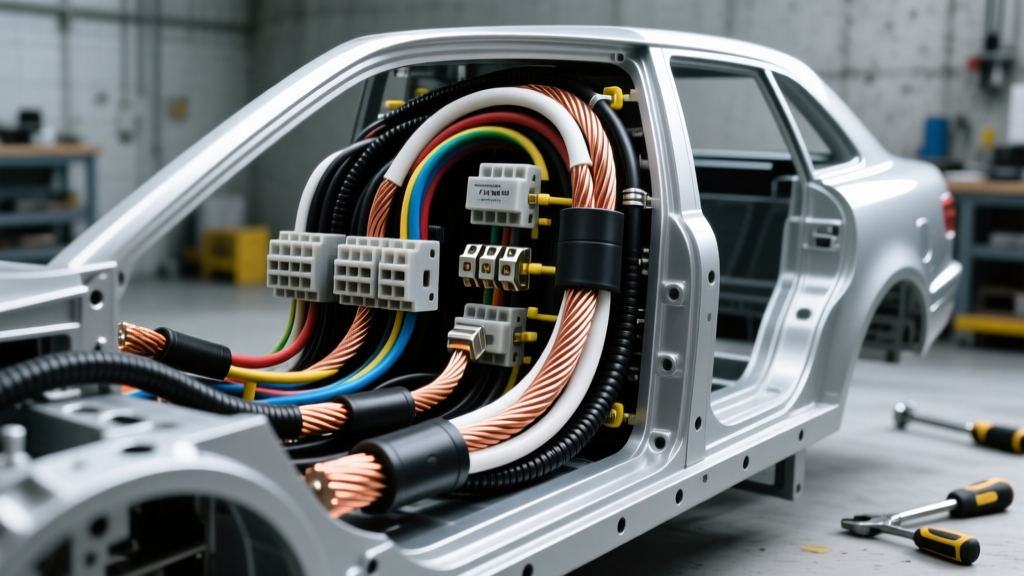
What is THHN 4 Gauge Wire? (The Beginner's Breakdown)
When beginners tackle high-current 12V or 24V automotive projects—such as EV conversions, off-road winch setups, or competition car audio—they inevitably find themselves in the electrical aisle of a local hardware store. Staring at the spools, a common question arises: Can I use THHN 4 gauge wire in my vehicle? It is cheap, readily available, and comes in easy-to-identify color codes. But before you route building wire through your chassis, you must understand the fundamental differences between National Electrical Code (NEC) building wire and Society of Automotive Engineers (SAE) vehicle wire.
THHN stands for Thermoplastic High Heat-resistant Nylon-coated. It is primarily designed for static, indoor, or conduit-protected commercial building wiring. The "Thermoplastic" refers to the PVC insulation, the "High Heat" denotes a 90°C rating in dry locations (75°C in wet), and the "Nylon" outer jacket provides excellent resistance to abrasion, oil, and gasoline. In terms of physical size, 4 AWG (American Wire Gauge) THHN features a bare copper diameter of roughly 0.2043 inches and a cross-sectional area of 41,740 circular mils. According to Southwire THHN Specifications, standard 4 AWG THHN is typically constructed using 19 coarse copper strands.
THHN vs. SAE Automotive Wire: The Critical Stranding Dilemma
To understand why THHN is controversial in automotive circles, we have to talk about vibration and stranding. Building wire is pulled through rigid PVC or metal conduit and sits completely static for decades. Vehicles, however, are dynamic environments subjected to constant chassis vibration, engine harmonics, and thermal cycling.
Standard 4 AWG THHN uses 19 relatively thick copper strands. When subjected to the constant vibration of a vehicle chassis or engine bay, these thick strands experience "work-hardening." Over time, the copper becomes brittle, micro-fractures develop inside the nylon jacket, and the wire's resistance increases, eventually leading to a catastrophic internal break or short circuit.
Conversely, true automotive battery cable (governed by the SAE J1128 Battery Cable Standard) or high-quality welding cable utilizes hundreds of ultra-fine copper strands (often 210 to 600+ strands for 4 AWG). This fine stranding allows the wire to flex, absorb vibration, and dissipate heat more effectively without work-hardening. For beginners building a custom harness, this is the most vital takeaway: THHN is acceptable for static, bench-top testing or rigidly mounted battery banks, but SAE SGT or fine-strand welding cable is mandatory for routing along a moving vehicle chassis.
THHN 4 Gauge Wire Specification Chart
Below is the fundamental specification reference for standard 19-strand 4 AWG THHN copper wire. Keep in mind that automotive environments require severe derating of maximum ampacity due to under-hood heat and wire bundling.
| Specification | Measurement / Rating | Notes for Automotive Use |
|---|---|---|
| AWG Size | 4 AWG | Handles heavy loads (starters, inverters, EV phases) |
| Stranding | 19 Strands (Coarse) | Prone to fatigue under constant chassis vibration |
| Bare Copper Diameter | 0.2043 inches | Requires heavy-duty closed-barrel ring terminals |
| Nominal O.D. (with insulation) | 0.330 inches | Thick nylon jacket resists under-hood fluid spills |
| Resistance @ 20°C | 0.2485 Ω / 1,000 ft | Standard copper conductivity |
| Max Ampacity (NEC 90°C Dry) | 95 Amps | Building code rating; do not use for automotive continuous limits |
| Automotive Continuous Limit | ~60 - 70 Amps | Derated for engine bay heat and SAE safety margins |
Ampacity and Voltage Drop: The 12V Reality Check
Beginners often confuse ampacity (how much current the wire can carry before melting) with voltage drop (how much voltage is lost over the length of the wire). In a 12V automotive system, voltage drop is almost always your primary limiting factor, not the melting point of the THHN insulation.
According to the Painless Performance 12V Wiring Manual, a 12V EFI (Electronic Fuel Injection) system or modern ECU can malfunction or reset if it receives less than 11.5V under load. Let us calculate the voltage drop for a 4 AWG THHN wire powering a 60-Amp continuous load (like a high-output cooling fan or a small DC-DC inverter) over a 10-foot total circuit length (5 feet positive, 5 feet negative).
- Formula: Voltage Drop = (2 x Length x Current x Resistance per ft)
- Calculation: 2 x 10 ft x 60A x 0.0002485 Ω/ft
- Result: 0.29 Volts of drop.
A 0.29V drop is perfectly acceptable for a 12V system (leaving 11.71V at the load). However, if you attempt to use that same 4 AWG THHN wire for a 400-Amp starter motor surge over 15 feet, the voltage drop spikes to nearly 1.5 Volts. Your starter will receive only 10.5V, resulting in slow cranking and excessive heat generation within the wire itself. For high-surge, short-duration automotive loads, 4 AWG is the bare minimum, and upgrading to 2 AWG or 1/0 AWG SAE battery cable is highly recommended.
Termination and Crimping Best Practices for 4 AWG
Terminating 4 AWG THHN requires specific tools and techniques to ensure a reliable, moisture-proof connection. Because THHN features a slippery nylon outer jacket and stiff 19-strand core, standard split-bolt connectors or cheap plier-style crimpers will fail.
Step-by-Step Termination Guide:
- Strip the Insulation: Use a dedicated 4 AWG wire stripper. Do not use a utility knife, as nicking the thick 19-strand copper cores will create a weak point that will snap under vibration.
- Select the Right Lug: Use copper, closed-barrel ring terminals sized specifically for 4 AWG and your stud size (usually 5/16" or 3/8" for automotive mega-fuses and busbars).
- The Crimp: Use a heavy-duty ratcheting hex-crimper or a hydraulic crimping tool. A hex crimp compresses the copper strands into a solid, unified mass, eliminating air pockets where corrosion can hide.
- Seal the Connection: Slide a piece of adhesive-lined, dual-wall polyolefin heat shrink over the wire before crimping. Once crimped, apply heat until the inner adhesive melts and oozes out the ends. This creates a watertight seal, preventing the "green crust" of copper oxidation from wicking up inside the THHN nylon jacket.
Expert Troubleshooting: Overheating and Nylon Degradation
If you are retrofitting a vehicle and using THHN 4 gauge wire inside a sealed battery box or EV motor controller enclosure, monitor the connections for the first 50 hours of operation. The most common failure mode for beginners is terminal creep. Because the 19-strand THHN core is stiff, it exerts mechanical leverage on the crimp barrel when the wire is bent to fit into tight spaces. This leverage can slowly pull the wire out of the crimp over time, increasing resistance and causing the terminal to melt.
The Fix: Always leave a "service loop" (a gentle, sweeping curve of extra wire) near your termination points. Never pull THHN wire taut like a guitar string. If the wire must make a sharp 90-degree turn immediately after a busbar, use a 90-degree offset ring terminal rather than forcefully bending the stiff 4 AWG wire against the terminal neck.
Summary: When to Use THHN 4 AWG in Your Build
THHN 4 gauge wire is an incredible, cost-effective conductor for static applications. It is perfectly suited for bench-testing high-current relays, wiring up off-grid solar battery banks mounted in rigid, vibration-dampened enclosures, or serving as phase wires inside sealed EV motor housings. However, for routing through a vehicle's firewall, along the chassis frame, or anywhere near engine-mounted accessories, spend the extra money on SAE J1128 compliant fine-strand automotive wire. Understanding the physical limitations of your wire's stranding and insulation is the hallmark of a true automotive electrical expert.