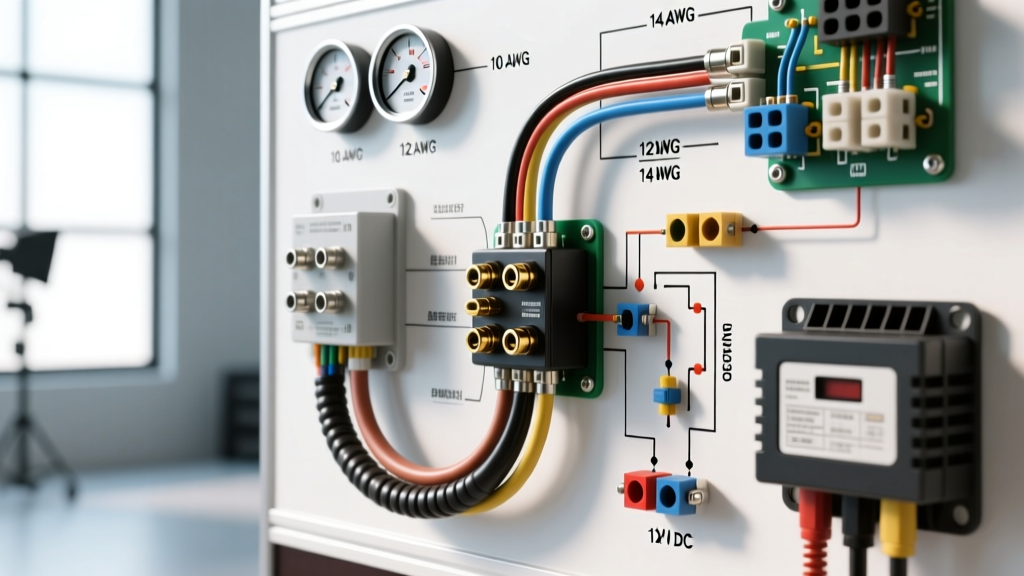
Determining Power Architecture: 12V DC vs. 120V AC Inverter
When mobile technicians, marine outfitters, and van-lifers ask what gauge wire for a dishwasher, the answer requires a fundamental shift from residential electrical codes to mobile power dynamics. In automotive, RV, and marine environments, dishwashers generally fall into two categories: native 12V DC drawer units (like the Vesta or Fisher & Paykel marine series) and standard 120V AC residential units powered through a pure sine wave inverter. The wiring methodology, AWG selection, and troubleshooting flows for these two systems are vastly different.
Unlike static home environments governed strictly by the NEC, mobile platforms must adhere to SAE and ABYC standards, accounting for severe voltage drop over long cable runs, high-vibration environments, and ambient temperature derating. This step-by-step troubleshooting and sizing guide will walk you through calculating loads, selecting the correct GXL or THHN wire gauges, and diagnosing the most common power-delivery failures in mobile dishwasher installations.
Phase 1: Calculate Load, Inrush, and Continuous Ampacity
The first step in any automotive or RV electrical troubleshooting flow is identifying the exact amperage draw and surge requirements. Dishwashers are highly inductive and resistive loads; the circulation pumps create inductive inrush currents, while the heating elements draw massive continuous resistive amperage.
| Dishwasher Type | Voltage | Running Amps | Surge / Inrush | Min AWG (<10ft Run) | Min AWG (>15ft Run) |
|---|---|---|---|---|---|
| 12V DC Marine/RV Drawer | 12V DC | 12A - 18A | 25A (Pump Start) | 10 AWG GXL | 8 AWG GXL |
| 120V AC Compact (Inverter) | 120V AC | 10A - 12A | 18A (Motor Start) | 14 AWG THHN | 12 AWG THHN |
| 120V AC Standard (Inverter) | 120V AC | 15A (Heating) | 22A (Surge) | 12 AWG THHN | 10 AWG THHN |
Note: For 12V DC systems, always use SAE J1128 compliant cross-linked wire (GXL or SXL) for superior heat and abrasion resistance. Reference the SAE J1128 Standard for exact insulation thickness and temperature ratings up to 125°C.
Phase 2: Voltage Drop Troubleshooting & AWG Selection
The most frequent cause of a mobile dishwasher failing to heat or prematurely terminating a cycle is undervoltage at the appliance terminal. A 12V DC dishwasher heating element requires a minimum of 11.5V to engage the internal thermal cutoff and control board relays. If your wire gauge is too thin, the resistance will cause a voltage drop, starving the unit of power.
The Voltage Drop Formula
To verify your AWG selection, apply the standard DC voltage drop formula:
VD = (2 x L x I x R) / 1000
- VD: Voltage Drop
- L: One-way length of the wire in feet
- I: Current in Amps (Use the maximum heating draw, e.g., 18A)
- R: Resistance per 1,000 feet of the chosen AWG wire (e.g., 10 AWG = 1.018 ohms)
Troubleshooting Scenario: You are wiring a 12V DC dishwasher drawing 18A, located 20 feet from the DC distribution busbar. Using 12 AWG wire (Resistance = 1.588 ohms/1000ft), the voltage drop calculates to 1.14V. Subtracting this from a fully charged 12.8V LiFePO4 battery leaves only 11.66V at the appliance. While this may barely pass, any slight battery sag under load will drop the voltage below the 11.5V threshold, triggering a fault code. Fix: Upsize to 8 AWG wire to reduce the drop to 0.71V, ensuring stable operation.
Phase 3: The Inverter DC Feed (The Hidden Bottleneck)
If you are running a 120V AC residential dishwasher off an inverter, the AC wire gauge (typically 12 AWG or 14 AWG THHN) is only half the equation. The most critical troubleshooting point for inverter-fed appliances is the DC battery-to-inverter cable.
A 1500W dishwasher heating element pulling 12.5A at 120V AC requires roughly 1500W from the 12V DC battery bank. Factoring in inverter efficiency losses (typically 85-90%), the DC draw spikes to over 140 Amps. If your inverter is wired with 2 AWG wire instead of the required 2/0 AWG or 4/0 AWG, the inverter's low-voltage cutoff (LVC) will trip instantly when the dishwasher's heating cycle begins.
- Up to 1000W Inverters: 2 AWG or 1/0 AWG pure copper battery cables.
- 2000W - 3000W Inverters: 2/0 AWG or 4/0 AWG pure copper battery cables.
- Fusing: Install a Class T fuse within 18 inches of the battery positive terminal, rated slightly above the inverter's maximum continuous DC draw (e.g., 250A for a 3000W inverter).
For comprehensive marine and RV AC/DC integration standards, consult the ABYC E-11 guidelines and NFPA 70 NEC Article 551 for recreational vehicle routing requirements.
Phase 4: Step-by-Step Wiring & Termination Flow
Proper termination prevents high-resistance connections, which generate heat and mimic voltage drop symptoms. Follow this sequence for mobile dishwasher wiring:
- Select Wire Type: Use tinned, stranded marine-grade wire (THHN for AC conduit, GXL/SXL for 12V DC chassis routing). Tinning prevents galvanic corrosion in humid environments.
- Color Coding: Follow SAE/ABYC standards. For 12V DC, use Red (or Yellow with Red stripe) for positive, and Black (or Yellow with Black stripe) for negative. For 120V AC, use Black (Hot), White (Neutral), and Green (Ground).
- Crimp and Seal: Strip the wire using a precision gauge stripper. Use adhesive-lined marine heat-shrink ring terminals. The adhesive lining melts during heating, creating a waterproof seal that prevents capillary corrosion.
- Torque Specifications: When securing ring terminals to the appliance terminal block or DC busbar, use a calibrated torque screwdriver. For standard M5/M6 terminal screws, torque to 2.5 - 3.5 Nm (22 - 31 in-lbs). Overtightening will snap the screw; undertightening causes arcing.
- Strain Relief: Secure the wiring harness within 6 inches of the dishwasher connection using rubber-cushioned Adel clamps to prevent vibration-induced wire fatigue and insulation chafing against the chassis.
Phase 5: Troubleshooting Decision Tree
When a mobile dishwasher installation fails, use this symptom-cause-fix decision tree to isolate the electrical fault.
Symptom 1: Dishwasher Powers On, Fills with Water, but Fails to Heat
- Step 1: Measure voltage at the appliance terminal block during the expected heat cycle using a digital multimeter.
- Step 2: If voltage reads below 11.5V (for 12V systems) or below 105V (for 120V systems), you have a voltage drop issue.
- Step 3: Check all intermediate connections (busbars, breakers, fuses) for heat. A hot breaker indicates a loose terminal or undersized wire gauge.
- Fix: Upsize the branch circuit wire by two AWG sizes and re-crimp all terminals with adhesive heat shrink.
Symptom 2: Inverter Shuts Down / Trips LVC When Dishwasher Starts
- Step 1: Verify the inverter's continuous and surge wattage ratings. A standard dishwasher requires a minimum 2000W pure sine wave inverter to handle the pump motor inrush and heating element simultaneously.
- Step 2: Measure DC voltage directly at the inverter's input terminals (not the battery) while the dishwasher is running.
- Step 3: If the DC voltage at the inverter drops below 10.5V while the battery bank remains above 12.5V, the DC battery cables are undersized or corroded.
- Fix: Upgrade the inverter-to-battery cables to 2/0 AWG or 4/0 AWG flexible welding cable, and ensure the Class T fuse and ANL lugs are properly torqued.
Symptom 3: GFCI or Branch Breaker Trips Immediately
- Step 1: Inspect the wiring routing. In mobile platforms, AC and DC wires must be routed separately. Running 120V AC THHN wire parallel to 12V DC GXL wire without separation can induce electromagnetic interference (EMI), causing sensitive GFCI modules to nuisance-trip.
- Step 2: Check for pinch points where the wiring harness passes through the floor or cabinetry. A compromised neutral wire touching the chassis ground will instantly trip the breaker.
- Fix: Reroute AC and DC harnesses with a minimum 4-inch separation, or use shielded conduit. Replace any wire with compromised insulation and apply grommets to all sheet-metal pass-throughs.
Summary Reference Chart
Keep this quick-reference chart in your service manual for mobile dishwasher electrical diagnostics:
| Component | 12V DC Native System | 120V AC Inverter System |
|---|---|---|
| Branch Wire Gauge | 10 AWG or 8 AWG (GXL/SXL) | 12 AWG or 10 AWG (THHN) |
| Overcurrent Protection | 20A or 25A ATO/ATC Blade Fuse | 15A or 20A AC Circuit Breaker |
| Max Allowable Voltage Drop | 3% (approx. 0.36V on a 12V system) | 5% (approx. 6V on a 120V system) |
| Inverter DC Cable (If Applicable) | N/A | 2/0 AWG or 4/0 AWG Pure Copper |
By treating the dishwasher not just as an appliance, but as a high-draw node in a complex mobile electrical network, you ensure reliable operation, prevent fire hazards, and eliminate the frustrating voltage-drop faults that plague amateur RV and marine builds.