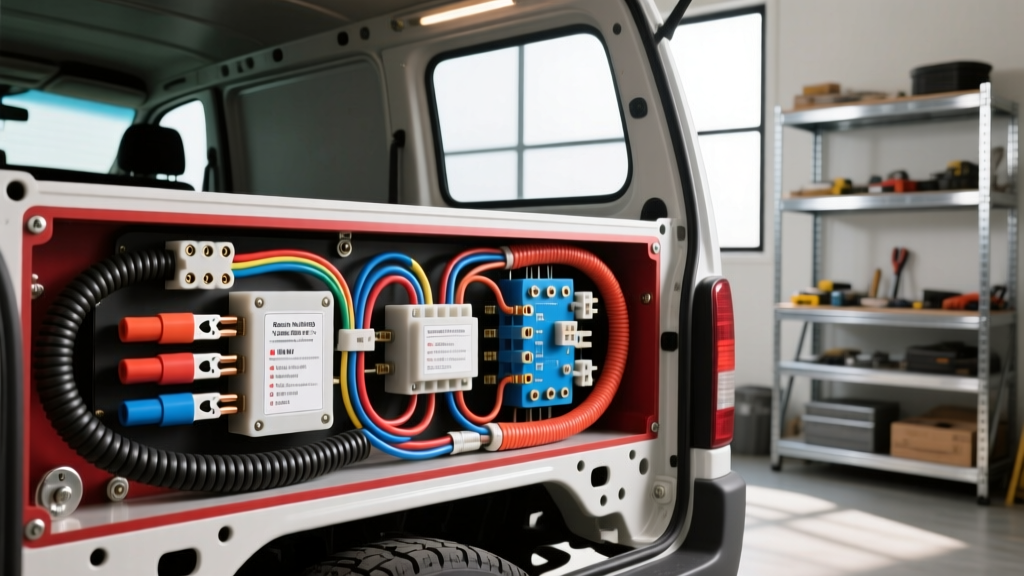
The Great Debate: House Wire Gauge vs. Automotive Wire in Vehicle Mods
When tackling a camper van conversion, overlanding rig build, or RV electrical upgrade, many DIYers make a critical trip to the local hardware store. Staring at the spools of solid-core NM-B (Romex), they often assume that standard house wire gauge sizing and ampacity charts apply directly to their 12V DC chassis and auxiliary battery systems. This is a dangerous misconception that leads to melted insulation, severe voltage drop, and potentially catastrophic electrical fires.
Residential alternating current (AC) systems operate under entirely different physical and environmental constraints than direct current (DC) automotive systems. While the American Wire Gauge (AWG) measurement of the copper cross-section remains mathematically consistent, the insulation type, stranding, and ampacity derating factors for a moving vehicle require a completely different approach. In this guide, we break down why relying on a residential house wire gauge chart will compromise your vehicle modification project and how to properly size automotive GXL/TXL wire for high-current DC upgrades.
Why Residential NM-B (Romex) Fails in Automotive Applications
Before pulling wire through your vehicle's chassis, you must understand the mechanical and thermal differences between house wire and automotive wire. The National Electrical Code (NEC) governs residential wiring, prioritizing cost-effectiveness for static, climate-controlled environments. Automotive wiring is governed by standards like SAE J1128, which demands extreme resilience.
1. Vibration and Work-Hardening
House wire (NM-B) typically uses solid-core copper or very coarse, low-strand-count copper. When subjected to the constant, high-frequency vibration of a diesel or gasoline engine and chassis flex on off-road terrain, solid-core copper rapidly work-hardens, becomes brittle, and snaps. This creates high-resistance arcing points inside the wall cavity of your van. Automotive wire (GXL, TXL, or SXL) utilizes fine-stranded copper (often Class K stranding), allowing the wire to flex continuously for decades without internal fracturing.
2. Insulation Melting Points and Abrasion
Standard house wire uses PVC insulation rated for 90°C in dry locations. Under the hood of a vehicle, or routed near a high-output alternator and exhaust components, ambient temperatures easily exceed this threshold, causing the PVC to melt and short against the chassis. Automotive GXL (Cross-Linked Polyethylene) insulation is rated for continuous operation at 125°C and features a thin, incredibly tough outer jacket that resists chafing against sheet metal and frame rails.
3. The DC Voltage Drop Penalty
A 120V AC house circuit can tolerate a 3% to 5% voltage drop with minimal impact on appliance performance. A 12V DC automotive system is hyper-sensitive. A drop of just 1.2V (10%) on a 12V circuit will cause LED lights to flicker, water pumps to stall, and inverters to trigger low-voltage disconnects. Therefore, automotive wire runs often require a significantly thicker AWG than a house wire gauge chart would suggest for the same amperage.
Ampacity Showdown: House Wire Gauge Chart vs. Automotive GXL
The following table compares the maximum ampacity of standard residential copper wire against automotive GXL wire in a high-temperature engine bay or enclosed van chassis. Notice how automotive ampacity is heavily dependent on the wire's ability to dissipate heat in bundled harnesses.
| AWG Size | House Wire (NM-B) Max Amps (AC) | Auto Wire (GXL) Max Amps (DC)* | Voltage Drop at 10ft (12V DC @ 15A) | Typical Vehicle Application |
|---|---|---|---|---|
| 14 AWG | 15A | 15A | 0.77V (6.4%) | Interior LED lighting, 12V USB outlets |
| 12 AWG | 20A | 20A | 0.48V (4.0%) | 12V water pumps, roof vent fans |
| 10 AWG | 30A | 30A | 0.30V (2.5%) | DC fuse block main feed, 12V fridge |
| 8 AWG | 40A | 45A | N/A (Higher Load) | Solar charge controller to battery |
| 6 AWG | 55A | 60A | N/A (Higher Load) | DC-DC Charger input, winch control |
| 4 AWG | 70A | 80A | N/A (Higher Load) | Alternator to auxiliary battery bank |
| 2 AWG | 95A | 100A | N/A (Higher Load) | High-output alternator upgrades |
| 1/0 AWG | 125A | 150A | N/A (Higher Load) | 2000W+ Inverter battery cables |
*Automotive ampacity ratings based on single wire in free air at 125°C ambient. Bundled wires require severe derating. Always consult the Blue Sea Systems Wire Sizing Guide for precise DC circuit calculations.
Real-World Upgrade Project: Sizing a Van Build DC Distribution Block
Let's apply this to a common modification: installing a Blue Sea Systems ST Blade fuse block and routing power from a 200Ah Lithium Iron Phosphate (LiFePO4) auxiliary battery bank. Many beginners look at a house wire gauge chart, see that their total DC load is 40 Amps, and attempt to use 8 AWG wire because "it handles 40 amps in a house." Here is how an automotive electrical expert actually sizes the run.
Step 1: Calculating Continuous DC Loads and Future-Proofing
First, tally the maximum continuous draw. A 12V compressor fridge (5A), a diesel heater (8A), roof fans (3A), and water pump (7A) equal 23A. However, inductive loads like compressors and pumps have massive startup surge currents. Furthermore, you must add a 20% safety buffer for future modifications (like adding a 12V espresso machine or Starlink router).
Target Continuous Ampacity: 45 Amps minimum.
Step 2: Factoring in Distance and Voltage Drop
The battery bank is located in the rear wheel well, and the fuse block is behind the driver's B-pillar. The one-way distance is 12 feet (24 feet round-trip). Using standard 8 AWG automotive wire for a 45A load over 24 feet will result in a voltage drop of roughly 0.85V. While this keeps you above the 11.5V inverter cutoff, it generates excess heat in the wire.
The Expert Choice: Upgrade the main feed to 6 AWG GXL stranded wire. This drops the voltage loss to an acceptable 0.53V and ensures the wire remains cool to the touch even during peak summer ambient temperatures inside the van walls.
Step 3: Selecting the Correct Automotive Color Codes
Do not use house wire colors in a vehicle. In residential AC wiring, Black is Hot, White is Neutral, and Bare/Green is Ground. In 12V DC automotive systems:
- Red: Constant +12V DC (Battery Positive)
- Black: DC Ground (Chassis or Battery Negative)
- Yellow/Blue: Switched or accessory circuits
Termination and Connector Specs for High-Vibration Environments
The weakest point in any automotive electrical upgrade is the termination. House wire is typically secured with wire nuts or push-in Wago connectors. These are strictly forbidden in mobile applications. Vibration will loosen wire nuts within miles, leading to arcing and fires.
Adhesive-Lined Heat Shrink Terminals
For ring terminals spade connectors, you must use closed-barrel copper lugs sealed with dual-wall, adhesive-lined polyolefin heat shrink (such as 3M EPS400 or Ancor marine-grade). When heated, the inner meltable adhesive flows into the wire strands, creating a watertight seal that prevents oxygen and moisture from causing green copper corrosion (verdigris), which drastically increases electrical resistance over time.
High-Current Quick Disconnects
For modular upgrades like removable solar suitcases or external power inlets, abandon residential twist-lock plugs. Utilize Anderson Powerpole connectors (rated up to 120A for the 2/0 AWG housing) or Deutsch DT series connectors for sensor and low-amperage accessory wiring. These feature stainless steel retention springs that maintain positive contact pressure regardless of chassis vibration.
Expert Troubleshooting: Spotting Failing "House Wire" Mods
If you are buying a used camper van or RV, or troubleshooting a rig built by an amateur, look for these red flags that indicate dangerous house wire gauge implementations:
- Stiff, Unyielding Wire Runs: If the wire routing from the battery to the inverter feels rigid and holds its shape like a coat hanger, it is likely solid-core or coarse-strand house wire. It must be replaced with fine-strand welding cable or GXL immediately.
- Discolored PVC Insulation: Brown or yellowish tinting on white or black PVC wire near the engine bay or inverters indicates the insulation has been baked beyond its 90°C thermal limit.
- Wire Nuts in Junction Boxes: Any use of twist-on wire connectors in a mobile environment is an immediate failure point. Cut them out and replace them with adhesive-lined heat shrink butt splices or terminal block distribution bars.
- Undersized Inverter Cables: A 2000W inverter pulls roughly 166 Amps at 12V. If the installer used 2 AWG wire (which maxes out around 100A-120A in bundled DC applications) based on a flawed house wire gauge chart, the cables will become dangerously hot under load. This requires an immediate upgrade to 1/0 AWG or 2/0 AWG flexible welding cable.
By respecting the extreme demands of the automotive environment and abandoning residential electrical shortcuts, your upgrade project will deliver safe, reliable power for miles of off-grid exploration.