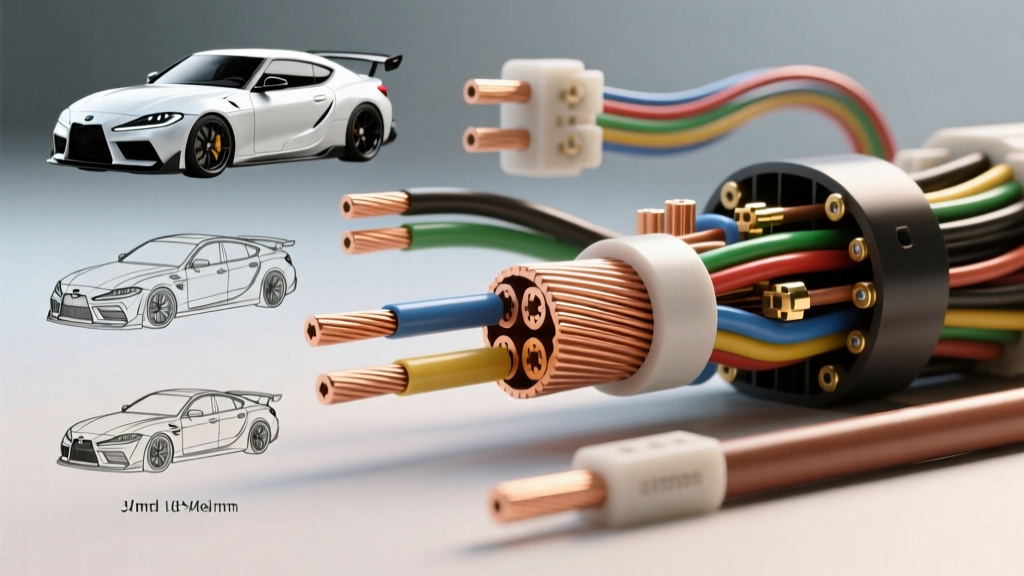
Introduction: The AWG vs. Metric Dilemma in Modern Garages
As the global automotive landscape continues to blend, technicians and fabricators frequently encounter a critical crossroads: merging domestic American Wire Gauge (AWG) standards with imported metric wiring systems. Whether you are performing a JDM engine swap, repairing a modern European CAN-bus network, or building a custom harness from scratch, understanding how to properly specify wire gauge in millimeters is no longer optional. Misinterpreting metric cross-sectional area (mm²) as physical diameter (mm), or attempting to force thick-walled AWG wire into metric connector cavities, leads to voltage drop, terminal rejection, and catastrophic electrical failures.
This guide serves as a comprehensive product comparison and selection reference, contrasting standard North American SAE wiring with European and JDM metric alternatives. We will break down insulation types, strand counts, and real-world application data to ensure your next harness build meets OEM-level reliability.
Understanding Wire Gauge in Millimeters: Diameter vs. Cross-Section
The most common pitfall for builders transitioning to metric wire is confusing the conductor diameter with the cross-sectional area. In the AWG system, a lower number indicates a thicker wire (e.g., 10 AWG is thicker than 18 AWG). In the metric system, wire is sized by its cross-sectional area in square millimeters (mm²).
When sourcing wire gauge in millimeters, a '1.5 mm' wire does not mean the wire is 1.5 millimeters in diameter; it means the copper cross-section equals 1.5 square millimeters. According to Waytek Wire Technical Resources, confusing a 1.5mm outer diameter (OD) wire with a 1.5mm² cross-section wire will result in using a conductor that is nearly 40% smaller than required, leading to severe voltage drop and potential thermal runaway in high-amperage circuits like fuel pumps or cooling fans.
Product Comparison: TXL/GXL (AWG) vs. FLRY (Metric) Wire Types
Selecting the correct wire product requires understanding the insulation standards dictated by regional automotive engineering bodies.
1. SAE J1128 TXL and GXL (Standard AWG)
TXL (Thin-wall) and GXL (General cross-linked) are the gold standards for North American automotive wiring, governed by the SAE J1128 Standard. These wires feature cross-linked polyethylene (XLPE) insulation, offering exceptional resistance to high temperatures (up to 125°C), solvents, and abrasion. However, the insulation is relatively thick compared to metric equivalents, and the copper stranding is optimized for standard AWG terminal crimps.
2. ISO 6722 FLRY-A and FLRY-B (Metric European/JDM Standard)
FLRY wire is the metric equivalent used heavily in European (BMW, Audi, Porsche) and JDM (Toyota, Honda, Nissan) harnesses. FLRY features a thin-walled PVC insulation.
- FLRY-A: Features a standard stranded copper core. It is stiffer and highly resistant to vibration-induced fatigue.
- FLRY-B: Features a fine-stranded, highly flexible copper core. This is the preferred choice for custom engine harnesses where wires must bend tightly around intake manifolds and tight firewall grommets.
Conversion Chart: AWG to Wire Gauge in Millimeters
Use the following reference chart to match AWG sizes to their metric cross-sectional equivalents. Note that ampacity ratings are based on single conductors in free air at 40°C ambient, per Aptiv Vehicle Electrical Architecture guidelines.
| AWG Size | Metric Area (mm²) | FLRY-B Strand Count | Nominal OD (mm) | Max Ampacity (Chassis) |
|---|---|---|---|---|
| 20 AWG | 0.50 mm² | 16 | 1.45 mm | 5 Amps |
| 18 AWG | 0.75 mm² | 24 | 1.65 mm | 9 Amps |
| 16 AWG | 1.00 mm² | 32 | 1.90 mm | 13 Amps |
| 14 AWG | 2.00 mm² | 64 | 2.35 mm | 18 Amps |
| 12 AWG | 3.00 mm² | 96 | 2.80 mm | 25 Amps |
| 10 AWG | 5.00 mm² | 160 | 3.40 mm | 35 Amps |
Real-World Application: Rewiring a JDM Honda K-Series Harness
To illustrate the importance of precise wire selection, let us examine a custom harness build for a JDM Honda K-Series (PRB ECU) engine swap. Using the correct wire gauge in millimeters ensures compatibility with the OEM JST and TE AMP Superseal connectors.
Sensor and Injector Pinouts & Wire Sizing
- Fuel Injectors (Pins A1, A2, A3, A4): Require 0.75 mm² (18 AWG) FLRY-B wire. OEM color code is typically Blue/Red or Yellow/Green. These circuits carry pulsed 12V loads; the 24-strand FLRY-B wire ensures flexibility near the hot fuel rail.
- Throttle Position Sensor (TPS) & MAP Sensors (Pins A11, A12, A14): Require 0.50 mm² (20 AWG) FLRY-B. OEM colors include Solid Green (Signal), Yellow/Blue (5V Reference), and Black/White (Sensor Ground). Using 0.75 mm² wire here will cause the wires to bind in the 0.64mm micro-terminal connector cavities, leading to pin push-out.
- Main Power and Ground (Pins A4, A5, D16): Require 2.00 mm² (14 AWG) or 3.00 mm² (12 AWG) wire. OEM colors are Yellow/Black (12V+) and Black/White (Chassis Ground).
Common Failure Modes When Mixing Metric and AWG
When builders ignore the physical differences between metric and AWG wire products, several distinct failure modes emerge:
- Insulation Crush and Terminal Rejection: TE AMP Superseal 1.5mm connectors are designed for the thin PVC insulation of FLRY wire. If you attempt to use 18 AWG TXL (which has thick XLPE insulation) in a 0.75mm² Superseal cavity, the terminal crimp will bite into the insulation rather than the copper wire. This creates a high-resistance joint that will melt under load.
- Wire Seal Blowout: Metric connector silicone weather seals are sized to the exact OD of FLRY wire. Standard AWG wire is physically thicker. Forcing 14 AWG TXL through a 2.00mm² metric weather seal will slice the silicone, destroying the IP67 waterproof rating and allowing capillary action to draw water directly into the ECU.
- Strand Shearing: FLRY-B wire features ultra-fine copper strands. Using a standard AWG ratchet crimper (designed for thicker AWG strands) on FLRY-B wire often results in the tool shearing the fine copper strands, reducing the effective cross-sectional area and creating a localized hot spot.
Expert Sourcing and Crimping Guidelines
To achieve a factory-quality harness when working with wire gauge in millimeters, you must align your tooling with your wire selection. For metric FLRY wire terminating into JST or TE micro-terminals, abandon standard hardware store crimpers. Invest in a ratcheting crimper with interchangeable dies specifically profiled for metric wire, such as the TE Connectivity CERTI-CRIMP or the Titan TCT-21 micro-terminal tool. These tools feature an 'F' or 'B' crimp profile that perfectly folds the terminal wings around the fine strands of FLRY-B wire without cutting them, ensuring a minimum pull-out force of 15 lbs for 0.50mm² wire and 30 lbs for 1.00mm² wire.
By respecting the nuances of metric cross-sectional area, insulation thickness, and strand flexibility, you ensure that your custom automotive wiring is not only electrically sound but mechanically bulletproof against the harsh underhood environment.