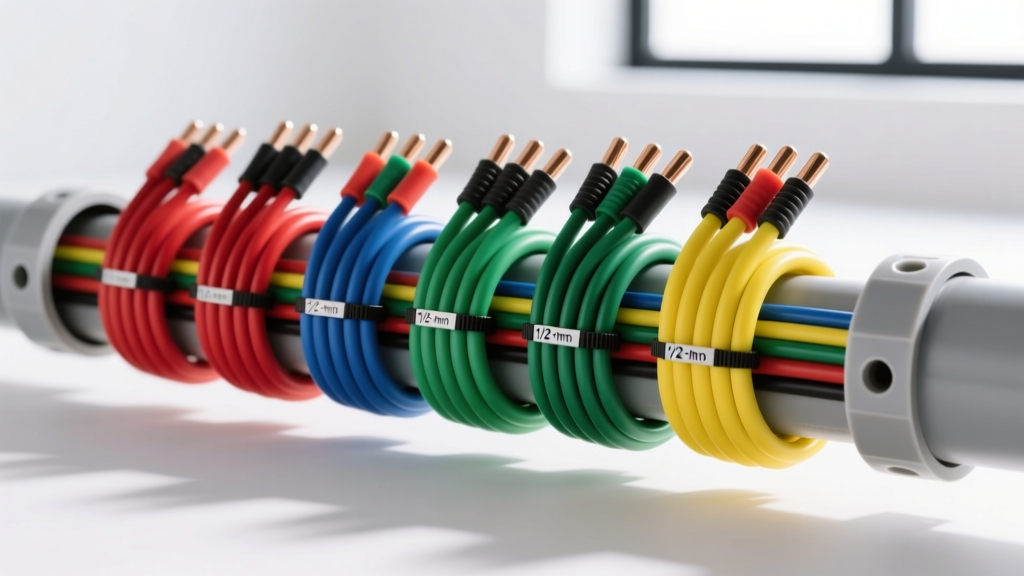
The 40% Rule: Answering How Many 12 Gauge Wires in 1/2 Conduit
When routing custom harnesses for EV battery management systems (BMS), classic car chassis rewires, or marine automotive applications, determining how many 12 gauge wires in 1/2 conduit can safely fit is a critical safety calculation. Overfilling a conduit traps heat, increases voltage drop, and creates severe chafing hazards under engine bay vibration.
Unlike residential wiring, automotive environments demand strict adherence to both the National Electrical Code (NEC) conduit fill limits and Society of Automotive Engineers (SAE) thermal standards. The short answer? For a standard 1/2-inch Inner Diameter (ID) flexible automotive split loom, the maximum safe capacity is 6 to 7 strands of 12 AWG SAE GXL wire. However, this number shifts dramatically based on insulation type, conduit material, and bundling derating factors.
Conduit Fill Capacity Chart: 12 AWG Automotive Wire
To calculate exact capacity, we apply the NEC 40% fill rule for three or more wires. This ensures enough air space for heat dissipation and prevents the 'pulling tension' that snaps copper strands. Below is the technical breakdown based on SAE J1128 insulation specifications.
| Conduit Type (1/2 Inch Nominal) | Actual Inner Diameter (ID) | Cross-Sectional Area | Max 12 AWG GXL (OD 2.95mm) | Max 12 AWG TXL (OD 2.45mm) |
|---|---|---|---|---|
| Standard Corrugated Split Loom | 0.500 in (12.7mm) | 0.196 sq in | 7 Wires | 10 Wires |
| Rigid PVC Schedule 40 | 0.622 in (15.8mm) | 0.303 sq in | 11 Wires | 16 Wires |
| Flexible Non-Metallic Liquid-Tight | 0.630 in (16.0mm) | 0.311 sq in | 11 Wires | 16 Wires |
| Expandable Braided PET Sleeving | 0.500 in (Under tension) | 0.196 sq in | 5 Wires (Derated for weave) | 8 Wires |
Note: Calculations assume the 40% fill rule. SAE J1128 GXL (General Cross-Linked) features a thin-wall polyethylene insulation, while TXL (Thin Cross-Linked) is extra-thin, allowing for tighter harness wraps in modern ECU modules.
Critical Mistake #1: Using THHN Instead of SAE GXL/TXL
The most frequent and dangerous error in custom automotive conduit routing is pulling residential THHN or THWN wire through a 1/2-inch loom. THHN features a thick PVC base with a brittle nylon outer jacket.
- The Hazard: The nylon jacket on THHN has a low melting point and poor abrasion resistance. When pulled through 1/2-inch split loom around the tight bend radii of a vehicle firewall or suspension crossmember, the nylon jacket strips off. This exposes the PVC to engine bay temperatures exceeding 105°C, leading to rapid insulation failure and dead shorts to the chassis.
- The Fix: Exclusively use SAE J1128 certified GXL or TXL wire. Cross-linked polyethylene (XLPE) insulation is rated to 125°C, resists battery acid, and will not melt when resting against an exhaust header shield.
Critical Mistake #2: Ignoring Bundled Ampacity Derating
A single 12 AWG GXL wire in free air can safely carry up to 41 Amps at an ambient temperature of 25°C. However, when you stuff seven 12-gauge wires into a 1/2-inch conduit under an EV battery skid plate, the ambient temperature inside that conduit can easily exceed 60°C.
According to NFPA 70 (NEC) Chapter 9 and automotive thermal management guidelines, bundling 4 to 6 current-carrying conductors requires an 80% derating factor. If your 12 AWG wire is powering a 35A fuel pump or an EV coolant circulation pump, a 7-wire bundle in a 1/2-inch conduit will overheat, increasing resistance and triggering voltage drop faults at the ECU.
Automotive Connector & Pinout Considerations for 12 AWG
Routing 12 AWG wire through a 1/2-inch conduit is only half the battle; terminating it correctly at the connector is where most harness failures occur. Standard 1/2-inch conduit bundles often terminate into multi-pin environmental connectors.
Approved 12 AWG Automotive Connectors
- Deutsch DT Series (Size 12 Pins): Rated for 25A continuous. Requires specific Size 12 open-barrel crimps. Do not force 12 AWG wire into Size 16 (14-18 AWG) pins, as the wire strands will splay, causing high-resistance hot spots.
- TE Connectivity AMP Superseal 1.5: Excellent for ECU sensor bundles exiting a 1/2-inch loom. Ensure you use the specific 1.5mm to 2.0mm wire seal (usually grey or green) to maintain IP67 waterproofing where the conduit meets the connector boot.
- Delphi Weatherpack 2000 Series: While capable of handling up to 20A, the cavity plugs and terminal grips are optimized for 14 AWG. If using 12 AWG, you must strip exactly 5/16' of insulation to ensure the insulation grip and wire crimp do not overlap, which will cause the terminal to back out of the nylon housing under vibration.
Step-by-Step Safe Pulling Procedure for 1/2 Conduit
- Calculate and Cut: Measure the conduit run. Add 15% for slack at firewall grommets and connector drip loops.
- Stagger the Stripping: If terminating into a multi-pin connector like a 12-way Deutsch, stagger your wire strip lengths by 1/4 inch. This prevents a massive 'bulge' of bare copper and heat shrink at the connector backshell, which would otherwise prevent the connector from seating into its mounting flange.
- Use Wire Pulling Compound: For runs longer than 24 inches through rigid PVC or liquid-tight conduit, use a dielectric silicone wire pulling lubricant. Never use dish soap or petroleum jelly, which degrades XLPE insulation over time.
- Protect the Ends: Wrap the leading ends of the harness in electrical tape or a pulling eye. Exposed copper strands will catch on the internal corrugations of split loom, tearing the GXL insulation and creating an immediate short-to-ground risk against the vehicle chassis.
- Secure with Adhesive-Lined Heat Shrink: Where the 1/2-inch conduit enters a connector backshell or firewall grommet, seal it with dual-wall, adhesive-lined heat shrink (minimum 3:1 shrink ratio). This prevents moisture wicking into the conduit, which is a primary cause of CAN-bus corrosion in modern vehicles.
Troubleshooting Conduit-Related Harness Failures
| Symptom | Probable Cause | Diagnostic Fix |
|---|---|---|
| Intermittent CAN-Bus Dropout (U-Codes) | Overfilled conduit causing compression on CAN-H/CAN-L twisted pair, altering the 120-ohm impedance. | Remove 2-3 ground wires from the 1/2' loom. Route power and ground in a separate conduit from data lines. |
| Voltage Drop > 0.5V at Fuel Pump | THHN insulation melted inside engine bay conduit, increasing resistance and causing copper oxidation. | Perform a voltage drop test across the conduit run. Replace entirely with SAE GXL wire and high-temp fiberglass sleeving. |
| Blown Fuse Upon Steering Turn | Conduit zip-tied too tightly to steering column or suspension A-arm, causing internal 12 AWG strand fatigue and shorting. | Use P-clips with rubber cushions. Maintain a minimum 3-inch bend radius for 12 AWG bundles to prevent work-hardening the copper. |
Final Safety Directives
When planning your next EV conversion, classic car restoration, or auxiliary lighting harness, never treat conduit as a 'stuff it until it fits' container. Adhering to the 40% fill rule for how many 12 gauge wires in 1/2 conduit ensures your harness survives the thermal cycling, high-frequency vibration, and chemical exposure inherent to automotive environments. Always cross-reference your wire gauge with TE Connectivity and Deutsch terminal specifications to guarantee your crimp depths match your conduit fill strategy.