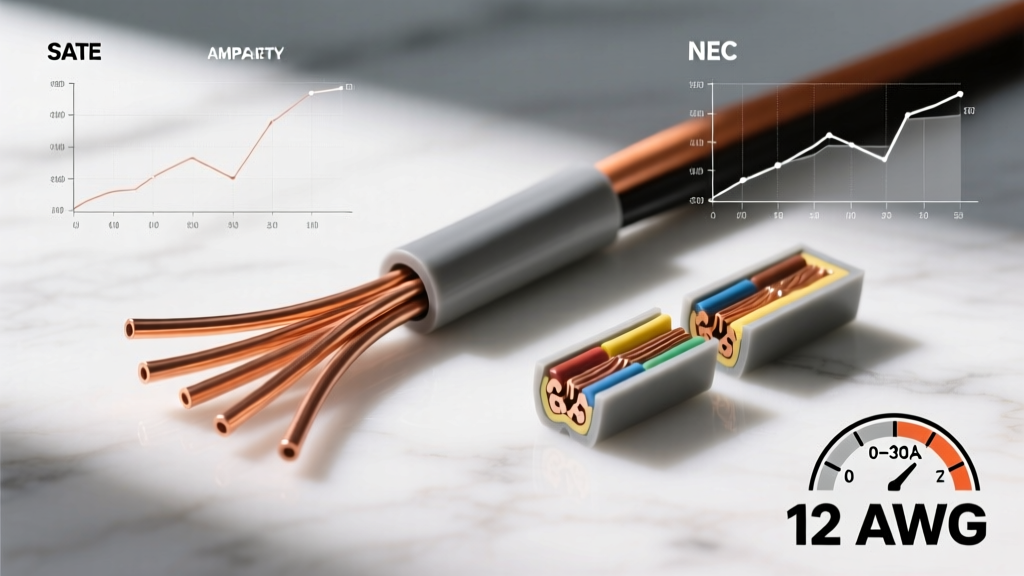
The Definitive Answer: 12 AWG Ampacity Explained
When automotive technicians and DIY builders ask, "how many amps is 12 gauge wire rated for?", the answer depends entirely on the governing standard and the operating environment. In the automotive industry, chassis wiring is governed by the SAE J1128 standard. Under SAE J1128, 12 AWG copper wire is rated for a maximum continuous current of 20 amps in open-air chassis wiring applications where ambient temperatures do not exceed 50°C (122°F).
However, if you consult the NFPA 70 National Electrical Code (NEC) for building wiring, 12 AWG is typically limited to 20 amps for branch circuits, but its power transmission rating in enclosed, bundled conduits drops significantly to around 9.3 amps. The discrepancy exists because automotive chassis wiring assumes the wire is routed in free air, allowing for superior convective heat dissipation compared to wires bundled tightly inside a residential wall or an enclosed automotive harness loom.
SAE vs. NEC Ampacity Comparison Chart
| Standard | Application | 12 AWG Max Ampacity | Temperature Rating |
|---|---|---|---|
| SAE J1128 (GXL/TXL) | Automotive Chassis (Free Air) | 20 Amps | Up to 125°C / 150°C |
| SAE J1128 (Bundled) | Enclosed Harness Looms | 14 - 16 Amps | Derated for heat trapping |
| NEC Article 310 | Residential Branch Circuits | 20 Amps | 60°C - 90°C |
| NEC (Power Transmission) | Bundled Conduit / Long Runs | 9.3 Amps | Strict voltage drop limits |
Material Comparison: OFC Copper vs. CCA (Copper-Clad Aluminum)
When selecting 12 AWG wire for automotive electrical upgrades, the conductor material is just as critical as the gauge size. The market is currently flooded with CCA (Copper-Clad Aluminum) wire, which is significantly cheaper than Oxygen-Free Copper (OFC) but poses severe risks in 12V DC automotive systems.
Aluminum has roughly 61% of the conductivity of copper. To compensate, CCA wire requires a larger gauge to carry the same amperage. A 12 AWG CCA wire effectively performs like a 14 AWG copper wire. Pushing 20 amps through a 12 AWG CCA wire in a high-demand circuit (like an aftermarket fuel pump or a high-wattage off-road light bar) will result in excessive heat generation, insulation melting, and catastrophic voltage drop.
Conductor Material Specifications
| Specification | OFC Copper (12 AWG) | CCA (12 AWG) |
|---|---|---|
| Resistance @ 20°C | 1.588 Ω / 1,000 ft | ~2.600 Ω / 1,000 ft |
| Max Safe Ampacity (Auto) | 20 Amps | 12 - 14 Amps |
| Weight (per 100 ft) | ~1.2 lbs | ~0.7 lbs |
| Automotive Recommendation | Mandatory for EFI, Pumps, Relays | Avoid entirely in 12V DC systems |
Vehicle-Specific Applications & Wire Codes
In OEM automotive design, 12 AWG wire is the workhorse for moderate-to-high draw accessories. Automotive engineers utilize specific color codes and insulation types (like GXL or TXL cross-linked polyethylene) to handle under-hood temperatures. Below are common applications where 12 AWG is the factory-specified gauge.
Common OEM 12 AWG Applications
- High-Current Lighting Feeds: Main headlight feeds from the lighting control module. For example, older GM trucks (1999-2006 Silverado) utilize a 12 AWG Yellow wire for the high-beam feed and Tan for the low-beam feed from the headlight switch to the dimmer relay.
- Electric Fuel Pumps: In-tank EFI fuel pumps, such as the Walbro 255 or Holley Sniper setups, draw between 12A and 18A under peak load (60+ PSI). Ford often uses a 12 AWG Pink/Black or Dark Green/Yellow tracer wire for the primary fuel pump feed.
- Power Windows & Seats: Motors for power windows experience massive inrush current (stall current can exceed 25A momentarily). 12 AWG wire is used from the circuit breaker to the master window switch cluster to prevent voltage sag during operation.
- Aftermarket Amplifiers: For audio systems, 12 AWG OFC wire is suitable for amplifiers drawing up to 200W RMS (approx. 15-18A draw) provided the run is under 12 feet.
Voltage Drop: The Hidden 12V System Killer
Knowing how many amps 12 gauge wire is rated for is only half the battle. In a nominal 12V automotive system (which actually operates at 13.8V to 14.4V when the alternator is charging), a voltage drop of more than 3% (0.36V - 0.43V) can cause severe performance issues. Fuel pumps will lose pressure, HID/LED ballasts will flicker, and ECU sensors will return faulty data.
According to technical data provided by Waytek Wire and standard Ohm's Law calculations, you must derate the physical length of your 12 AWG wire run based on the continuous amperage draw. The chart below dictates the maximum round-trip distance (positive + ground wire length combined) to maintain a safe voltage drop under 3%.
12 AWG Voltage Drop Limits (Max Round-Trip Length)
| Continuous Amperage | Max Length (3% Drop @ 14.4V) | Typical Automotive Circuit |
|---|---|---|
| 5 Amps | 62 Feet | LED Light Bars, Horn Relays |
| 10 Amps | 31 Feet | Transmission Solenoids, Radiator Fans |
| 15 Amps | 20.5 Feet | EFI Fuel Pumps, Heated Seats |
| 20 Amps (Max SAE) | 15.4 Feet | Main Headlight Feeds, Winch Solenoids |
Pro Tip: Always calculate the total circuit length. If your fuel pump is 8 feet from the battery, the round-trip length is 16 feet (8ft positive + 8ft ground). At 15A, 12 AWG is perfectly within the safe 20.5-foot limit.
Terminal & Connector Selection Guide
Matching 12 AWG wire to the correct terminal is critical for preventing high-resistance connection points. Using a 16-14 AWG terminal on a 12 AWG wire requires stripping and folding the copper strands, which creates a weak point prone to fatigue failure from engine vibration.
Recommended Connector Ecosystems for 12 AWG
- Delphi Weather-Pack: The industry standard for under-hood connections. For 12 AWG wire, you must use the 12-10 AWG terminal and seal (typically part numbers ending in -002 or specific 12-10 cavity seals). The Weather-Pack system is rated for up to 20 amps per circuit.
- Delphi Metri-Pack 280: Used heavily by GM and Ford for high-current sensor and actuator connections. The 280 series female and male terminals feature an open-barrel crimp design that securely bites into the 12 AWG strands without requiring excessive insulation crimping force.
- Deutsch DT Series: Ideal for off-road, marine, and heavy-duty applications. The DT size 16 contacts are designed to accept 14-16 AWG, but high-quality 12 AWG wire with a few strands carefully trimmed, or utilizing the specialized DT 12-14 AWG crimp barrels, ensures a weather-tight, vibration-proof seal.
Real-World Failure Modes & Diagnostics
When troubleshooting a failing 12 AWG circuit, visual inspection is your first step. Look for the "green crust"—copper oxide corrosion that creeps up the wire strands under the insulation, often caused by capillary action drawing moisture from a failed weather seal. This corrosion increases resistance, turning the wire into a heating element.
Diagnostic Procedure: Do not rely solely on a test light. Use a high-quality Digital Multimeter (DMM) to perform a dynamic voltage drop test. Back-probe the connector at the power source and the connector at the load (e.g., the fuel pump pigtail) while the circuit is under load. If your DMM reads more than 0.40V across the 12 AWG positive feed, the wire is either undersized for the length, internally corroded, or suffering from a failing crimp at the terminal. Replace the wire with fresh SAE J1128 GXL OFC copper, and always seal your crimps with marine-grade adhesive-lined heat shrink to prevent future oxidation.