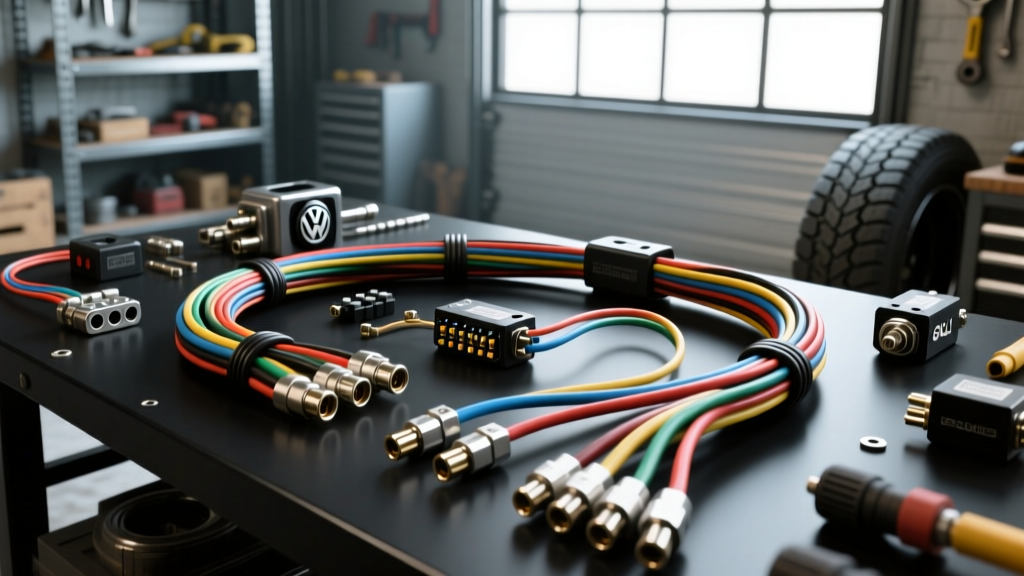
The Vulnerability of Stock Harnesses in Off-Road Environments
Building or restoring a dune buggy—whether it is based on a shortened VW Type 1 floorpan or a custom 4130 chromoly tube chassis—demands an electrical system that can withstand extreme vibration, water ingress, and abrasive dirt. Many builders make the critical mistake of reusing a vintage OEM wiring harness or purchasing a cheap, generic universal kit wrapped in standard PVC insulation. In an off-road environment, these harnesses fail rapidly. PVC insulation becomes brittle under UV exposure and cracks when subjected to the constant flexing of a buggy without a rigid body tub. Furthermore, vintage circuits lack the amperage capacity for modern off-road accessories like LED light bars, winches, and electric fuel pumps. Upgrading your dune buggy wiring harness is not just about adding features; it is a mandatory safety and reliability modification.
Wire Chemistry: Why GXL and TXL Are Mandatory
The foundation of any high-performance off-road harness is the wire itself. Standard hardware store wire uses Polyvinyl Chloride (PVC) insulation, which is rated for lower temperatures and degrades quickly when exposed to engine bay heat and off-road solvents. For a dune buggy wiring harness, you must use Cross-Linked Polyethylene (XLPE) wire, specifically GXL or TXL automotive primary wire. According to the SAE J1128 standard, cross-linked insulation offers superior resistance to heat (up to 125°C), abrasion, and chemicals. TXL features a thinner insulation wall than GXL, making it ideal for routing through the tight, constrained spaces of a dune buggy dashboard and steering column, while GXL is perfect for general chassis routing. Both feature stranded copper cores that resist the metal fatigue and breakage caused by the violent shaking of off-road driving.
Dune Buggy Wiring Harness Circuit Architecture
When fabricating or upgrading a harness, segmenting your circuits prevents a single short from disabling the entire vehicle. A properly designed dune buggy harness separates high-draw accessories from sensitive ignition and ECU circuits. Below is the recommended AWG (American Wire Gauge) sizing and fusing strategy for a modernized, 12-volt off-road buggy.
| Circuit Application | Wire Gauge (AWG) | Inline Fuse Rating | Recommended Connector |
|---|---|---|---|
| Main Battery to Fuse Block | 8 AWG (or 6 AWG for long runs) | 100A Mega / ANL | Ring Terminal / Busbar |
| Starter Solenoid & Ignition Feed | 10 AWG | 30A | Deutsch DT / Spade |
| Headlights (Halogen/LED) | 12 AWG | 15A | Delphi Weather-Pack |
| Taillights, Brake, & Turn Signals | 14 AWG | 10A | Delphi Weather-Pack |
| LED Light Bar (via Relay) | 10 AWG (Power), 16 AWG (Trigger) | 30A (Power) | Deutsch DT (Power) |
| Accessory 12V (Dash / USB) | 14 AWG | 10A | Weather-Pack / Blade |
VW Type 1 Specifics: Alternator and Ignition Terminals
If your dune buggy utilizes a traditional VW Type 1 engine or a conversion based on its architecture, your harness must interface correctly with the specific Bosch-style charging system terminals. Miswiring these will result in a dead battery or a fried alternator diode pack.
- Terminal 30 (B+): The main battery positive output. This requires a heavy 8 AWG or 6 AWG wire routed directly from the alternator/generator output post to the main starter solenoid battery post or a dedicated high-amperage busbar. It must be fused at the battery.
- Terminal 15: Switched 12V ignition power. This wire energizes the ignition coil and provides the 'wake up' signal to the alternator regulator.
- Terminal D+ (or 61): The alternator exciter wire. This connects to the dash charge indicator light. When the key is turned to 'ON' (but engine off), 12V flows through the bulb to ground via the regulator, lighting the bulb. Once the engine starts and the alternator generates voltage, both sides of the bulb see 12V, the potential difference drops to zero, and the light turns off. Use 16 AWG GXL for this circuit.
- Terminal 50: The starter solenoid trigger wire. Sourced directly from the ignition switch 'Start' position. Use 12 AWG to prevent voltage drop that can cause slow cranking.
Connector Selection: Weather-Pack vs. Deutsch DT
Open spade connectors and twist-tape splices have no place in a dune buggy wiring harness. Moisture and fine silt will cause rapid galvanic corrosion and voltage drops. You must use sealed connector systems.
Delphi Weather-Pack Connectors
Originally designed for agricultural and heavy-duty use, Weather-Pack connectors utilize silicone rubber seals that compress around the wire insulation and the terminal cavity. When crimping Weather-Pack terminals, you must use the correct seal color based on wire gauge: Red seals for 14-16 AWG, and Blue seals for 12 AWG. The crimp must capture both the conductor strands and the wire insulation to provide proper strain relief.
Deutsch DT Series
For high-vibration areas like the engine bay, front suspension light pods, or winch controls, upgrade to Deutsch DT connectors. These feature a solid thermoplastic housing with a silicone grommet seal at the rear and secondary locking wedges that prevent terminals from backing out under extreme chassis flex.
Integrating Relays for High-Draw Off-Road Accessories
Running high-amperage off-road LED light bars or auxiliary fuel pumps directly through a dashboard toggle switch is a recipe for melted switches and electrical fires. Your upgraded harness must utilize Bosch-style ISO mini relays to isolate the high-current load from the low-current switch circuit.
Standard 5-Pin ISO Relay Pinout
- Pin 30: Constant 12V+ from the battery (via an inline fuse). Use 10 AWG or 12 AWG wire.
- Pin 87: Output to the accessory (e.g., Light Bar positive). Use the same gauge as Pin 30.
- Pin 85: Relay coil ground. Connect to a clean chassis ground.
- Pin 86: Switched 12V+ trigger from the dashboard toggle switch. Can be 16 AWG or 18 AWG, as it only carries the coil current (approx. 150mA).
- Pin 87a: Normally Closed (NC). Unused in most off-road lighting applications; snip and heat-shrink the end to prevent shorts.
Pro-Tip: When wiring multiple LED pods, use a centralized relay block mounted high on the chassis firewall or roll cage to keep the heavy-gauge power runs as short as possible, minimizing voltage drop.
Grounding Strategy: The Most Overlooked Buggy Upgrade
A dune buggy wiring harness is only as good as its return path to the battery. Tube chassis buggies suffer from poor grounding because the frame tubes are often painted, powder-coated, or subjected to flex that breaks ground continuity. Never rely on self-tapping screws for grounding.
- Preparation: Grind away all paint, powder coat, and rust down to bare, shiny metal at every ground point.
- Hardware: Use Grade 8 or stainless steel bolts with internal star washers (which bite into the metal) and external star washers (which bite into the ring terminal).
- Protection: After torquing the ground strap, coat the entire terminal and exposed bare metal with a heavy layer of dielectric grease or a dedicated anti-corrosion compound to prevent moisture and mud from causing rust creep.
- Star Grounding: For sensitive electronics like digital dashes or fuel injection ECUs, run dedicated 10 AWG ground wires directly back to the engine block or battery negative terminal, rather than relying on the tubular chassis as a common ground plane.
Looming and Physical Protection
Once your harness is fabricated and tested, physical protection is the final step. Avoid cheap, rigid split-loom tubing which traps dirt and moisture against the wires. Instead, use PET (Polyethylene Terephthalate) expandable braided sleeving. PET sleeving is highly abrasion-resistant, flexible, and allows water and mud to pass through rather than trapping it. For sections of the harness that pass through the firewall or chassis bulkheads, use 3:1 dual-wall adhesive-lined heat shrink. The inner wall melts and forms a waterproof environmental seal, preventing water from wicking down the wire insulation and into your connectors. By combining SAE-rated GXL wire, sealed connectors, relay-isolated circuits, and proper chassis grounding, your dune buggy wiring harness will survive the harshest off-road abuse while delivering flawless electrical performance.