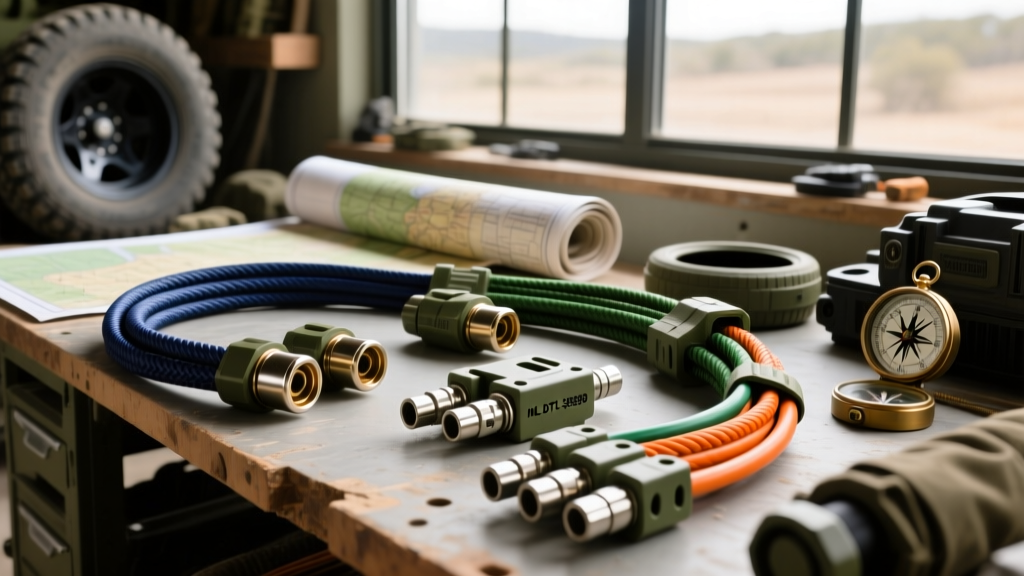
Why Civilian Harnesses Fail in Extreme Overlanding
Standard automotive wiring, governed by the SAE J1128 Standard, is engineered for paved roads, predictable engine bay temperatures, and protected routing. When you push an overland expedition rig—whether it is a heavily modified Ford F-450 camper or a surplus HMMWV—through deep water crossings, high-vibration corrugated washboards, and extreme ambient heat, standard PVC and cross-linked polyethylene (XLPE) insulations rapidly degrade. Chafing, moisture ingress, and thermal breakdown lead to catastrophic electrical failures miles from civilization. This is where sourcing from specialized military wiring harnesses suppliers becomes a critical upgrade path for serious expedition builds.
Vetting Military Wiring Harnesses Suppliers for Custom Projects
Not all vendors advertising "mil-spec" components actually deliver Qualified Products List (QPL) certified hardware. When upgrading a heavy-duty platform, you must rigorously verify the supplier's manufacturing and sourcing certifications. True military wiring harnesses suppliers will provide components that meet stringent Department of Defense (DoD) performance specifications, rather than commercial off-the-shelf (COTS) equivalents that merely look rugged.
Key Certifications to Demand
- AS9100D Quality Management: Ensures the supplier maintains aerospace-level quality control, traceability, and counterfeit part prevention.
- IPC/WHMA-A-620 Class 3 Workmanship: Class 3 dictates the highest level of reliability for harsh environments. It requires specific wire strippers, crimp tension testing, and strict inspection protocols that prevent wire strand nicking and improper insulation crimping.
- MIL-PRF-38999 Compliance: The benchmark for high-performance circular connectors used in aerospace and ground combat vehicles.
- RoHS-Compliant Zinc-Nickel Plating: Modern suppliers use zinc-nickel shell plating to replace the highly toxic cadmium finishes found on older olive drab surplus connectors, providing equal or better salt-spray resistance without environmental hazards.
Technical Spec: MIL-W-22759/16 vs. Standard Automotive Wire
When designing a custom harness for an overland swap, the wire insulation is just as critical as the copper conductor. Standard GXL wire is excellent for daily drivers, but MIL-W-22759/16 wire utilizes an extruded Tefzel (ETFE) insulation. Tefzel is virtually impervious to automotive fluids, hydraulic oil, and extreme heat, maintaining its dielectric strength up to 200°C. Furthermore, the insulation wall thickness is significantly reduced compared to PVC, allowing for tighter bundle routing in cramped engine bays without sacrificing current-carrying capacity.
Wire Gauge and Ampacity Comparison Chart
| Specification | Insulation Material | Max Temp Rating | 12 AWG Ampacity (Single) | Abrasion Resistance |
|---|---|---|---|---|
| SAE J1128 GXL | Cross-linked Polyethylene (XLPE) | 125°C | 41 Amps | Moderate |
| MIL-W-22759/16 | Tefzel (ETFE) | 200°C | 41 Amps | Extreme |
| MIL-W-81381 (Polyimide) | Kapton / Polyimide | 260°C | 41 Amps | High (but notch-sensitive) |
Note: Always apply a 20% derating factor when bundling more than three current-carrying conductors in a single loom, per standard aerospace harness design practices.
Integrating MIL-DTL-38999 Connectors into a 12V Swap
The TE Connectivity MIL-DTL-38999 Series III connector is the gold standard for expedition vehicle bulkhead pass-throughs and engine-to-chassis disconnects. Featuring a quick-disconnect bayonet coupling mechanism and environmental sealing via fluorosilicone elastomer grommets, these connectors prevent water ingress even when submerged during river crossings.
Step-by-Step Crimping and Insertion Protocol
Improper crimping is the leading cause of mil-spec connector failure. You cannot use standard automotive ratcheting crimpers for MIL-DTL-38999 contacts. You must use a turret-style or indent crimp tool calibrated to MIL-DTL-22520 specifications.
- Strip the Wire: Use a precision thermal stripper or calibrated mechanical stripper. For 16 AWG MIL-W-22759/16 wire, strip exactly 0.28 inches of insulation. Do not nick the copper strands; Class 3 standards dictate immediate rejection of any nicked conductors.
- Set the Crimp Tool: Using an M22520/2-01 universal crimp tool with the appropriate turret head (e.g., M22520/2-09), set the dial to position 4 for 16 AWG wire and size 16 contacts.
- Crimp the Contact: Insert the contact into the tool, align the wire fully into the crimp barrel (ensuring all strands are captured and flush with the inspection hole), and squeeze the handles until the tool releases.
- Insert the Contact: Using the appropriate plastic insertion tool (e.g., M81969/14-10 for size 16), push the crimped contact into the rear of the connector housing until you feel and hear a distinct "click." This indicates the contact retaining clip has locked the shoulder of the pin.
- Pull Test: Gently tug the wire backward to verify the retaining clip has engaged. The wire should not move.
24V to 12V Surplus Vehicle Bulkhead Repinning
When sourcing a surplus HMMWV or LMTV for an overland build, the primary electrical hurdle is the 24V military architecture. If you are swapping in a civilian 12V Cummins or LS engine, you must repin the main chassis bulkhead connector. Military wiring harnesses suppliers often provide the extraction tools and replacement 12V-rated contacts needed for this conversion.
- Pin A (Original 24V Main): Extract the heavy 8 AWG wire. Repin with a new 6 AWG MIL-W-22759/16 wire routed directly to your new 12V high-output alternator and main distribution busbar.
- Pin B (Original 24V Ignition/Run): Repurpose this circuit for your 12V ECU ignition relay trigger. Downsize the wire to 14 AWG, as the ECU draw is minimal compared to the original 24V glow plug controller.
- Pin C (Original 24V Accessory): Convert to a 12V switched auxiliary feed for overland lighting relays and winch solenoids.
Always use the proper Defense Logistics Agency (DLA) Quick Draw schematics to verify pin assignments before cutting or extracting wires from surplus military harnesses, as NATO-standard pinouts can vary by vehicle production year.
Troubleshooting Mil-Spec Ground Faults and Corrosion
Even with mil-spec components, environmental factors can cause electrical gremlins. The most common issue in expedition rigs utilizing military connectors is galvanic corrosion and ground-loop interference.
| Symptom | Probable Cause | Corrective Action |
|---|---|---|
| White powdery residue inside aluminum connector shell | Galvanic corrosion between aluminum shell and copper wire due to moisture ingress. | Disassemble, clean with isopropyl alcohol, apply dielectric grease to the grommet, and ensure backshell environmental seal is torqued to spec. |
| Intermittent ECU sensor drops on corrugated roads | Wire strand fatigue inside the crimp barrel due to improper tool calibration. | Cut back the wire, strip fresh insulation, and recrimp using a verified M22520 tool. Perform a pull-test to 15 lbs. |
| High resistance reading across chassis ground pins | Zinc-nickel plating on the connector shell acting as an insulator against the raw aluminum chassis mount. | Use a dedicated copper grounding pigtail from the connector backshell directly to a cleaned, bare-metal chassis grounding stud. Do not rely on the connector shell for high-amperage grounding. |
Final Thoughts on Expedition Harness Fabrication
Upgrading your overland rig via specialized military wiring harnesses suppliers is an investment in absolute reliability. By utilizing MIL-W-22759/16 Tefzel wire and MIL-DTL-38999 Series III connectors, you eliminate the primary failure points of civilian electrical systems: heat degradation, vibration-induced strand breakage, and water intrusion. While the upfront cost of mil-spec components and the required crimping tooling is higher than standard automotive parts, the peace of mind when traversing remote, unforgiving terrain is invaluable. Always demand QPL-certified parts, adhere strictly to Class 3 crimping standards, and map your pinouts meticulously before executing any 24V-to-12V surplus conversions.