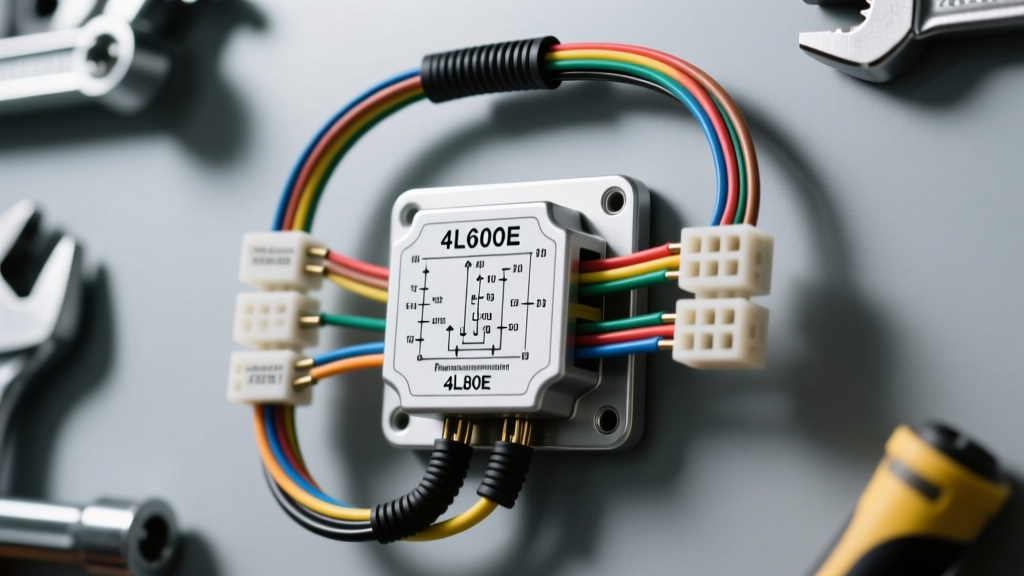
Why You Need a 4L60E to 4L80E Harness Adapter
Swapping a fragile 4L60E for a heavy-duty 4L80E is one of the most popular drivetrain upgrades in the GM performance community. Whether you are building a high-horsepower street car, a dedicated drag racer, or a heavy-towing truck, the 4L80E offers unmatched durability. However, beginners quickly discover that this mechanical swap is only half the battle; the electrical side is where most swap projects stall. The factory engine harness designed for a 4L60E will not physically plug into a 4L80E, nor does it contain the correct circuits to operate it. This is where a dedicated 4L60E to 4L80E harness adapter becomes essential. Rather than splicing into your fragile factory engine harness or attempting a complex custom fabrication from scratch, a pre-engineered adapter harness bridges the physical and electrical gaps between your factory PCM (Powertrain Control Module) and the 4L80E case connector.
Core Wiring Differences: 4L60E vs. 4L80E
To understand why an adapter is required, you must understand the fundamental electrical architecture differences between the two transmissions. The 4L60E and 4L80E utilize different solenoid packs, different sensor configurations, and entirely different case connectors. Below is a breakdown of the primary electrical differences that your adapter harness must reconcile.
| Feature | 4L60E Architecture | 4L80E Architecture |
|---|---|---|
| Case Connector | 16-Pin Square (Early) / Internal (Late) | 14-Pin Round (Early) / 21-Pin or 16-Pin (Late) |
| Shift Solenoids | SSA, SSB, 3-2 Downshift | SSA, SSB (No 3-2 Downshift) |
| TCC & Pressure | TCC PWM, TCC ON/OFF | TCC Apply, Pressure Control (PC) Solenoid |
| Speed Sensors | VSS (Output Tailshaft Only) | ISS (Input Turbine) & OSS (Output Tailshaft) |
| Fluid Temp | TFT Sensor | TFT Sensor (Different resistance curve) |
The Speed Sensor Dilemma (VSS vs. ISS/OSS)
The most common trap for beginners is the speed sensor configuration. The 4L60E relies solely on a Vehicle Speed Sensor (VSS) located on the tailshaft. The PCM calculates clutch slip by comparing Engine RPM to the VSS output. The 4L80E, however, requires both an Input Speed Sensor (ISS) on the turbine shaft and an Output Speed Sensor (OSS) on the tailshaft. The PCM uses the ISS and OSS to calculate precise, real-time clutch slip volume, which it uses to dynamically adjust line pressure via the PC solenoid. If you attempt to run a 4L80E without wiring the ISS, the PCM will trigger codes like P0716 or P0717 and default to maximum line pressure, resulting in bone-shattering, harsh shifts. A proper 4L60E to 4L80E harness adapter includes the necessary wiring and PCM pins to route the ISS signal back to the computer.
Essential Wire Gauge and Routing Specifications
When inspecting or modifying your adapter harness, verifying the wire gauge and insulation type is critical for long-term reliability. The under-car environment is hostile, exposing wiring to extreme heat, vibration, and corrosive road salts. According to SAE J1128 standards for low-tension primary cables, automotive wiring must meet strict thermal and chemical resistance criteria. Below are the strict specifications your adapter harness should meet or exceed.
| Circuit Type | AWG Size | Wire Insulation | Technical Notes |
|---|---|---|---|
| Solenoids (SSA, SSB, TCC, PC) | 18 AWG | TXL or GXL | Thin-wall, cross-linked polyethylene rated for 125°C. Resists melting near the exhaust. |
| Speed Sensors (ISS, OSS) | 20 AWG | Shielded Twisted Pair | Crucial for rejecting Electromagnetic Interference (EMI) from ignition coils and alternators. |
| 12V Ignition Feed | 14 AWG | SXL or TXL | Must be fused at 10A-15A at the source to protect the PCM drivers. |
| Main Ground | 12 or 14 AWG | SXL | Must terminate in a heavy-duty ring terminal directly to the transmission case or engine block. |
Step-by-Step Installation Fundamentals
Installing a 4L60E to 4L80E harness adapter is a straightforward process if you follow a methodical approach. Do not rush the routing phase, as poor wire management is the leading cause of post-swap electrical gremlins.
- Bench Prep and Inspection: Before dropping the 4L80E into the vehicle, plug the adapter into the transmission case connector on the bench. Verify that the locking tab engages securely. Inspect the male pins on the transmission case for corrosion or bending. Clean the case connector with electrical contact cleaner.
- Route the ISS and OSS Wires: The speed sensor wires are highly sensitive to EMI. Route the ISS and OSS wires along the top of the bellhousing and transmission case, keeping them at least 4 inches away from ignition coil packs, plug wires, and the alternator. Never zip-tie speed sensor wires directly to high-voltage ignition harnesses.
- Secure and Shield the Harness: Wrap the entire length of the adapter harness in split-loom tubing or high-temperature Techflex braided sleeving. Use adhesive-lined heat shrink tubing on any splices. Secure the harness to the transmission case using stainless steel P-clips, avoiding sharp metal edges that could saw through the insulation over time.
- PCM Repinning (If Required): Many adapter kits require you to add the ISS wires to your factory PCM connector. For example, on the popular GM P01 and P59 (LS1/LS2/LS6) PCMs, the ISS pins are often located in the Blue connector. Use a proper Delphi terminal crimping tool to attach the new pins. Never use pliers to crimp weather-pack pins, as this will compromise the waterproof seal and lead to internal corrosion.
- Establish a Dedicated Ground: Do not rely solely on the transmission case mating to the engine block for electrical grounding. Attach the 12 AWG ground wire from the adapter harness to a clean, bare-metal stud on the bellhousing or cylinder head. Apply dielectric grease to the terminal to prevent galvanic corrosion.
Common Beginner Mistakes and Troubleshooting
Even with a high-quality adapter harness, beginners often encounter issues due to overlooked details. If your 4L80E is shifting erratically or throwing codes, consult this troubleshooting matrix before blaming the transmission.
Symptom: Harsh, Bang-Shifts into 2nd and 3rd Gear
Cause: Missing ISS signal or unshielded speed sensor wires. The PCM cannot calculate clutch slip and defaults to maximum line pressure to prevent clutch burn-up.
Fix: Verify the ISS pins are fully seated in the PCM connector. Check the shield drain wire on the ISS circuit; it must be grounded at the PCM, not at the transmission case, to prevent ground loops.
Symptom: TCC (Torque Converter Clutch) Will Not Lock Up
Cause: Incorrect TCC wiring or brake switch conflict. The 4L80E TCC circuit requires a dedicated 12V feed and a PCM-controlled ground. Additionally, the PCM will abort TCC lockup if it detects an open brake switch circuit.
Fix: Verify 12V at the TCC pin on the transmission case connector with the key in the 'ON' position. Check your brake pedal switch wiring to ensure the PCM receives the correct 'brake applied/released' logic states.
Symptom: Intermittent Shift Solenoid Codes (P0753, P0758)
Cause: Heat damage to the solenoid wires or poor case grounding. The exhaust crossover pipe on many V8 engines sits inches from the transmission case connector.
Fix: Inspect the adapter harness near the exhaust for melted loom or brittle TXL insulation. Install a dedicated heat shield between the exhaust and the transmission harness. For expert-level diagnostics on internal transmission electrical faults, refer to Sonnax Tech Resources for solenoid resistance testing procedures.
Final Thoughts on PCM Tuning
A physical 4L60E to 4L80E harness adapter only solves the electrical connectivity puzzle; it does not recalibrate the computer. The 4L80E has entirely different gear ratios (2.48, 1.48, 1.00, 0.75) compared to the 4L60E (3.06, 1.63, 1.00, 0.70). Furthermore, the shift timing, line pressure curves, and torque management parameters are vastly different. You must use tuning software (such as HP Tuners or EFI Live) to disable the 4L60E-specific codes, enable the 4L80E ISS/OSS logic, and recalibrate the shift tables. Always consult your specific GM Powertrain service documentation or tuning software instructions to ensure your PCM is correctly configured for the new transmission architecture. By combining a high-quality adapter harness with proper wire routing and professional tuning, your 4L80E swap will deliver bulletproof reliability for years to come.