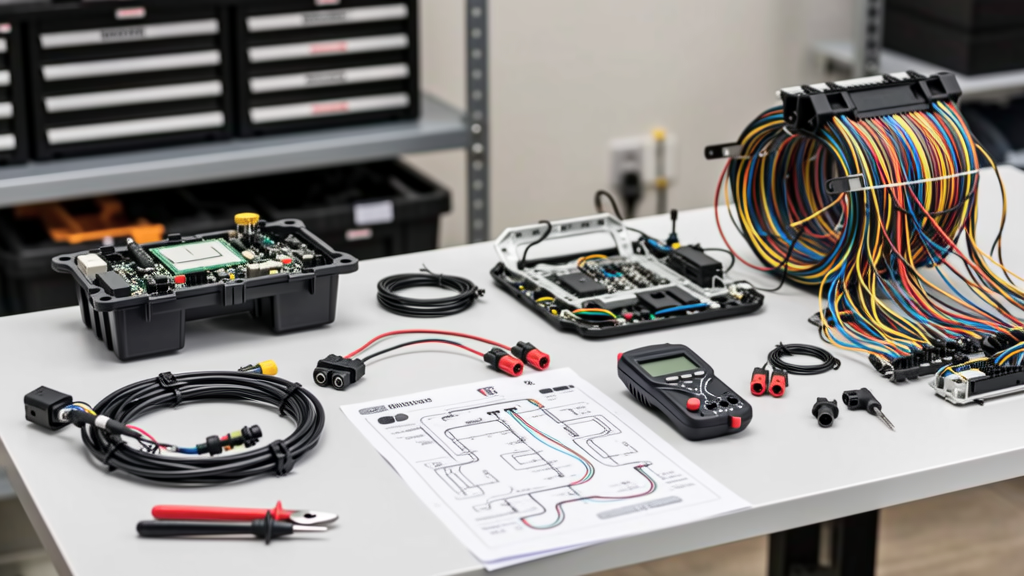
Electrical systems power modern life—but misunderstanding them can lead to fire, shock, or equipment damage. This guide is written for absolute beginners: homeowners, DIYers, and new trades apprentices who need actionable knowledge—not theory alone. You’ll learn how voltage, current, and resistance interact in real circuits; why 14-gauge NM-B cable is rated for 15 amps but not for 20-amp circuits; how to read a multimeter from Fluke (Model 117) or Klein Tools (MM400); and why the National Electrical Code (NEC) 2023 mandates AFCI protection in bedrooms, living rooms, and dining areas—not just kitchens and bathrooms. We cover actual product specs, code-mandated clearances, and common mistakes that trigger insurance denials. No jargon without definition. No assumptions about prior knowledge. Just facts you can use safely today.
What Is Electricity—Really?
Electricity isn’t magic—it’s the controlled movement of electrons through a conductor. Three core quantities define every electrical interaction: voltage (V), current (I), and resistance (R). Voltage is electrical pressure—measured in volts (V). In North America, standard residential service delivers 120/240 VAC (volts alternating current) from the utility transformer. Current is the flow rate of electrons—measured in amperes (amps, A). Resistance opposes that flow—measured in ohms (Ω). These relate via Ohm’s Law: V = I × R. If a 120 V circuit has a load drawing 10 A, total resistance is 12 Ω. Exceed that resistance with undersized wire or corroded connections, and heat builds—potentially igniting insulation.
Real-world example: A standard 60 W incandescent bulb on 120 V draws 0.5 A (60 ÷ 120 = 0.5). An equivalent LED bulb uses only 8.5 W—drawing just 0.07 A. That’s why upgrading lighting reduces circuit loading dramatically. But don’t assume lower wattage means safer wiring: cheap LED drivers can generate high-frequency harmonics that trip sensitive AFCIs if not UL-listed.
Voltage Types Matter
Residential systems use alternating current (AC), where electron flow reverses direction 60 times per second (60 Hz in North America). This enables efficient long-distance transmission and transformer operation. Direct current (DC)—used in batteries, solar panels, and EVs—is steady-state flow. Never mix AC and DC components without proper isolation: connecting a 12 V DC LED strip directly to a 120 V AC junction box will destroy it instantly and create arcing hazards.
Wires, Cables, and Why Gauge Isn’t Just a Number
Wire gauge refers to its diameter—and inversely relates to current-carrying capacity. The American Wire Gauge (AWG) system assigns smaller numbers to thicker wires. A 14 AWG copper wire has a cross-sectional area of 2.08 mm² and is rated for 15 A at 75°C under NEC Table 310.16. A 12 AWG wire (3.31 mm²) handles 20 A. Using 14 AWG on a 20 A circuit violates NEC 240.4(D)(3) and risks overheating: Under sustained 20 A load, 14 AWG can reach 90°C—above safe insulation limits for standard THHN or NM-B.
Common residential cables include:
- NM-B (Non-Metallic Sheathed Cable): Brand examples: Southwire SIMpull® Romex®, Cerro Wire 14/2 NM-B. Contains insulated conductors + bare ground, wrapped in flame-retardant PVC. Used indoors in dry locations only. Not permitted in commercial garages or exposed outdoor runs.
- THHN/THWN-2: Single-conductor wires (e.g., Southwire 12 AWG THHN, 600V rating). Used inside conduit—required in basements, crawlspaces, and all commercial work. THWN-2 is wet-location rated; THHN is dry-only.
- UF-B (Underground Feeder): Direct-burial rated (e.g., Southwire UF-B 12/2). Has moisture-resistant thermoplastic jacket. Minimum burial depth: 24 inches per NEC 340.10(4).
Color Coding: More Than Convention
NEC 200.6 mandates color coding for safety and troubleshooting:
- Black or Red: Ungrounded (hot) conductors—carry voltage to loads.
- White or Gray: Grounded (neutral) conductor—returns current to panel. Must be continuous from outlet to main panel bus bar.
- Bare Copper or Green: Equipment grounding conductor (EGC)—safety path only activated during faults. Never used to carry normal operating current.
Violating this—like using white wire as hot without tape marking—causes miswiring that defeats GFCI protection and confuses first responders.
Circuits: How Power Gets Delivered Safely
A circuit is a complete, unbroken loop: source → hot wire → load → neutral wire → source. Break the loop (e.g., open switch), and current stops. Break the safety path (e.g., missing ground), and fault current has no low-resistance route—increasing shock risk.
Two primary residential circuit types:
- Branch Circuits: Feed outlets, lights, and appliances. Sized by load demand and NEC Article 210. Standard 15 A circuits serve general lighting and receptacles (max 12 outlets per circuit per NEC 210.21(B)(1) guidance). 20 A circuits are required for kitchen small-appliance branches (NEC 210.11(C)(1)) and laundry areas.
- Feeder Circuits: Deliver power from the main service panel to subpanels. Sized per NEC Article 215. A 100 A feeder to a garage subpanel requires 3 AWG copper THHN in conduit—or 1/0 AWG aluminum for same ampacity (NEC Table 310.16).
Breakers: Your First Line of Defense
Circuit breakers interrupt current when overload or short-circuit occurs. They’re not precision instruments—they’re thermal-magnetic devices calibrated to trip within defined time windows. For example, a Square D QO 15 A breaker must hold 13.5 A indefinitely but trip between 1 minute and 10 minutes at 30 A (NEC 240.6(A)). At 100 A (667% overload), it trips in under 5 seconds.
Key breaker types:
- Standard Thermal-Magnetic: Protects against overloads and shorts. Brands: Eaton BR, Siemens QP, Square D Homeline.
- GFCI (Ground-Fault Circuit Interrupter): Trips at 4–6 mA imbalance between hot and neutral—fast enough to prevent lethal shock. Required within 6 feet of sinks (NEC 210.8(A)(1)), outdoors, and in garages. UL 943 certified units like Leviton GFCI-20 (20 A) or Eaton GFTR20 have test/reset buttons and self-test features.
- AFCI (Arc-Fault Circuit Interrupter): Detects dangerous arcing (series or parallel) from damaged cords or loose connections. Required for all 120 V, 15–20 A branch circuits in dwelling unit bedrooms, living rooms, hallways, and dining areas (NEC 210.12(A)). Siemens AFDD20 or GE AFCI+ breakers include both arc-fault and overcurrent protection.
Outlets, Switches, and Proper Installation Practices
Receptacles and switches are interface points—and installation errors cause most DIY-related incidents. A standard NEMA 5-15R duplex outlet (15 A, 125 V) must be mounted in a noncombustible box with minimum volume per NEC 314.16. For two 14/2 cables plus ground entering one box, minimum box volume is 18 in³ (e.g., Carlon B120R 20 in³ plastic box).
Back-wire vs. side-screw terminals: Modern outlets like Leviton Decora Plus (5252) accept back-wire push-in connections—but UL testing shows higher failure rates under thermal cycling versus screw-terminal connections. Always tighten side screws to 14 in-lbs (Leviton spec) using a torque screwdriver—not fingers.
Grounding: Not Optional, Not Negotiable
Proper grounding ensures fault current flows safely to earth—tripping breakers before voltages rise on appliance chassis. NEC 250.53 requires a grounding electrode system: at least one 8 ft copper-clad steel rod driven fully into earth, bonded to the main panel with 6 AWG bare copper (Southwire 6 AWG bare CU). If soil resistivity exceeds 25 ohm-meters (common in rocky or sandy areas), a second rod spaced ≥6 ft away is mandatory.
Never “bootleg” ground by connecting neutral to ground at a receptacle—this energizes metal boxes and defeats GFCI operation. It also violates NEC 250.142(B) and voids UL listing on connected devices.
Multimeters and Testing: Verify Before You Trust
A multimeter is your truth-teller. Budget models often lack CAT III 600 V rating—required for residential panel work. Recommended entry-level tools:
- Fluke 117: True-RMS, CAT III 600 V, includes non-contact voltage detection, continuity beeper, and 0.5% basic accuracy. Measures up to 10 A via clamp accessory.
- Klein Tools MM400: CAT III 600 V, auto-ranging, large LCD, 0.7% accuracy. Includes low-impedance voltage mode to avoid ghost voltage readings.
Testing steps before touching wires:
- Set meter to AC voltage (V~), range >200 V.
- Test meter on known live circuit (e.g., working outlet) to confirm operation.
- Test hot-to-neutral and hot-to-ground: both should read ~120 V.
- Test neutral-to-ground: should read <2 V. >2 V indicates neutral-ground bond error or overloaded neutral.
- Verify de-energization: test hot-to-ground again after turning off breaker—should read 0 V.
Ghost voltage—a false reading caused by capacitive coupling—can show 20–50 V on an open neutral. Use a low-Z mode (Klein MM400) or solenoid tester (Watts Up? or Ideal SureTest) to distinguish real voltage from induced signal.
Code Compliance: Why NEC Rules Exist
The National Electrical Code (NEC) isn’t arbitrary—it’s data-driven. Each revision incorporates findings from the Electrical Injury Report (EIR) database and NFPA 70E incident analysis. For example, NEC 210.52(A)(1) requires receptacles every 6 feet along wall space ≥2 ft wide because 72% of shock incidents in homes occur within 3 ft of outlets (NFPA 2022 Electrical Injury Report).
Key 2023 NEC updates affecting beginners:
- 210.12(A): AFCI protection now extends to hotel/motel guest rooms and dormitory units—not just dwelling units.
- 406.4(D)(2)(a): All replacement receptacles in areas requiring GFCI must be GFCI-type—even if upstream GFCI protection exists—unless physically impractical (e.g., single-receptacle garage outlet).
- 314.16(B)(5): Equipment grounding conductors count as one conductor regardless of quantity when calculating box fill—simplifying calculations for multi-gang boxes.
Local amendments may exceed NEC. California Title 24 mandates 20 A circuits for all kitchen countertop receptacles (vs. NEC’s 15 A allowance), and Seattle requires tamper-resistant (TR) receptacles in all dwelling unit rooms—including unfinished basements.
Safety Protocols: Non-Negotiable Habits
No tool replaces discipline. These protocols prevent 94% of residential electrical injuries (CPSC 2023 data):
- Lockout/Tagout (LOTO): Turn off breaker, verify de-energization, then place physical lock on panel cover. Use a Klein Tools LOTO kit with padlocks and tags.
- One-Hand Rule: When testing live circuits, keep one hand behind your back or in pocket—prevents current crossing the heart.
- PPE Minimums: ANSI-rated safety glasses (e.g., Pyramex i-Spec), flame-resistant (FR) shirt (Bulwark FR Cotton Blend), and voltage-rated gloves (Class 00, 500 V max—tested per ASTM D120) for panel work.
- Distance Limits: Maintain 36 inches clearance in front of panels (NEC 110.26(A)(2)) and 30 inches width (NEC 110.26(A)(2)). Never store boxes or holiday decorations in this zone.
Real incident example: In 2022, a homeowner replaced a ceiling fan without locking out the circuit. The hot wire contacted the metal bracket, energizing the entire fixture. When he touched the mounting strap while standing on a damp ladder, 120 V passed across his chest—causing ventricular fibrillation. He survived due to immediate CPR but required cardiac rehab. This was preventable with a $12 padlock and 90 seconds of verification.
| Circuit Type | Max Load (VA) | Wire Size (Copper) | Breaker Size | NEC Reference | Common Applications |
|---|---|---|---|---|---|
| General Lighting & Receptacles | 1,800 VA (15 A × 120 V) | 14 AWG NM-B | 15 A | 210.11(A) | Bedrooms, hallways, living rooms |
| Kitchen Small-Appliance | 2,400 VA (20 A × 120 V) | 12 AWG NM-B | 20 A | 210.11(C)(1) | Countertop outlets, island receptacles |
| Laundry Branch | 2,400 VA | 12 AWG NM-B | 20 A | 210.11(C)(2) | Washer, gas dryer receptacle |
| Electric Range Feeder | 12,000 VA (50 A × 240 V) | 6 AWG THHN | 50 A | 210.19(A)(3) | 40–50 A ranges (e.g., GE JB735SPSS) |
| EV Charging (Level 2) | 11,520 VA (48 A × 240 V) | 6 AWG THHN (75°C) | 60 A | 625.42(B) | ChargePoint Home Flex, Tesla Wall Connector |
Remember: Electricity doesn’t care about intent. It responds only to physics and path. A 120 V circuit can deliver 100 mA—enough to stop your heart—if conditions align. But with correct wire sizing, verified grounding, appropriate protection devices, and disciplined verification, residential electricity is exceptionally safe. Start small: replace one GFCI outlet using the steps outlined here. Test with your Fluke 117. Tighten screws to spec. Record your work. Then build—methodically, respectfully, and always with safety as the first design criterion. Your home, your family, and your future projects depend on it.
Always consult a licensed electrician before modifying panels, adding circuits, or working on services above 120/240 V. Local permitting requirements vary: in Texas, minor repairs don’t require permits, but in New York City, any receptacle replacement triggers inspection. Check with your AHJ (Authority Having Jurisdiction) before starting.
Brands cited meet UL 67 (breakers), UL 498 (receptacles), UL 1449 (surge protectors), and UL 1053 (GFCIs) standards. Never substitute unlisted components—even if they ‘look the same.’ Counterfeit breakers from online marketplaces have failed catastrophic testing at Underwriters Laboratories, tripping at 200% rated current instead of 135%.
Finally, keep records. Photograph each box before closing. Note breaker numbers, wire sizes, and device models. Store in a fireproof binder or encrypted cloud folder. When selling your home, buyers’ inspectors will request proof of compliance—and your documentation becomes evidence of due diligence.
This isn’t about becoming an electrician overnight. It’s about understanding what powers your world—and respecting its rules so you can live safely within them.