Introduction to Infratech Infrared Heaters in Automotive Workspaces
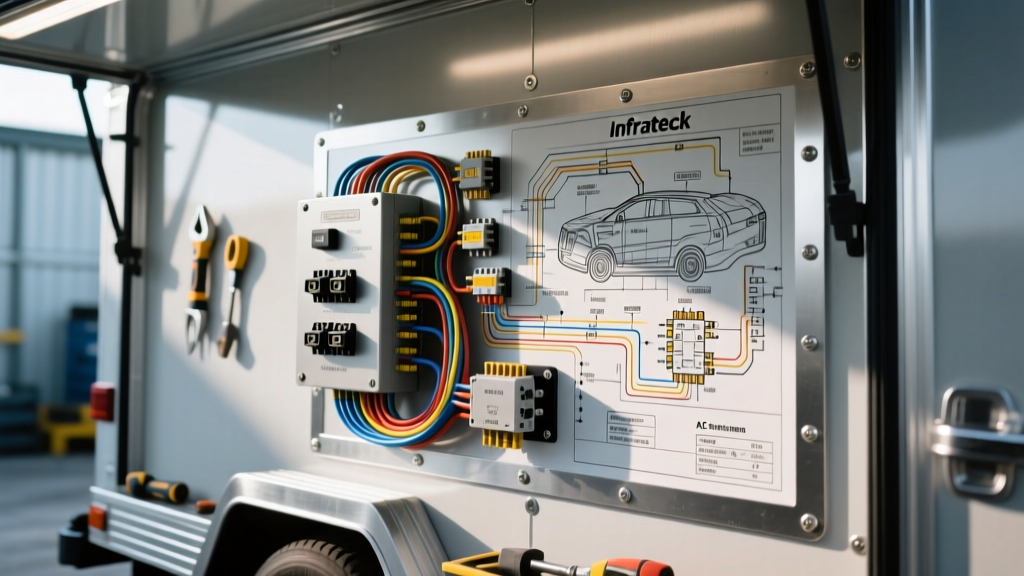
When upgrading an enclosed car trailer, mobile detailing rig, or Sprinter van workshop, maintaining a stable ambient temperature is critical for paint curing, adhesive application, and winter mechanical work. Infratech quartz infrared heaters are the industry standard for these mobile automotive environments due to their zero-airflow design, which prevents dust contamination on fresh clear coats. However, integrating a high-wattage AC appliance into a mobile vehicle or trailer platform requires a meticulous understanding of both AC shore power distribution and DC-to-AC inverter architectures. This comprehensive infratech heater wiring diagram guide details the exact circuit layouts, AWG wire sizing, and solid-state relay (SSR) configurations required to safely install Infratech C-Series and W-Series heaters in mobile automotive workspaces.
Core Circuit Architecture: Shore Power vs. Inverter Topologies
Unlike residential garage installations, mobile automotive shops rely on one of two primary power sources: a 30A/50A shore power inlet (NEMA L5-30 or 14-50) or a heavy-duty pure sine wave inverter tied to the vehicle’s alternator and lithium house bank. The Infratech heater wiring diagram must account for the specific topology you are utilizing.
1. Shore Power Configuration (Enclosed Trailers)
For enclosed car trailers equipped with a 30A AC distribution panel, the Infratech heater is wired as a dedicated branch circuit. The AC hot leg (Black) routes from a 20A GFCI breaker through 12 AWG THHN wire to an Infratech solid-state control relay, then to the heater junction box. The neutral (White) and ground (Green/Bare) bypass the relay and terminate directly at the heater.
2. Off-Grid Inverter Configuration (Sprinter Vans / Box Trucks)
Running a 1500W or 2000W Infratech heater off-grid requires a minimum 3000W Pure Sine Wave inverter. Modified sine wave inverters will cause the Infratech solid-state dimmer relays to overheat and fail catastrophically. The DC side of this diagram requires 2/0 AWG welding cable from the battery busbar to the inverter, protected by a 250A ANL fuse within 7 inches of the positive terminal, per ABYC E-11 mobile electrical standards.
Wire Sizing, Breaker Specs, and Connector Pinouts
Selecting the correct wire gauge is dictated by the heater's voltage and amperage draw, factoring in the 125% continuous load rule mandated by the National Electrical Code (NEC) Article 551 for mobile environments. Below is the specification chart for the most common Infratech models used in mobile automotive bays.
| Infratech Model | Voltage | Wattage | Amperage | Min. Breaker | Wire Gauge (THHN) | Relay Requirement |
|---|---|---|---|---|---|---|
| C1500 (Single) | 120V | 1500W | 12.5A | 15A | 14 AWG | SSR-120 / SR-120 |
| C2000 (Single) | 120V | 2000W | 16.7A | 20A | 12 AWG | SSR-120 / SR-120 |
| C3000 (Dual) | 240V | 3000W | 12.5A | 15A (2-Pole) | 14 AWG | SSR-240 |
| W2500 (Dual) | 208V | 2500W | 12.0A | 15A (2-Pole) | 14 AWG | SSR-240 |
Step-by-Step Wiring Procedure for Enclosed Trailers
Follow this sequence to integrate the Infratech heater into your trailer’s AC subpanel and interior ceiling framing. Always use stranded copper THHN wire for mobile applications to withstand highway vibration and harmonic resonance.
- Mount the Junction Box: Secure the Infratech flush-mount junction box to the trailer ceiling studs using 1/4" lag bolts. Ensure a minimum 14-inch clearance from the ceiling and 18-inch side clearance from combustible materials (e.g., wood cabinetry or insulated walls).
- Run the Branch Circuit: Pull 12 AWG stranded THHN (Black, White, Green) through flexible non-metallic liquid-tight conduit from the AC subpanel to the junction box. Liquid-tight conduit prevents chafing against the trailer's aluminum or steel ribs during transit.
- Wire the Solid-State Relay (SSR): Standard TRIAC wall dimmers will destroy Infratech quartz elements and cause severe EMI interference with vehicle diagnostic tools. Install the Infratech SSR-120 in a ventilated NEMA 1 enclosure. Connect the 120V AC Hot (Black) to the SSR Line-In, and the SSR Load-Out to the heater's internal Black wire.
- Terminate Neutral and Ground: Connect the White (Neutral) wire directly to the heater's White wire using a 12-10 AWG closed-end crimp connector or Wago 221 lever nut. Bond the Green/Bare ground to the heater chassis ground screw and the junction box ground lug.
- Torque Specifications: Terminate the Black and White wires into the 20A GFCI breaker. Torque the breaker terminal screws to exactly 20 in-lbs (0.17 ft-lbs) to prevent thermal arcing under heavy vibration.
Integrating with the Tow Vehicle and DC Systems
If your mobile shop relies on a heavy-duty truck's PTO generator or a massive under-hood alternator upgrade (e.g., a 280A Nations Starter & Alternator), the DC-to-AC wiring diagram becomes the critical bottleneck. To sustain a 2000W Infratech C2000 heater (drawing ~16.7A AC, which translates to roughly 145A DC at 14.4V including inverter efficiency losses), your vehicle's DC wiring must be oversized.
- Alternator to Battery: Use 2/0 AWG fine-strand welding cable.
- Battery to Inverter: Use 2/0 AWG with a 250A Class-T fuse.
- Grounding: The inverter chassis must be bonded to the vehicle chassis using a minimum 6 AWG ground strap, independent of the main DC negative return path.
For detailed OEM alternator pinouts and ECU-controlled variable voltage alternator bypasses required for high-amperage mobile builds, refer to our comprehensive vehicle wiring diagrams database.
Troubleshooting Common Infratech Installation Faults
Mobile environments introduce unique electrical anomalies. Use this diagnostic tree to resolve common Infratech heater failures in automotive trailers and vans.
- Symptom: Heater turns on but immediately trips the GFCI breaker.
Cause: Moisture ingress in the trailer ceiling junction box or an improperly bonded neutral-to-ground downstream of the GFCI.
Fix: Verify the neutral and ground are strictly isolated in the AC subpanel. Apply dielectric grease to the junction box wire nuts and ensure the liquid-tight conduit fittings are sealed with silicone. - Symptom: Solid-state relay emits a loud buzzing noise or overheats.
Cause: The inverter is outputting a Modified Sine Wave (MSW) or the SSR is undersized for the specific Infratech wattage.
Fix: Verify inverter output with an oscilloscope; it must be a Pure Sine Wave (PSW). Ensure the SSR amperage rating exceeds the heater draw by at least 20%. - Symptom: Heater elements glow unevenly or flicker at low dimmer settings.
Cause: Voltage drop across undersized AC wiring or poor terminal crimps.
Fix: Measure voltage at the SSR Load-Out under load. If voltage drops below 112V on a 120V system, upgrade the branch circuit from 14 AWG to 12 AWG or 10 AWG THHN.
Safety Standards and Authoritative References
Modifying automotive and trailer electrical systems carries inherent fire and shock risks. Always adhere to the official Infratech installation manuals for clearances and mounting hardware torque specs. Furthermore, all AC wiring in mobile platforms must comply with NEC Article 551 (Recreational Vehicles and Trailers) or local equivalents for mobile commercial workspaces. Ensure your final installation is verified with a multimeter for continuity, proper grounding impedance, and correct phase rotation before energizing the quartz elements.