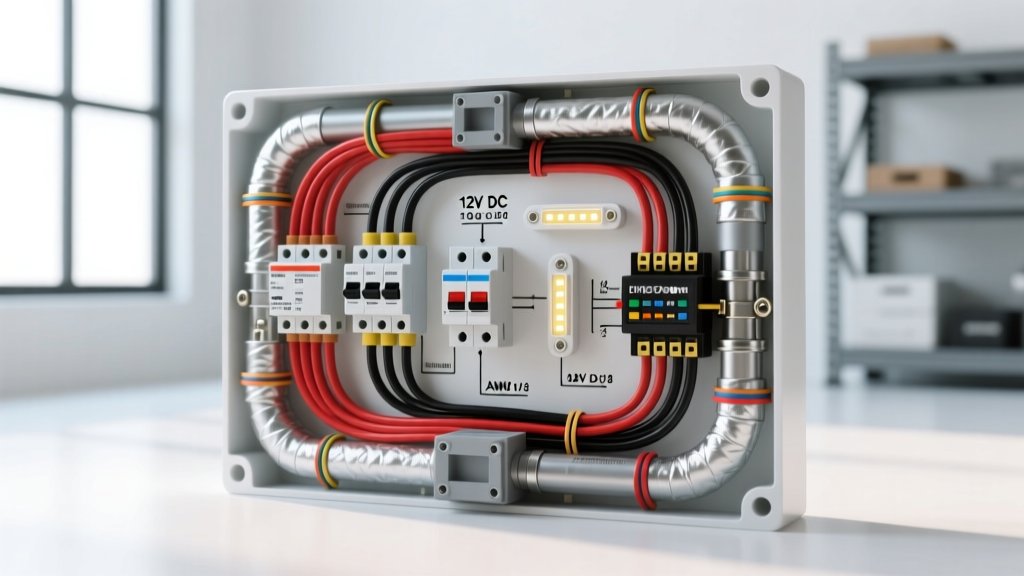
Introduction to 12V DC RV Bedroom Circuits
When transitioning from automotive engine bays to recreational vehicle (RV) living spaces, the electrical principles remain rooted in mobile, vibration-heavy environments. If you are searching for a wiring diagram for a bedroom in a camper van, skoolie, or Class C motorhome, you must immediately discard residential 120V AC logic. A vehicle bedroom operates on a 12V DC (or 24V DC) architecture, demanding strict adherence to automotive wire standards, vibration-resistant terminations, and precise overcurrent protection.
This beginner-friendly guide breaks down the fundamental 12V DC bedroom circuit. We will cover the main distribution feed, branch circuit routing, wire gauge selection, and the critical grounding strategies required to prevent LED ghosting and severe voltage drops. Whether you are wiring a custom Sprinter van conversion or repairing a factory motorhome harness, these automotive electrical fundamentals apply directly to your living space.
Core Components of the Bedroom Circuit Architecture
A standard vehicle bedroom circuit typically powers low-amperage, high-duty-cycle devices. Unlike the high-current draw of an automotive starter motor or an RV inverter, the bedroom branch circuit usually handles:
- LED reading lamps: 2W to 5W each (approx. 0.15A - 0.40A at 12V)
- 12V USB charging receptacles: 15W to 30W (approx. 1.2A - 2.5A)
- 12V ventilation fans: e.g., MaxxFan or Fantastic Vent (drawing 3A to 5A on high)
- Carbon monoxide / propane detectors: 0.5A continuous draw
Because these loads are sensitive to voltage fluctuations and are often left on for extended periods, the wiring diagram for a bedroom must prioritize voltage drop mitigation and clean DC grounding. The circuit originates at a secondary 12V fuse block, travels through the vehicle's wall cavities or headliner, and terminates at the individual components.
Wire Selection: SAE J1128 vs. NEC THHN
The most common beginner mistake in vehicle conversions is using solid-core residential wire (THHN). Automotive and RV environments subject wiring to constant chassis vibration, thermal cycling, and flexing. Solid core wire will work-harden and snap under these conditions, leading to intermittent shorts or open circuits.
For your bedroom branch circuits, you must use stranded, cross-linked polyethylene (XLPE) insulated wire meeting SAE J1128 specifications. The three primary automotive wire types are:
- TXL (Thin wall): Excellent for tight spaces and looms.
- GXL (General wall): The most common and versatile choice for RVs and camper vans.
- SXL (Special wall): Thicker insulation for high-heat areas (usually unnecessary for bedroom interiors).
GXL wire offers an excellent balance of flexibility, abrasion resistance, and high-temperature tolerance (up to 125°C), making it ideal for routing through vehicle wall cavities where sharp metal edges may be present.
AWG Sizing and Ampacity Chart for Bedroom Loads
While 18 AWG wire is technically sufficient for a single 2W LED light, automotive best practices dictate using a minimum of 16 AWG for structural integrity, and 14 AWG or 12 AWG for shared branch circuits to mitigate voltage drop over long vehicle runs.
| Wire Gauge (AWG) | Max Ampacity (Chassis) | Max Ampacity (Prewiring) | Best Bedroom Application |
|---|---|---|---|
| 18 AWG | 16A | 6A | Individual LED reading light pigtails |
| 16 AWG | 22A | 10A | USB receptacle drops, sensor wiring |
| 14 AWG | 32A | 15A | Main bedroom branch circuit (lights + fan) |
| 12 AWG | 41A | 20A | High-draw 12V roof fans, main distribution feeds |
Overcurrent Protection and Fusing Standards
According to NFPA 1192 (Standard on Recreational Vehicles) and standard automotive best practices, every ungrounded (positive) conductor must be protected by an overcurrent device. The fuse must be rated for the wire's ampacity, not just the load's draw.
Rule of thumb: The fuse must be located within 18 inches of the power source. If the bedroom circuit originates from a secondary fuse block located 15 feet away, the primary feed wire to that fuse block must be fused at the battery or main inverter bus bar. For the bedroom branch circuit itself, use a dedicated ATC/ATO blade fuse panel. A 10A fuse on 14 AWG GXL wire provides ample headroom for a 5A fan and multiple LED lights, while ensuring the wire will never overheat in the event of a dead short.
The Grounding Strategy: Avoiding LED Ghosting
In residential wiring, the neutral and ground are bonded at the main panel. In a 12V DC vehicle system, the chassis or a dedicated negative bus bar serves as the return path. Beginners often daisy-chain grounds from one bedroom light to the next, eventually grounding to a single sheet metal screw. This causes voltage drop on the ground side, leading to LED ghosting (lights glowing dimly when switched off) due to back-feeding through shared, high-resistance ground paths.
The Fix: Implement a localized grounding bus bar. Run a dedicated 14 AWG white (DC ground) wire from the main negative bus bar directly to the bedroom. Terminate all bedroom negative loads into this localized bus bar. This star-ground topology ensures that the high current draw of a roof fan does not elevate the ground potential of your sensitive LED reading lights.
Termination, Crimping, and Connector Pinouts
Never use solder-only connections in a vehicle. Solder wicks into the wire strands, creating a rigid point of failure that snaps under chassis vibration. Use a ratcheting crimp tool to apply closed-barrel or open-barrel crimps, followed by adhesive-lined dual-wall heat shrink. The inner adhesive melts and seals the connection against moisture and oxidation, which is critical in uninsulated van walls where condensation occurs.
For modular connections, such as wiring a bed frame that may need to be removed for maintenance, use Deutsch DT series connectors. A standard 2-pin Deutsch DT connector for a bedroom reading light follows this pinout:
- Pin 1 (Socket): 12V+ Positive (Red Wire)
- Pin 2 (Socket): 12V- Negative / Ground (White or Black Wire)
Calculating Voltage Drop for Long Vehicle Runs
Voltage drop is the silent killer of 12V DC systems. If your battery is at 12.6V, but the wire run to the bedroom is too thin, your LED lights might only see 11.2V, causing flickering or premature failure. Use the standard automotive voltage drop formula:
VD = (2 x L x I x R) / 1000
- VD: Voltage Drop
- L: One-way length of the wire in feet
- I: Current (Amps)
- R: Resistance of the wire per 1,000 feet (14 AWG = 2.525 ohms)
Example: A 20-foot run to the bedroom (L=20), powering a 5A fan and lights (I=5), using 14 AWG wire (R=2.525).
VD = (2 x 20 x 5 x 2.525) / 1000 = 0.505 Volts.
This is a 4% drop, which is acceptable (under the 5% SAE threshold). If you used 18 AWG (R=6.385), the drop would be 1.27 Volts (over 10%), resulting in poor fan performance and dim lights.
Troubleshooting Bedroom Circuit Voltage Drop
If your bedroom components are malfunctioning, follow this diagnostic tree:
- Symptom: LED lights flicker when the 12V roof fan turns on.
Cause: Shared positive or negative wire is undersized, causing a transient voltage drop.
Fix: Upgrade the main bedroom branch feed from 16 AWG to 12 AWG, or run a dedicated circuit for the fan. - Symptom: LED lights glow dimly when the switch is OFF (Ghosting).
Cause: High resistance on the shared ground path or a faulty solid-state switch leaking current.
Fix: Install a localized negative bus bar and ensure all ground crimps are tight and free of corrosion. - Symptom: USB charger outputs only 4.5V under load.
Cause: Excessive voltage drop on the positive feed, or a poor crimp at the fuse block.
Fix: Perform a voltage drop test across the fuse and wire connections using a digital multimeter. Replace any crimp showing more than a 0.1V drop under load.
Authoritative References
For further reading on automotive and RV electrical standards, consult the following resources:
- SAE J1128: Low Tension Primary Cable Standard - Defines the physical and thermal requirements for GXL, TXL, and SXL automotive wire.
- NFPA 1192: Standard on Recreational Vehicles - The governing code for 12V DC and 120V AC electrical safety in motorhomes and camper vans.
- Blue Sea Systems: Voltage Drop Calculation Tools - Essential charts for sizing marine and RV DC wiring based on round-trip circuit length.