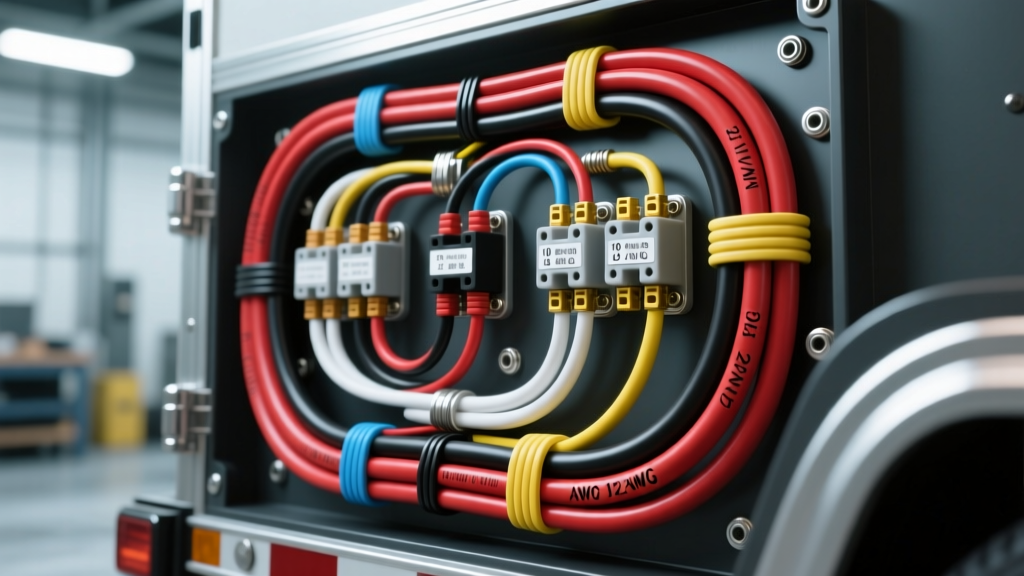
The Definitive Answer: What Gauge Wire for Trailer Lights?
When building or repairing a trailer harness, the most common question DIYers ask is, what gauge wire for trailer lights is actually required? The short answer is that 16 AWG is the absolute minimum for short runs (under 10 feet) with LED lighting, while 14 AWG is the industry standard for typical incandescent setups. However, for runs exceeding 20 feet, or when powering multiple marker lights and dual brake lights, stepping up to 12 AWG is critical to prevent voltage drop and overheating.
Choosing the wrong American Wire Gauge (AWG) does not just result in dim lights; it creates severe fire hazards, melts connector housings, and can trigger fault codes in the Body Control Module (BCM) of modern tow vehicles like the Ford F-150 or Ram 1500. Below is the definitive sizing chart based on circuit amperage and total wire length (positive and ground return combined).
| Total Harness Length | LED Setup (Under 5A) | Incandescent Setup (5A - 10A) | Heavy Duty / Extra Markers (10A+) |
|---|---|---|---|
| Under 10 Feet | 16 AWG | 14 AWG | 12 AWG |
| 10 to 20 Feet | 14 AWG | 12 AWG | 10 AWG |
| 20 to 30 Feet | 12 AWG | 10 AWG | 10 AWG |
| Over 30 Feet | 10 AWG | 10 AWG | 8 AWG |
5 Dangerous Trailer Wiring Mistakes (And How to Fix Them)
Even if you know the basic AWG requirements, installation errors can negate the safety of your wire gauge. Here are the most frequent and hazardous mistakes made during trailer light harness installations.
Mistake 1: Ignoring Voltage Drop on Long Harness Runs
Many builders assume that because a 14 AWG wire can handle 15 amps of current, it is perfectly safe for a 30-foot trailer. This ignores the physics of voltage drop. As wire length increases, resistance increases. If you run 14 AWG wire 30 feet to a set of incandescent brake lights drawing 8 amps, the voltage at the bulb may drop below 10.5V. This results in dim illumination, delayed brake light response, and excessive heat generation within the wire jacket. According to Pacer Group's wire resistance charts, a 12 AWG wire has roughly 40% less resistance than 14 AWG, making it mandatory for long-wheelbase trailers like car haulers and enclosed cargo trailers.
Mistake 2: The Incandescent to LED Amperage Mismatch
Upgrading to LED trailer lights drastically reduces amperage draw (often from 2.1A per 1157 bulb down to 0.2A). While this seems like a good reason to use thinner 18 AWG wire, it is a trap. LED circuits are highly sensitive to resistance and voltage fluctuations. Using wire that is too thin can cause hyper-flashing or trigger the tow vehicle's BCM to assume a bulb is out, shutting down the circuit entirely. Always maintain a minimum of 14 AWG for the main harness trunk, even for LED setups, to ensure structural durability and consistent voltage delivery.
Mistake 3: Relying on a Single 18 AWG Ground Wire
The white ground wire is the most abused circuit on any trailer. A massive mistake is running a single, thin 18 AWG white wire from the 4-way flat connector and daisy-chaining it to every light fixture. If that single ground wire encounters resistance or corrosion, the electrical current will seek an alternative path to ground—often backfeeding through the turn signal or running light circuits. This causes the dreaded "all lights flash when you hit the brake" syndrome. The Fix: Run a dedicated 12 AWG or 10 AWG ground wire directly from the connector to a clean, bare-metal point on the trailer tongue. Furthermore, ground each individual light housing locally to the trailer frame using a minimum 14 AWG wire and a star washer to bite through surface rust.
Mistake 4: Using Household THHN Instead of SAE J1128 GXL
A critical safety warning: never use household building wire (THHN/THWN) or cheap automotive wire with PVC insulation for trailer harnesses. Trailer wiring is subjected to extreme vibration, UV exposure, road salt, and high undercarriage temperatures. According to the SAE J1128 standard for Low Tension Primary Cable, automotive wire must use cross-linked polyethylene (GXL or TXL) insulation. GXL wire features a thinner, harder jacket that resists abrasion against the trailer frame and can withstand temperatures up to 125°C (257°F). Household PVC wire will melt, crack, and short out against the steel frame within a single season of highway towing.
Mistake 5: Overloading the 4-Way Flat Connector Pins
The standard 4-way flat connector is rated for a maximum of roughly 7.5 amps per pin. If you are wiring a large enclosed trailer with 20 incandescent clearance markers, 4 brake lights, and 2 license plate lights, the brown (running light) circuit can easily exceed 12 amps. Pushing 12 amps through a standard 4-way flat pin will cause the plastic housing to melt and the brass contacts to arc, potentially causing a highway fire. For high-amperage lighting setups, you must upgrade to a 7-way RV blade connector, which features heavier-duty pins, or install a dedicated relay harness powered directly by the trailer's onboard battery or a heavy-duty 12V feed from the tow vehicle.
Professional Termination and Safety Protocols
Knowing what gauge wire for trailer lights to use is only half the battle; proper termination prevents 90% of all trailer electrical failures.
- Heat Shrink Butt Connectors: Never use standard vinyl crimp connectors. Use adhesive-lined, polyolefin heat shrink connectors (Red for 16-14 AWG, Blue for 12-10 AWG). The internal adhesive melts and seals out moisture, preventing galvanic corrosion.
- Dielectric Grease: Apply a high-quality silicone dielectric grease to all 4-way or 7-way connector pins. This displaces water and prevents white oxide buildup on the brass terminals.
- Wire Loom and Clamps: Protect the main harness trunk with split-loom tubing. Secure the loom every 18 inches using UV-resistant zip ties or rubber-cushioned Adel clamps. Never use bare metal hose clamps over wiring, as vibration will eventually cut through the insulation.
- Fuse Protection: Always install an inline waterproof fuse holder on the positive feed wire within 12 inches of the power source. Use a 10A or 15A ATO/ATC blade fuse depending on your calculated lighting load.
For comprehensive vehicle-specific pinouts and adapter wiring diagrams, consult resources like the etrailer wiring FAQ to ensure your tow vehicle's factory harness matches your trailer's configuration. By respecting AWG limits, utilizing SAE-rated GXL wire, and executing marine-grade terminations, you will build a trailer lighting harness that is safe, legal, and immune to the elements.