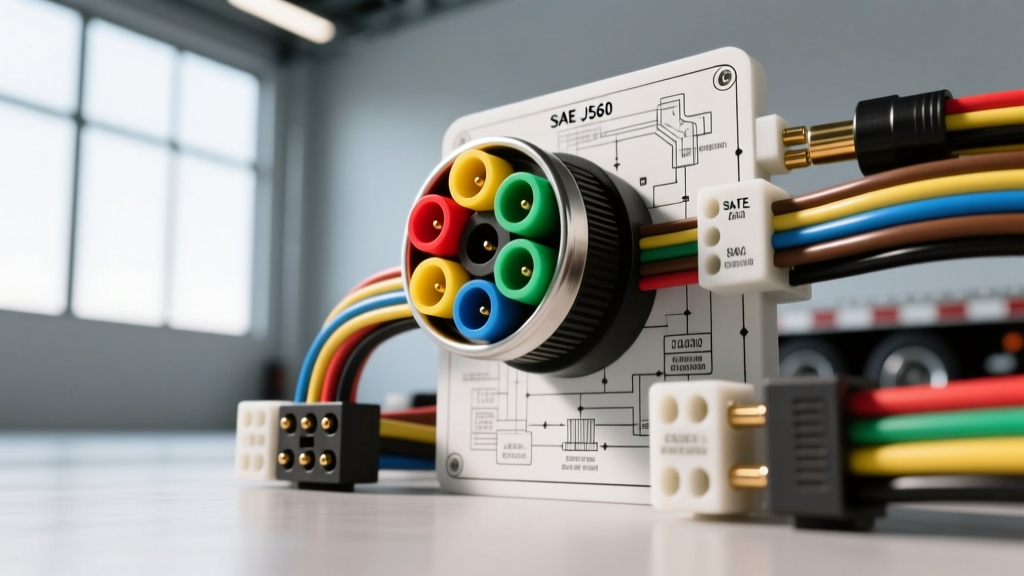
Understanding the SAE J560 Semi Truck Trailer Plug Wiring Diagram
When spec'ing, repairing, or upgrading Class 8 commercial vehicles, relying on a standard RV 7-way blade connector is a critical failure point. Heavy-duty commercial transport requires the SAE International J560 standard, which dictates a robust 7-pin round configuration. This semi truck trailer plug wiring diagram is engineered specifically for 12V high-amperage circuits, powering pneumatic air brake systems, trailer ABS, and heavy LED lighting arrays. Unlike consumer-grade setups, the J560 standard prioritizes high-vibration resistance, extreme temperature tolerance, and strict AWG (American Wire Gauge) sizing to prevent voltage drop over the 60-to-80-foot run between the tractor and the trailer.
In this product comparison and selection guide, we will break down the exact pinout diagram, compare heavy-duty connector housing materials, analyze cable jacket compounds, and outline the termination methods recommended by fleet maintenance councils.
SAE J560 7-Way Round Pin Configuration Chart
The physical layout of the J560 plug features a central pin surrounded by six outer pins, with a keyway at the bottom to prevent misalignment. Below is the definitive wiring matrix for North American commercial trucks.
| Pin Number | Function / Circuit | Standard Wire Color | Minimum AWG Size | Max Continuous Load |
|---|---|---|---|---|
| Pin 1 | System Ground (Chassis) | White | 8 AWG (or 6 AWG) | 40A |
| Pin 2 | Clearance, Side Marker, ID | Black | 12 AWG | 10A |
| Pin 3 | Tail Lights, License Plate | Red | 12 AWG | 10A |
| Pin 4 | Left Turn Signal & Stop | Blue | 12 AWG | 15A |
| Pin 5 | Right Turn Signal & Stop | Green | 12 AWG | 15A |
| Pin 6 | Auxiliary (Reefer, Liftgate) | Brown | 10 AWG | 20A |
| Pin 7 | Tractor ABS / EBS Power | Red or Black | 8 AWG (or 6 AWG) | 40A |
Note: While 12 AWG is standard for lighting circuits, modern fleets running high-draw LED arrays or heated mirrors often upgrade Pins 2 through 5 to 10 AWG to mitigate thermal buildup inside the connector housing.
Product Comparison: Connector Housing Materials
When selecting a replacement plug or socket for a semi-truck trailer harness, the housing material dictates the lifespan of the connection. Commercial environments subject connectors to road salt, caustic chemicals, and severe mechanical impacts.
1. Die-Cast Zinc Housings (Premium Fleet Grade)
Products like the Phillips Industries QCP (Quick-Change Plug) series utilize die-cast zinc shells. Zinc offers superior crush resistance if a trailer jackknife event puts lateral stress on the cable. Furthermore, zinc acts as a sacrificial anode, preventing galvanic corrosion from attacking the internal brass terminals. Selection Verdict: Mandatory for winter-weather fleets and heavy-haul applications where physical impact is a daily hazard.
2. Glass-Filled Nylon / Thermoplastic (Standard Duty)
Thermoplastic housings are lighter and generally less expensive. High-quality glass-filled nylon resists UV degradation and chemical corrosion from diesel exhaust fluid (DEF) and road de-icers. However, in sub-zero temperatures, thermoplastic can become brittle and shatter upon impact from road debris. Selection Verdict: Ideal for regional haulers in moderate climates or dry-van trailers where the cable is heavily protected by the gladhand wrap.
Cable Selection: TPE vs. PVC and AWG Sizing
The cable connecting the tractor to the trailer is a high-wear item. The selection of the outer jacket material and the internal copper stranding is critical for maintaining the integrity of the semi truck trailer plug wiring diagram.
Jacket Material Matrix
| Feature | PVC (Polyvinyl Chloride) | TPE (Thermoplastic Elastomer) |
|---|---|---|
| Cold Flexibility | Cracks below 0°F | Remains flexible down to -40°F |
| Memory / Coiling | Loses coil memory, drags on ground | Excellent retraction memory |
| Abrasion Resistance | Moderate | High (Resists road debris) |
| Cost | Low | High |
According to the Technology & Maintenance Council (TMC) Recommended Practice 137, fleet managers should exclusively spec TPE-jacketed cables for operations that experience freezing temperatures. A PVC cable that loses its coil memory will drag on the asphalt, eventually exposing the 8 AWG ground wire to moisture and causing catastrophic ABS faults.
The Voltage Drop Factor: Why 8 AWG is Non-Negotiable
Pin 1 (Ground) and Pin 7 (ABS Power) are the lifelines of the trailer's braking safety system. The distance from the tractor battery to the trailer ABS modulator can easily exceed 75 feet. Using the standard voltage drop formula, pushing 25 amps through a 12 AWG wire over 75 feet results in a voltage drop of nearly 2.5 volts. If the tractor alternator is outputting 13.8V, the trailer ABS module may only see 11.3V, triggering a fault code and disabling the anti-lock brakes. Upgrading to 8 AWG (or 6 AWG for extreme cold where copper resistance increases) ensures the ABS module receives a stable 12.5V+ under heavy braking loads.
Termination Methods: Crimp vs. Solder vs. Pierce
How the wire attaches to the brass pin inside the connector is just as important as the wire itself. Vibration from the diesel engine and road harmonics will quickly destroy improper terminations.
- Indent Crimping: The industry standard. Using a calibrated pneumatic crimping tool, an indent is pressed into the terminal barrel. This creates a cold-weld gas-tight seal. TMC guidelines strictly recommend indent crimping for J560 connectors.
- Soldering: While soldering provides excellent initial conductivity, it is highly discouraged for commercial trucking. Solder creates a rigid point on a flexible wire. The constant vibration causes the wire to fatigue and snap exactly at the edge of the solder joint, leading to intermittent, hard-to-diagnose electrical faults.
- Insulation Displacement (Piercing): Modern premium connectors, such as those featured on Phillips Industries QCP Data Sheets, use piercing technology. The terminal bites directly through the wire insulation, eliminating the need for stripping and crimping. This reduces human error during roadside repairs and ensures a uniform connection every time.
Troubleshooting Common Semi-Trailer Ground & Backfeed Issues
Even with a perfect semi truck trailer plug wiring diagram on paper, real-world degradation leads to specific failure modes. Here is a diagnostic decision tree for the most common J560 issues:
Symptom: Trailer Marker Lights Illuminated When Headlights Are Off
Cause: The 'Fake Ground' or Backfeed condition. If Pin 1 (White Ground) is heavily corroded or severed, the trailer's lighting system will attempt to ground itself through other circuits. Current flows backward through the tail light circuit (Pin 3) or clearance circuit (Pin 2), illuminating LEDs dimly or causing them to flash in time with the turn signals.
Fix: Do not simply replace the bulbs. Inspect the tractor-side socket for green copper oxide buildup on Pin 1. Use a dielectric grease specifically formulated for high-amperage connections (not standard silicone, which can melt under 40A loads) and ensure the 8 AWG ground wire is securely bonded to the trailer chassis with a star washer and torque spec of 15-20 ft-lbs.
Symptom: Intermittent Trailer ABS Fault Light on Dashboard
Cause: Voltage drop on Pin 7. The ABS module requires a sudden spike in amperage when the system performs its self-check at 5-7 MPH. If the 8 AWG red wire is frayed inside the TPE jacket (often caused by repeated tight turning radiuses stretching the coil), the voltage will sag below the 10.5V threshold required by the ECU.
Fix: Perform a loaded voltage drop test. Connect a headlamp bulb between Pin 7 and Pin 1 at the trailer end to simulate the ABS load. Measure the voltage at the tractor socket. If it drops below 12.0V under load, replace the entire 7-way harness assembly rather than attempting to splice the internal wires, as splices inside the coil wrap will inevitably fail from torsion stress.
Final Selection Recommendations for Fleet Buyers
When outfitting a fleet or upgrading a single owner-operator rig, match the connector to the operational environment. For long-haul, multi-state routes traversing the rust belt or mountain passes, invest in die-cast zinc housings with TPE-jacketed 8/12 AWG hybrid cables and indent-crimped brass terminals. For local drayage or yard hostlers operating in controlled environments, glass-filled nylon housings with standard PVC cables offer a cost-effective solution without sacrificing baseline SAE J560 compliance. Always verify continuity and voltage drop with a digital multimeter before putting a newly wired trailer into revenue service.