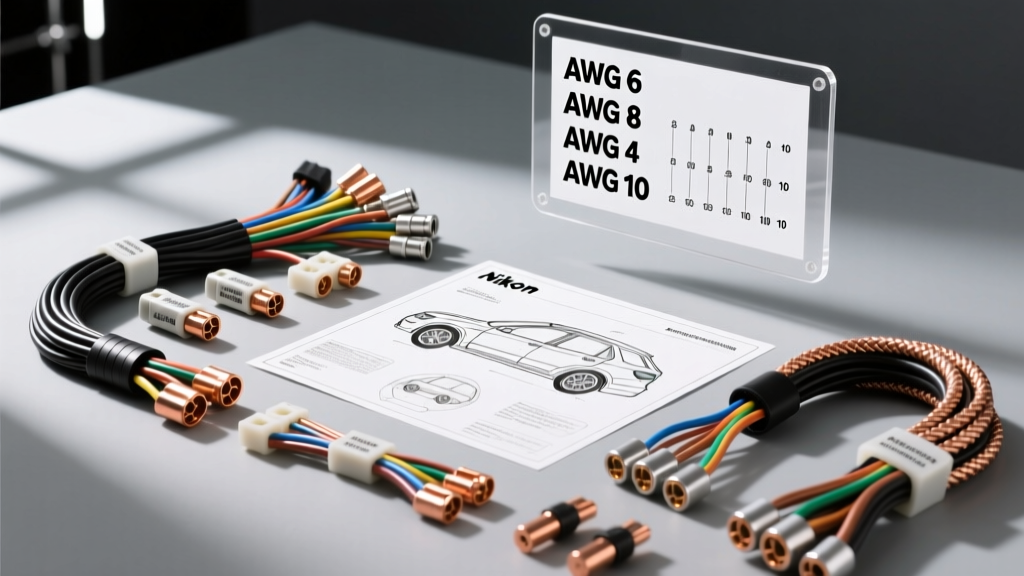
Understanding 220V vs. 240V in Automotive Power
When automotive enthusiasts, EV owners, and RV travelers ask, "what gauge wire for 220V circuits," they are usually referring to Level 2 Electric Vehicle (EV) charging stations or 50-amp RV shore power hookups. In North America, residential and commercial power is technically 240V (split-phase), though the terms 220V, 230V, and 240V are used interchangeably in the automotive and electrical trades. Sizing the correct American Wire Gauge (AWG) for these high-amperage applications is critical to prevent voltage drop, thermal runaway, and catastrophic connector failure.
The Golden Rule of Continuous Loads
According to the National Electrical Code (NEC) Article 210.20, EV chargers and RV shore power connections are classified as continuous loads because they operate at maximum current for three hours or more. Therefore, the circuit breaker and wire ampacity must be rated for 125% of the continuous load. If you are installing a 40-amp Level 2 EV charger, you must use a 50-amp breaker and wire rated for at least 50 amps.
Quick Reference: What Gauge Wire for 220V/240V Circuits?
| Application | Max Continuous Load | Breaker Size | Copper AWG | Aluminum AWG |
|---|---|---|---|---|
| RV 30A (TT-30)* | 24A (120V) | 30A | 10 AWG | 8 AWG |
| EV Charger (32A) | 32A | 40A | 8 AWG | 6 AWG |
| NEMA 14-50 / RV 50A | 40A | 50A | 6 AWG | 4 AWG |
| EV Charger (48A) | 48A | 60A | 4 AWG | 3 AWG |
| EV Charger (80A) | 80A | 100A | 2 AWG | 1/0 AWG |
*Note: A 30-amp RV hookup (TT-30) is strictly 120V, not 220V/240V, despite utilizing a large plug that confuses many DIYers.
EV Level 2 Charger Wiring Specifications
The SAE J1772 standard governs Level 2 EV charging connectors. While the vehicle-side connector handles the communication pilot and proximity pins, the supply-side wiring from your breaker panel to the EVSE (Electric Vehicle Supply Equipment) dictates the safety of the system.
NEMA 14-50 Receptacle Pinout and Wire Colors
The NEMA 14-50R is the most common 220V/240V receptacle for portable EV chargers and 50-amp RVs. It requires a 4-wire configuration:
- Line 1 (X): Black wire (120V to neutral, 240V to Line 2)
- Line 2 (Y): Red wire (120V to neutral, 240V to Line 1)
- Neutral (W): White wire (Current-carrying conductor for 120V accessories)
- Ground (G): Green or Bare Copper wire (Safety ground, non-current-carrying)
For a 50-amp circuit, 6 AWG copper THHN/THWN wire is standard when pulled through conduit. If using NM-B (Romex) cable, 6/3 AWG with ground is required. Ensure the ground wire is sized appropriately; for 6 AWG conductors, a 10 AWG copper ground is the minimum NEC requirement, though many EVSE manufacturers mandate a 6 AWG ground for redundant safety.
RV Shore Power: 50-Amp 220V/240V Hookups
Large motorhomes and fifth-wheel RVs utilize a 50-amp, 120/240V split-phase system. The plug is a NEMA 14-50P. Unlike a 30-amp RV plug, the 50-amp RV system provides two 120V legs that can be combined for 240V appliances (like large residential refrigerators or electric water heaters in luxury coaches).
When wiring a 50-amp RV pedestal in your driveway or shop:
- Use 4 AWG Aluminum or 6 AWG Copper for runs under 50 feet.
- For runs exceeding 75 feet, upsize to 4 AWG Copper or 2 AWG Aluminum to mitigate voltage drop.
- Torque all terminal lugs to the manufacturer's specification (typically 35-45 in-lbs for 6 AWG wire). Loose neutral connections on 14-50 receptacles are the leading cause of melted plugs in the RV and EV communities.
Copper vs. Aluminum: Which Should You Choose?
When determining what gauge wire for 220V runs, material choice heavily impacts the AWG requirement.
- Copper: Higher conductivity, more flexible, and resistant to oxidation. Preferred for indoor garage EVSE installations and short conduit runs. Requires smaller AWG (e.g., 6 AWG for 50A).
- Aluminum (XHHW-2 or THWN-2): Cost-effective for long underground runs to detached shops or remote RV pads. Aluminum expands and contracts more than copper under thermal load, requiring anti-oxidant paste (like Noalox) and strict adherence to torque specs. Requires larger AWG (e.g., 4 AWG for 50A).
Troubleshooting Melted NEMA 14-50 Receptacles
A frequent failure mode in high-amperage 220V automotive applications is the melting of the NEMA 14-50 receptacle face. This is rarely caused by the wire gauge being too small; rather, it is caused by poor mechanical termination.
Symptom-Cause-Fix Decision Tree
- Symptom: Burn mark on the EV plug or RV cord cap near the ground or neutral pin.
- Cause: The receptacle internal contacts have lost tension, or the terminal screws were not torqued to spec during installation, causing high resistance and thermal runaway.
- Fix: Replace the receptacle with a high-grade, industrial-spec 14-50R (e.g., Hubbell or Bryant). Do not use standard residential-grade receptacles for continuous EV charging. Apply a calibrated torque screwdriver to all terminal screws. Ensure wire insulation is stripped exactly to the gauge guide on the device (usually 3/4 inch) so no bare copper is exposed outside the terminal.
Voltage Drop and Long Driveway Runs
If your breaker panel is 150 feet away from your EV charging stall or RV pad, standard ampacity charts are insufficient. According to Tesla's Wall Connector installation guidelines and general engineering best practices, voltage drop should not exceed 3% for branch circuits.
For a 48-amp continuous load on a 60-amp breaker at 240V over 150 feet:
- 4 AWG Copper yields a ~2.8% drop (Acceptable).
- 6 AWG Copper yields a ~4.5% drop (Unacceptable; will cause EVSE to throttle charging speed or fault).
Always calculate voltage drop based on the continuous load amperage, not the breaker size, and use 100% copper for long subterranean conduit pulls to ensure optimal conductivity and heat dissipation.