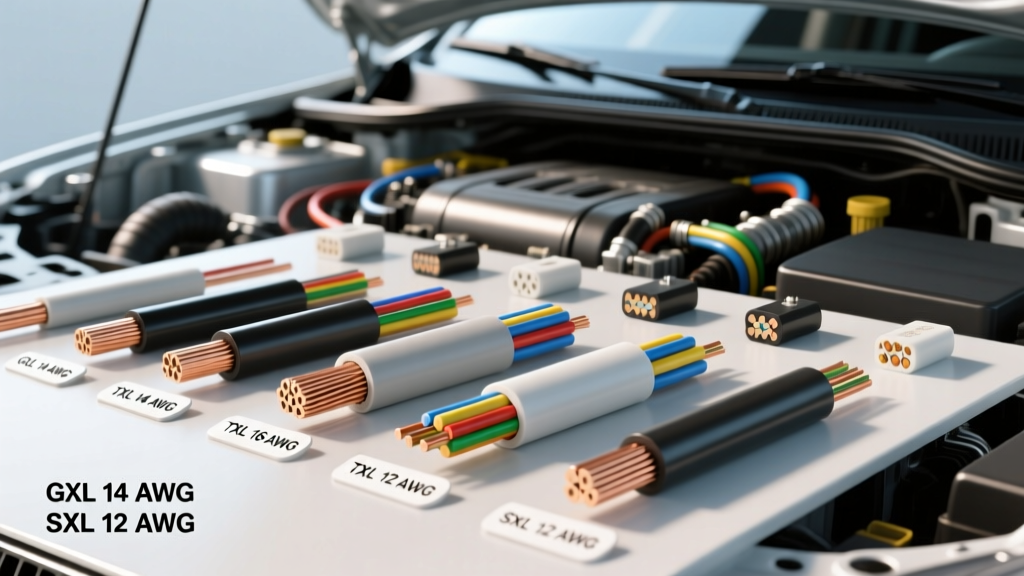
Beyond AWG: The Insulation Factor in Automotive Wiring
When building a custom automotive wiring harness, executing an EV conversion, or repairing a damaged factory loom, selecting the correct gauge wire sizes is only half the battle. While American Wire Gauge (AWG) dictates the copper cross-section and current-carrying capacity (ampacity), the insulation material dictates the wire's outer diameter, heat resistance, abrasion tolerance, and compatibility with specific connector terminals. In the automotive aftermarket and OEM manufacturing sectors, three primary cross-linked polyethylene (XLPE) insulation types dominate the landscape: SXL, GXL, and TXL.
Choosing the wrong insulation type for your specific gauge wire sizes can lead to catastrophic failures. A wire that is too thick may not seat properly in a high-density ECM connector, causing terminal back-out or short circuits. Conversely, a wire with insulation that is too thin may melt when routed near exhaust manifolds or fail under the mechanical stress of engine vibration. This guide compares these three automotive wire standards to help you select the optimal product for your application.
The Core Contenders: SXL vs. GXL vs. TXL
All three wire types meet the SAE J1128 Standard for low-tension primary cable and feature cross-linked polyethylene (XLPE) insulation. This cross-linking process creates a thermoset material that will not melt when exposed to high heat, unlike standard PVC (THHN) wire. However, their physical dimensions vary drastically.
SXL (Standard Cross-Linked)
SXL features the thickest insulation wall of the three. It is designed for extreme abrasion resistance and high-heat environments. You will typically find SXL used in heavy-duty commercial vehicles, agricultural equipment, and older classic car restorations where the wiring is exposed to sharp metal edges and routed through bulkheads without protective grommets.
GXL (General Cross-Linked)
GXL is the "goldilocks" standard for most aftermarket automotive harnesses. It offers a thinner wall than SXL, reducing overall harness weight and bulk, while maintaining excellent heat resistance (up to 125°C) and mechanical protection. It is the default choice for engine bay routing, headlight pigtails, and standard sensor extensions.
TXL (Thin-Wall Cross-Linked)
TXL features the thinnest insulation wall. It is engineered specifically for modern, high-density electronic modules where dozens of circuits must pass through a single connector cavity. TXL is mandatory for late-model OEM harnesses, airbag systems, and CAN-bus networks where space is at an absolute premium.
Technical Specification Matrix by Gauge Wire Sizes
The following table illustrates how the outer diameter (OD) and weight change across common gauge wire sizes depending on the insulation type. Notice how the copper strand count remains identical, but the overall footprint changes significantly.
| AWG Size | Strand Count (Bare Copper) | SXL Outer Diameter | GXL Outer Diameter | TXL Outer Diameter | Max Ampacity (Chassis) |
|---|---|---|---|---|---|
| 18 AWG | 16 x 30 AWG | 0.092" (2.34 mm) | 0.083" (2.11 mm) | 0.072" (1.83 mm) | 6 Amps |
| 14 AWG | 41 x 30 AWG | 0.125" (3.18 mm) | 0.110" (2.79 mm) | 0.097" (2.46 mm) | 15 Amps |
| 10 AWG | 105 x 30 AWG | 0.175" (4.45 mm) | 0.156" (3.96 mm) | 0.143" (3.63 mm) | 30 Amps |
| 8 AWG | 168 x 30 AWG | 0.215" (5.46 mm) | 0.195" (4.95 mm) | 0.175" (4.45 mm) | 40 Amps |
Source: Adapted from TE Connectivity Automotive Wire specifications and SAE J1128 data.
Application-Specific Selection Guide
Engine Bay & High-Ampacity Routing (Choose GXL or SXL)
When routing gauge wire sizes like 10 AWG or 8 AWG for alternator feeds, electric fan relays, or fuel pump power, GXL is the optimal choice. The slightly thicker wall of GXL protects against the sharp edges of sheet metal firewalls and the abrasive vibration of engine-mounted accessories. For example, when wiring a high-output 150-amp alternator using a 4 AWG feed, SXL or GXL will survive the 105°C+ ambient temperatures near the exhaust headers, whereas standard PVC will become brittle and crack.
ECM Pinouts & Thin-Wall Harnesses (Choose TXL)
Modern Engine Control Modules (ECMs) utilize high-density connectors. If you attempt to push 18 AWG GXL into a Metri-Pack 150 or Molex MX150 terminal designed for TXL, the insulation will bunch up, preventing the terminal from locking into the plastic housing cavity. This leads to "terminal back-out," a notorious cause of intermittent misfires and CAN-bus communication codes. Always use 20 AWG or 18 AWG TXL for sensor signals and injector drivers.
Connector Compatibility: Matching Insulation to Terminals
One of the most common mistakes in custom harness building is mismatching the wire insulation thickness to the crimp terminal. Automotive terminals are engineered with specific "F-crimp" (open barrel) geometries that fold the insulation tabs around the wire jacket to provide strain relief.
- Delphi Weather-Pack (Thick Wall): These robust, weather-sealed connectors were designed in the 1970s and 80s. They have large insulation crimp tabs that require SXL or GXL. If you use TXL in a Weather-Pack terminal, the insulation tabs will not grip the wire, leaving the connection vulnerable to pull-out forces and moisture ingress.
- Delphi Metri-Pack 2.8 & 1.5 (Medium/Thin Wall): Metri-Pack 2.8 (used for injectors and coils) works beautifully with GXL. However, the smaller Metri-Pack 150 series (used for MAP sensors, TPS, and O2 sensors) strictly requires TXL to ensure the silicone cavity plugs seal correctly around the wire jacket.
- Molex MX150 & AMP Superseal: These modern, high-density connectors demand TXL. The tight cavity tolerances will physically reject GXL or SXL.
Real-World Case Study: GM E38 ECM Harness Rebuild
To illustrate the practical application of mixing gauge wire sizes and insulation types, let us examine a custom harness build for a GM E38 ECM (commonly used in LS3 and LT1 V8 swaps). The E38 utilizes a 58-pin connector that requires a strategic mix of TXL and GXL.
- Pin 1 (CAN High): Requires 20 AWG TXL (Dark Green). The thin wall allows the terminal to seat fully into the dense 58-way housing.
- Pin 2 (CAN Low): Requires 20 AWG TXL (Dark Green w/ White tracer). Twisted with Pin 1 to maintain the 120-ohm impedance required for high-speed data transmission.
- Pin 32 (Ignition 1 Voltage): Requires 14 AWG GXL (Pink). This circuit powers the internal ECM microprocessors and requires a thicker copper cross-section to prevent voltage drop during engine cranking.
- Pin 19 (Fuel Pump Relay Control): Requires 18 AWG GXL (Gray). Routed to a high-current relay in the engine bay, GXL provides the necessary abrasion resistance for the under-hood environment.
By utilizing TXL for the low-amperage data and sensor pins, and GXL for the power and actuator pins, the harness remains flexible, lightweight, and mechanically sound. For a comprehensive look at terminal and wire pairings, referencing an Alpha Wire Automotive Catalog can help verify exact outer diameters before purchasing your crimp dies.
Voltage Drop: When to Upsize Your Gauge Wire Sizes
While TXL allows you to fit more wires into a small space, you must never compromise on copper cross-section to save space. Voltage drop is the silent killer of automotive electrical systems, particularly in 12V applications where even a 1-volt drop can cause fuel pumps to underperform or headlights to dim.
The formula for voltage drop in a DC circuit is:
VD = (2 x Length x Current x Resistance per 1000ft) / 1000
If you are running a 40-amp electric cooling fan relay located 15 feet from the battery, using 12 AWG wire will result in a voltage drop of approximately 0.95V at the fan motor. While this may seem acceptable, under high under-hood temperatures, copper resistance increases. Upsizing to 10 AWG GXL reduces the voltage drop to 0.60V, ensuring the fan motor receives full system voltage and operates at maximum RPM. Always calculate voltage drop based on the total round-trip length (positive and ground paths) of the circuit.
Expert Sourcing and Tooling Tips
When sourcing wire, always verify that the product is stamped with the SAE J1128 specification and the manufacturer's name. Counterfeit wire often uses PVC disguised as XLPE; you can test this by applying a soldering iron to the jacket. PVC will melt and smoke immediately, while genuine TXL, GXL, or SXL will merely scorch or discolor without melting.
Finally, ensure your crimping tools are calibrated for the specific insulation type. Open-barrel F-crimp dies feature distinct settings for the wire crimp (copper strands) and the insulation crimp (jacket). Because TXL is significantly thinner than GXL, using a GXL die setting on a TXL wire will result in a loose insulation crimp, leading to wire fatigue and eventual strand breakage right behind the terminal. Invest in a high-quality ratcheting crimp tool with interchangeable die sets to guarantee a gas-tight, factory-quality termination every time.