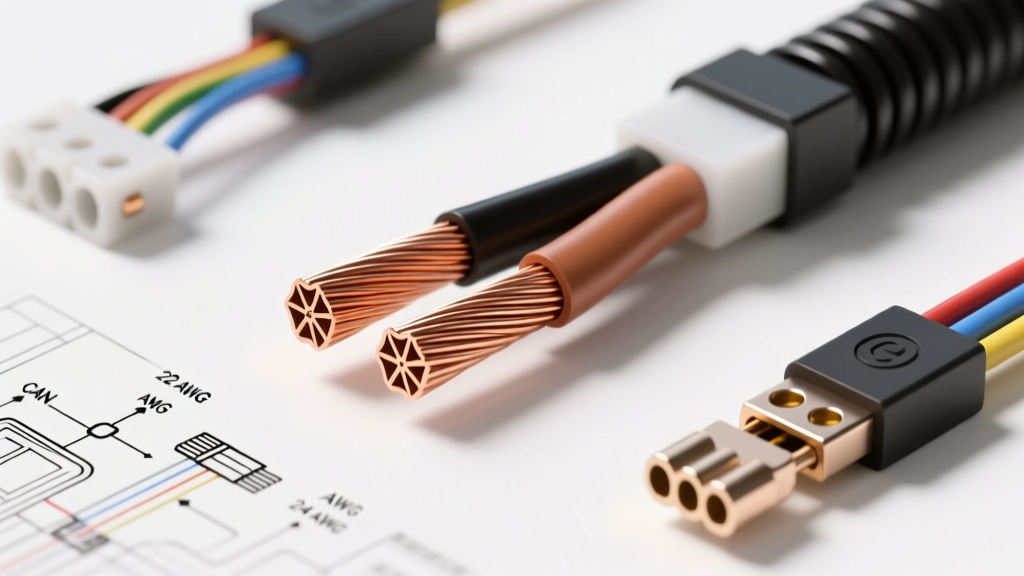
Defining the Thinnest Gauge Wire in Automotive Harnesses
When motorsport engineers, OEM harness designers, and advanced DIY tuners search for the thinnest gauge wire, they are typically targeting extreme weight reduction or navigating the microscopic pin cavities of modern ECU connectors. In traditional 12-volt automotive chassis wiring, standard primary wire usually bottoms out at 18 AWG or 16 AWG. However, modern multiplexed networks, high-impedance sensor arrays, and supplemental restraint systems demand much finer conductors.
In the automotive and powersports realm, the thinnest gauge wire practically deployed in harnesses ranges from 22 AWG down to 26 AWG. These ultra-fine wires are not designed to carry high current; instead, they are engineered to transmit high-speed data, millivolt sensor signals, and low-current logic triggers while minimizing harness bulk and weight. Selecting the correct micro-gauge wire requires a deep understanding of stranding, insulation jackets, and terminal compatibility.
Specification Matrix: 22 AWG vs. 24 AWG vs. 26 AWG
The following table outlines the physical and electrical characteristics of the finest automotive-grade copper wires, typically manufactured to SAE J1128 standards for low-tension primary cable.
| AWG Size | Stranding (Typical) | Conductor Dia. (in) | Max Resistance (Ω/1000ft @ 20°C) | Chassis Ampacity (Max) | Primary Automotive Use |
|---|---|---|---|---|---|
| 22 AWG | 19/34 AWG | 0.0253 | 16.14 Ω | 3.0 - 5.0 Amps | ECU logic triggers, injector signals, SRS squibs |
| 24 AWG | 19/36 AWG | 0.0201 | 25.67 Ω | 1.5 - 2.0 Amps | CAN Bus networks, O2 sensor signal lines, UART data |
| 26 AWG | 19/38 AWG | 0.0159 | 40.81 Ω | 0.5 - 1.0 Amps | Internal ECU pigtails, micro-sensor telemetry, shield drains |
Critical Applications for Ultra-Fine Automotive Wire
Using wire that is too thick for low-current signals can cause terminal back-out, excessive stiffness in tight looms, and difficulty in routing through firewall grommets. Here is where the thinnest gauge wire options are strictly required.
1. CAN Bus Network Topologies (ISO 11898)
High-speed Controller Area Network (CAN-C) bus systems operate at up to 500 kbps and require a twisted-pair topology to reject electromagnetic interference (EMI). The industry standard for CAN bus harnesses is 24 AWG twisted pair.
- OBD-II Port Pinout: Pin 6 (CAN High) and Pin 14 (CAN Low) almost universally utilize 24 AWG or 22 AWG wire.
- Termination: The network requires 120-ohm terminating resistors at each end of the bus. Using wire thinner than 26 AWG increases resistance, potentially skewing the termination value and causing bus-off errors.
- OEM Color Codes: General Motors typically uses Dark Green (CAN H) and Dark Blue (CAN L). Ford often uses White (CAN H) and White with a Black tracer (CAN L). Toyota favors Pink (CAN H) and Violet (CAN L).
2. High-Impedance Sensor Signal Returns
Wideband oxygen sensors, such as the Bosch LSU 4.9, utilize a multi-pin connector (typically a 5-pin or 6-pin Molex MX150 or TE Deutsch). The calibration and pump cell signal wires carry incredibly low milliamp currents.
- Wire Selection: The signal return wire (often White or Grey) is usually 24 AWG.
- Failure Mode: If a builder attempts to repair a wideband O2 pigtail using standard 18 AWG wire, the stiffness of the thicker wire will transfer mechanical vibration directly to the microscopic crimp joint inside the sensor cap, leading to an internal open circuit and a P0030/P0130 DTC.
3. Supplemental Restraint Systems (Airbag Squibs)
Airbag circuits (SRS) are highly sensitive to resistance changes. The squib initiators typically require 22 AWG or 24 AWG wire.
- Identification: SRS wiring is universally jacketed in bright yellow outer looms or yellow insulation to warn technicians of explosive devices.
- Shorting Bars: The connectors feature internal shorting bars that bridge the 22 AWG pins when disconnected to prevent accidental deployment via static discharge. Never probe these circuits with a standard multimeter; use a dedicated SRS simulator tool.
Insulation Jacket Selection: TXL vs. GXL vs. SXL
When sourcing the thinnest gauge wire, the copper stranding is only half the equation. The insulation must withstand under-hood temperatures while remaining thin enough to fit into micro-connectors.
- TXL (Thin Cross-Linked): The absolute best choice for 24 AWG and 26 AWG. TXL has the thinnest insulation wall (approx. 0.010 inches), allowing the wire to fit into the tightest cavities of TE Connectivity AMPSEAL and Molex MX150 connectors. Rated to 125°C.
- GXL (General Cross-Linked): Slightly thicker insulation than TXL. Better for 22 AWG wires that might be routed near exhaust manifolds where abrasion resistance is slightly more critical than cavity fitment. Rated to 125°C.
- PTFE (Teflon): Used in extreme aerospace and top-fuel motorsport applications. PTFE 26 AWG wire can handle 200°C+ and has incredible dielectric strength, but it requires specialized stripping tools to avoid nicking the ultra-fine 19/38 stranding.
Terminal and Connector Compatibility Matrix
You cannot force 24 AWG wire into a standard Weather-Pack or Metri-Pack 150 terminal; the wire will pull out under minimal tension. You must use connectors specifically stamped for micro-gauge wire.
| Connector System | Terminal Blade/Pin Size | Supported Wire Gauges | Common Application |
|---|---|---|---|
| Molex MX150 | 0.64mm | 22 AWG - 24 AWG | ECU headers, Wideband O2 pigtails, MAP sensors |
| TE Deutsch DTM | Size 20 Pin/Socket | 20 AWG - 24 AWG | Transmission TCMs, ABS modules, CAN bus junctions |
| TE AMPSEAL 16 | Size 16 (Reduced Dia) | 20 AWG - 22 AWG | Heavy-duty engine management, John Deere/CAT harnesses |
| JST JWPF | 0.64mm Waterproof | 24 AWG - 26 AWG | Motorcycle ECU sub-harnesses, drone telemetry |
Crimping Best Practices for 22-26 AWG Wire
Crimping the thinnest gauge wire requires precision. Standard ratcheting crimpers with stamped jaws will often crush 24 AWG strands or fail to fold the insulation support wings properly.
- Stripping: Use a thermal wire stripper or a high-precision micro-stripper (like the TE 58496-1). Standard mechanical strippers will frequently nick 19/36 AWG stranding, reducing the tensile strength of the wire by up to 40%.
- Open Barrel Crimping: Most modern automotive micro-terminals (MX150, AMPSEAL) use open-barrel 'F' crimps. You must use a crimp die that creates a distinct 'B' or 'M' shape in the conductor crimp, ensuring all 19 strands are compressed without being cut.
- Insulation Support: The secondary crimp wings must grip the TXL jacket tightly. If the jacket is loose, engine vibration will transfer directly to the copper crimp, causing work-hardening and eventual wire fracture.
- Tensile Testing: A proper 24 AWG crimp on an MX150 terminal should withstand a minimum pull-force of 15 lbs before the copper yields.
Real-World Failure Modes & Troubleshooting
When diagnosing faults in circuits utilizing the thinnest gauge wire, technicians must look beyond standard continuity checks.
The 'Green Death' Capillary Effect
Because 24 AWG and 26 AWG wires have high strand counts relative to their diameter, the capillary action between the strands is immense. If moisture breaches a poorly sealed connector, battery acid and road salt will wick deep into the harness via the wire strands, causing internal copper oxidation (green death). The Fix: Always use adhesive-lined, dual-wall heat shrink (e.g., 3/16" with a 3:1 shrink ratio) over any splice in 22-26 AWG wire. The melted adhesive blocks the capillary pathways between the copper strands.
CAN Bus Voltage Drop and Skew
According to Bosch CAN physical layer specifications, high-speed CAN requires strict symmetry between CAN High and CAN Low. If a repair is made using 24 AWG for CAN High, but 22 AWG is used for CAN Low due to parts availability, the difference in resistance per foot will cause signal skew. This results in a narrowed data eye-pattern, leading to intermittent communication dropouts when the ECU reaches operating temperature and wire resistance increases. The Fix: Always repair CAN bus twisted pairs with matched, factory-spec 24 AWG twisted cable. Never untwist more than 2 inches of the pair when splicing.
Summary Selection Guide
Choosing the thinnest gauge wire is an exercise in balancing mechanical fragility with electrical necessity. Use 22 AWG TXL for ECU logic outputs, injector grounds, and SRS circuits where a slightly higher current spike occurs. Rely on 24 AWG TXL for all CAN bus topologies, UART data lines, and high-impedance sensor signals. Reserve 26 AWG strictly for internal shielding drains, thermocouple extensions, and specialized telemetry where weight is the absolute primary constraint. Always pair these micro-wires with their designated open-barrel terminals and adhesive-lined heat shrink to ensure longevity in harsh automotive environments.