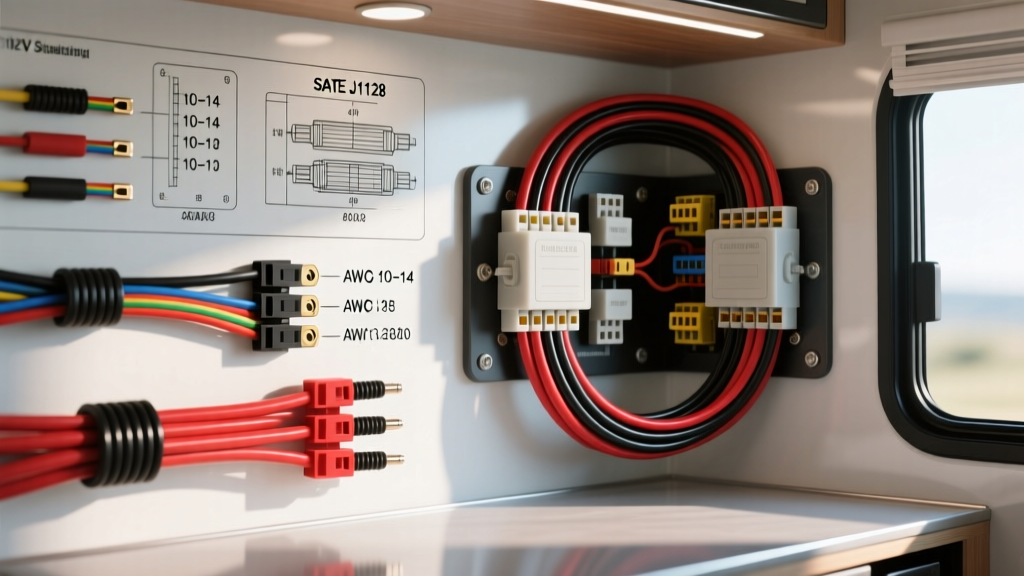
The Core Conflict: NEC Home Wiring vs. SAE Automotive Standards
When transitioning from residential electrical work to 12V DC vehicle builds, relying on your knowledge of standard home wire gauge ampacity tables will lead to catastrophic voltage drop, terminal failures, and potential fire hazards. While the National Electrical Code (NEC) governs residential wiring and standard home wire gauge applications, automotive and marine environments operate under entirely different physical and electrical stresses. In the RV, overland, and camper van sectors, builders frequently attempt to use standard NM-B (Romex) or THHN copper wire for 12V DC branch circuits because it is cheap and readily available at big-box hardware stores. This is a critical engineering mistake.
Automotive wiring is governed by SAE J1128 standards, which dictate specific strand counts, insulation dielectric strengths, and thermal tolerances designed for high-vibration, high-heat, and chemical exposure environments. Understanding the exact specifications where standard home wire gauge diverges from automotive SAE wire is essential for any 12V DC system architect.
Standard Home Wire Gauge Chart (NEC / AWG)
Standard home wire gauge sizing is based on the NEC (NFPA 70) ampacity tables for 60°C and 75°C rated insulation in a static, climate-controlled, zero-vibration environment. Below is the baseline for common residential AC wiring:
| AWG Size | Max Ampacity (60°C) | Typical AC Application | Conductor Type |
|---|---|---|---|
| 14 AWG | 15 Amps | Lighting, 120V Receptacles | Solid Core Copper |
| 12 AWG | 20 Amps | Kitchen/Bath 120V Circuits | Solid Core Copper |
| 10 AWG | 30 Amps | Dryers, Water Heaters (240V) | Solid/Stranded (7) |
| 8 AWG | 40 Amps | HVAC, Subpanels | Stranded (7-19) |
Automotive Wire Gauge Chart (SAE J1128 GXL)
Automotive GXL (Cross-linked Polyethylene) wire features a much higher strand count for flexibility and a thinner, tougher insulation jacket. Ampacity in a vehicle is heavily dependent on whether the wire is routed in the engine bay (high heat) or the cabin (moderate heat).
| AWG Size | Strand Count | Max Amps (Cabin 12V DC) | Insulation Temp Rating |
|---|---|---|---|
| 14 AWG | 19 | 25 Amps | 125°C (GXL) |
| 12 AWG | 19 | 35 Amps | 125°C (GXL) |
| 10 AWG | 19 | 50 Amps | 125°C (GXL) |
| 8 AWG | 19 | 70 Amps | 125°C (GXL) |
| 4 AWG | 133 | 120 Amps | 125°C (SGT/GXL) |
Why Standard Home Wire Fails in 12V Automotive Environments
1. Vibration Fatigue and Solid Core Snapping
The most glaring difference between standard home wire gauge conductors and automotive wire is the strand count. Standard 14 AWG and 12 AWG home wire (NM-B) utilizes a solid copper core. In a static wall, solid core is superior for pushing through conduit and terminating in screw-terminals. In a moving vehicle, engine harmonics, road chatter, and chassis flex induce continuous micro-vibrations. Solid core copper work-hardens rapidly under vibration and will eventually snap inside the insulation, creating an invisible open circuit or a high-resistance arc fault. Automotive SAE wire utilizes fine-stranded, annealed copper (e.g., 19 strands for 14 AWG, up to 259 strands for battery cables) to absorb kinetic energy without fracturing.
2. Insulation Breakdown and Fluid Resistance
Standard home wire utilizes PVC or nylon (THHN) insulation. PVC becomes brittle at low temperatures and softens at relatively low heat thresholds (typically rated for 75°C to 90°C). Furthermore, PVC is highly susceptible to degradation from automotive fluids, road salts, and UV exposure. SAE J1128 GXL and TXL wires use Cross-Linked Polyethylene (XLPE). XLPE is chemically inert to oil, grease, and battery acid, and maintains its dielectric integrity at continuous temperatures up to 125°C, withstanding the radiant heat found near exhaust manifolds and inverters.
12V DC Math: The Voltage Drop Reality
The primary reason builders incorrectly size wire is by applying 120V AC logic to 12V DC systems. In a home, a 1200W microwave draws 10 Amps. A standard home wire gauge of 14 AWG handles this easily with negligible voltage drop over 50 feet. In a 12V DC camper van, a 1200W inverter load draws 100 Amps (plus inverter inefficiency, pushing it closer to 115 Amps).
Voltage drop in DC systems is calculated using the formula:
Voltage Drop = (2 x Length x Current x Resistance per 1000ft) / 1000
According to Blue Sea Systems DC wiring guidelines, a 3% voltage drop is the maximum acceptable threshold for critical electronics, and 10% for non-critical lighting. If you attempt to run a 100A load over a 10-foot round trip using a standard home wire gauge of 2 AWG (which is rare in home wiring but common in auto), you will still experience a 2.5% drop. Using undersized home wire for high-amperage DC loads results in the wire acting as a heating element, melting the PVC insulation and shorting against the metal chassis.
12V Camper Van Wiring: Bridging Home and Auto Standards
There is one specific scenario where standard home wire gauge rules do apply in a vehicle: the 120V AC side of an RV electrical system. According to NFPA 70 (NEC) Article 551, which governs Recreational Vehicles, the 120V AC branch circuits originating from the inverter or shore power inlet must be wired using standard NEC-approved methods. This means using 14 AWG or 12 AWG THHN/THWN stranded copper routed through flexible liquid-tight conduit or using approved RV-rated NM cable. However, the 12V DC distribution system must strictly adhere to SAE or ABYC (American Boat and Yacht Council) marine standards.
Inverter and Battery Bank Connections
For a 3000W 12V inverter (like a Victron MultiPlus), peak draw can exceed 250 Amps. Standard home wire gauge charts do not even account for this amperage in flexible, high-vibration applications. You must use SAE J1128 SGT (Starter Ground Tube) or fine-stranded welding cable (e.g., 4/0 AWG with 5,262 strands of 30 AWG copper). These cables require heavy-duty, adhesive-lined heat shrink ring terminals crimped with a hydraulic or heavy mechanical crimper to ensure a gas-tight connection that prevents oxidation.
DC Fuse Block and Branch Circuits
When wiring a Blue Sea STBlade fuse block to 12V DC loads (LED lights, water pumps, MaxxAir fans), use 14 AWG or 12 AWG GXL automotive wire. Do not use solid core home wire. The blade terminals and push-pin connectors used in automotive relays and Deutsch DT connectors are engineered to bite into stranded wire. Inserting solid home wire into a standard automotive spade terminal will result in a loose mechanical fit, leading to arcing, localized melting, and eventual failure of the component.
Authoritative References & Standards
- SAE International: SAE J1128 - Low Tension Primary Cable Standard for automotive electrical systems.
- National Fire Protection Association (NFPA): NFPA 70 (NEC) Article 551 - Recreational Vehicles and RV Parks.
- Blue Sea Systems: DC Wiring Standards and Voltage Drop Tables for Marine and Mobile applications.