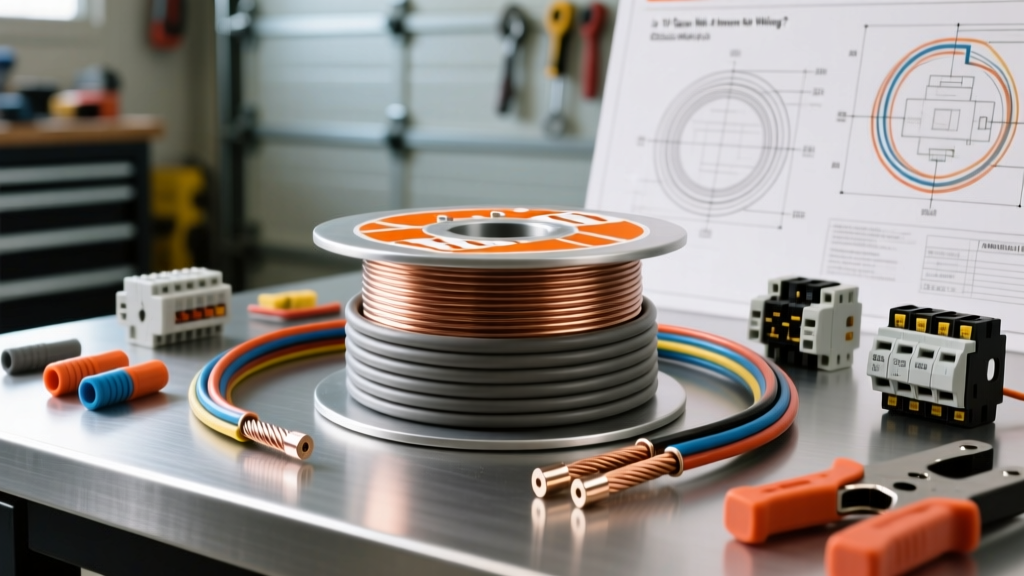
The Big Box Store Wiring Trap: Why Context Matters in 12V Systems
When a weekend project requires running a high-amperage circuit—like an off-road lighting relay, a winch solenoid feed, or an auxiliary fuse block—it is incredibly tempting to pick up a spool of 10 gauge wire at Home Depot or a similar big-box hardware store. The copper looks shiny, the gauge is stamped on the insulation, and the price is often lower than specialized automotive suppliers. However, substituting residential building wire for automotive primary cable is one of the most dangerous and common mistakes in mobile electrical systems.
To understand why, you must recognize the fundamental difference between a 120V alternating current (AC) home grid and a 12V to 14.4V direct current (DC) automotive environment. In a home, a minor voltage drop across a wire is negligible. In a vehicle, a 1.5V drop across a poorly specified 10 AWG wire represents over a 10% loss of system voltage. This drop can cause starter solenoids to chatter, fuel pumps to starve, and sensitive ECU modules to brown-out and reset. Furthermore, the physical environment under a vehicle's hood or within its chassis involves extreme thermal cycling, constant vibration, and exposure to corrosive fluids that residential wire was never engineered to survive.
SAE J1128 vs. NEC: Understanding the Insulation Divide
The core issue with buying 10 gauge wire at Home Depot for a car is the insulation specification. Hardware stores sell wire rated for the National Electrical Code (NEC) and UL listings, typically THHN or THWN-2. Automotive wire must comply with the SAE J1128 Standard for Low Tension Primary Cable, specifically types like GXL, TXL, or HDT.
| Specification | Automotive (SAE J1128 GXL) | Building (NEC THHN/THWN) |
|---|---|---|
| Insulation Material | Cross-linked Polyethylene (XLPE) | PVC with Nylon Jacket |
| Max Temperature | 125°C (Continuous) | 90°C (Dry) / 75°C (Wet) |
| Fluid Resistance | High (Resists oil, gas, battery acid) | Low (Degrades with petroleum exposure) |
| Strand Count (10 AWG) | ~105 Strands (Highly flexible) | 19 to 37 Strands (Stiff) |
| Insulation Thickness | 0.010 inches (Thin, saves space) | 0.020+ inches (Thick, bulky) |
As the table illustrates, THHN insulation relies on a PVC base that becomes brittle in freezing temperatures and melts or dissolves when exposed to engine oil, transmission fluid, or power steering leaks. SAE GXL wire uses cross-linked polyethylene, which is chemically inert to most automotive fluids and can withstand the radiant heat of exhaust manifolds without deforming.
Common Mistakes When Sourcing 10 AWG Wire Locally
Mistake 1: Assuming THHN is Under-Hood Safe
Many DIYers run THHN through split-loom tubing, believing the loom provides adequate protection. However, split loom traps heat and moisture. When THHN is subjected to under-hood temperatures exceeding 100°C near the firewall or valve covers, the PVC plasticizers leach out. The insulation cracks, exposing bare copper to the chassis, resulting in a dead short and a potential engine bay fire. Always use SAE-rated GXL or TXL for any wire routed through the firewall or engine bay.
Mistake 2: Falling for CCA (Copper Clad Aluminum)
Big box stores and online marketplaces are increasingly flooded with CCA (Copper Clad Aluminum) wire disguised as pure copper. CCA wire features an aluminum core with a microscopic copper wash. Aluminum has roughly 61% the conductivity of copper. To carry the same current safely, a CCA wire must be two AWG sizes larger than pure copper. If you use 10 AWG CCA wire for a 30-amp circuit, it will behave electrically like 12 or 14 AWG copper, leading to severe voltage drop, overheating, and melted terminals. Always verify the spool specifies OFC (Oxygen-Free Copper) or bare, unalloyed copper.
Mistake 3: Using Solid Core Wire in Mobile Applications
Home Depot primarily sells solid core 10 AWG wire (often found in NM-B Romex cables) for residential branch circuits. Solid core wire has zero tolerance for vibration. In a vehicle, the constant micro-vibrations from the chassis and engine will cause solid copper to work-harden, fatigue, and eventually snap inside the insulation. This creates an intermittent open circuit that is a nightmare to diagnose. Automotive wire must always be finely stranded (typically 105 strands of 30 AWG for a 10 AWG cable) to flex with the vehicle's movement.
Automotive 10 AWG Applications & Correct Terminations
When properly sourced from an automotive supplier, 10 AWG SAE GXL wire is the backbone of high-current accessory circuits. Common applications include:
- Starter Solenoid Feeds: Routing from the battery junction block to the starter relay (though main battery cables are typically 4 AWG to 1/0 AWG, 10 AWG is used for the relay trigger and secondary ignition feeds).
- High-Amp Off-Road Lighting: Powering a 40A relay that feeds multiple 50W LED light bars. 10 AWG prevents voltage drop over long runs to the front grille.
- Winch Control Circuits: Supplying heavy-duty continuous-duty solenoids in the engine bay.
- Aftermarket Audio: Main power runs for mid-level amplifiers (up to ~600W RMS) where the run is under 10 feet.
Terminating 10 AWG wire requires specialized hardware. Standard vinyl-insulated crimp terminals found in the hardware store electrical aisle often lack the internal wire grip necessary for high-vibration environments. Instead, use Delphi Weather-Pack or Metri-Pack connectors with the correct gray silicone seals designed specifically for 10-8 AWG wire. For ring terminals, use adhesive-lined, dual-wall heat shrink terminals (such as 3M Highland or equivalent) and crimp them with a dedicated ratcheting crimper calibrated for 10 AWG non-insulated or insulated dies. A proper crimp should withstand a 60 lb pull-test without the wire slipping.
Real-World Failure Modes: Symptom-Cause-Fix Decision Tree
When incorrect wire types or poor termination practices are used, the vehicle will exhibit specific electrical gremlins. Use this diagnostic tree to troubleshoot 10 AWG circuit failures:
- Symptom: Melted or discolored insulation near the crimp terminal.
Cause: High resistance connection due to using a mismatched crimp die on THHN wire, or the nylon jacket of THHN preventing the copper barrel from biting into the conductor.
Fix: Cut back the damaged wire. Strip SAE GXL wire, ensuring no insulation is inside the crimp barrel. Use a ratcheting crimper and verify the pull-test. - Symptom: Auxiliary lights dim significantly when the engine is idling, but brighten when RPMs increase.
Cause: Severe voltage drop caused by using CCA wire instead of pure copper, or using a wire strand count that is too low for DC current transfer.
Fix: Replace the run with 99.9% OFC 10 AWG SAE wire. Verify the ground path is sanded to bare metal and treated with dielectric grease. - Symptom: Circuit breaker trips or inline fuse blows randomly on rough terrain, despite the load drawing less than the fuse rating.
Cause: Solid core wire or stiff THHN has cracked internally due to chassis flex, causing momentary short circuits against the chassis or internal arcing that spikes current.
Fix: Perform a continuity and wiggle test. Replace the entire run with highly flexible 105-strand automotive primary wire and secure it with P-clips and rubber grommets through all sheet metal pass-throughs.
The Verdict: Sourcing Your Wire Safely
While picking up 10 gauge wire at Home Depot is convenient for wiring a 240V welder outlet or a garage sub-panel, it has no place in your vehicle's electrical harness. The savings of a few dollars on a spool of THHN are entirely negated by the risk of electrical fires, stranded vehicles, and destroyed electronic modules. Always source SAE J1128 compliant GXL or TXL wire from dedicated automotive electrical suppliers, ensure it is pure stranded copper, and terminate it with environmental connectors designed to withstand the brutal realities of the road. For comprehensive circuit protection guidelines and fuse sizing charts, consult resources like Littelfuse Automotive Circuit Protection to pair your correctly sized wire with the appropriate ATO, MAXI, or MIDI fuses.