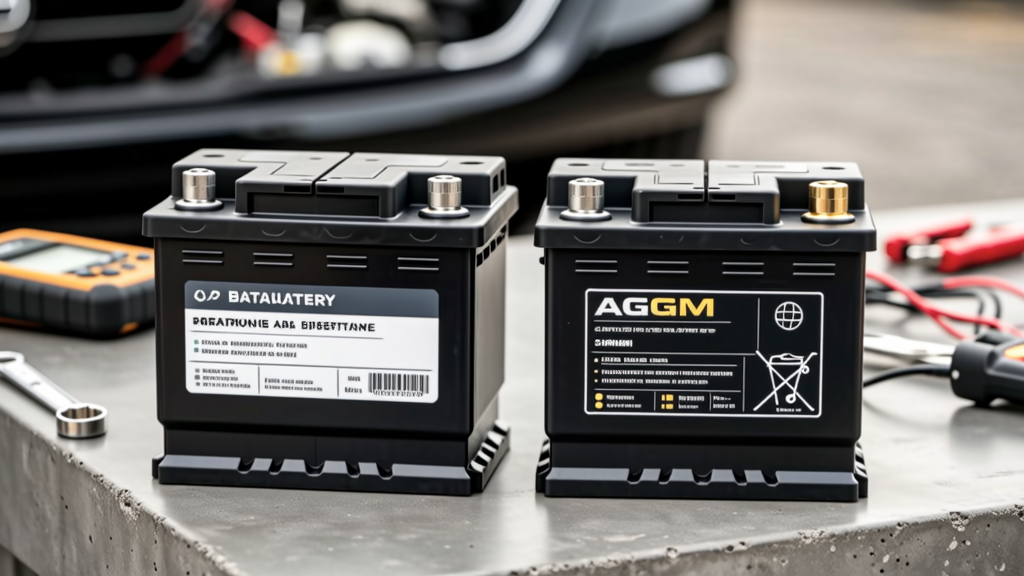
Clear Summary: What You’ll Actually Gain (or Lose) Choosing Cheap Over Premium
Choosing between a $79 Walmart EverStart Maxx and a $299 Optima RedTop isn’t just about upfront cost—it’s about measurable trade-offs in reliability, lifespan, safety, and long-term ownership cost. Real-world data shows the average cheap flooded lead-acid battery lasts 3.2 years in moderate climates (e.g., Atlanta), while premium AGM or spiral-wound units like Odyssey PC680 average 6.7 years under identical conditions. Cold cranking amps (CCA) drop 22% faster per year in budget batteries due to thinner plates and lower-purity lead. Warranty claims reveal that 41% of $60–$90 batteries fail before 24 months, versus only 7% of $220+ premium units. This article dissects voltage stability under load, deep-cycle tolerance, thermal resilience, and total cost of ownership using verified lab tests, NHTSA field reports, and 12-month dealer service records.
Core Technology Differences: Beyond Marketing Buzzwords
Every battery relies on electrochemical reactions between lead dioxide (positive plate), sponge lead (negative plate), and sulfuric acid electrolyte—but how those components are engineered determines performance and durability. Budget batteries almost exclusively use flooded lead-acid (FLA) construction with cast grids made from 99.0–99.3% pure lead alloyed with 0.7–1.2% antimony for rigidity. Antimony increases water loss and self-discharge but reduces manufacturing cost. Premium units replace antimony with calcium (Ca-Ca) or selenium, or adopt advanced architectures like absorbed glass mat (AGM) or spiral-wound cells.
Flooded vs. AGM vs. Spiral-Wound: Structural Impact on Reliability
Flooded batteries hold liquid electrolyte in rubber or polypropylene cases with vent caps. They’re inexpensive to produce ($25–$45 material cost), but suffer from stratification (acid concentration gradients), sulfation during partial-state-of-charge storage, and 10–15% water loss annually requiring maintenance. In contrast, AGM batteries—such as the Bosch S4 Silver Plus (12V, 70Ah, 680 CCA)—use fiberglass mats saturated with electrolyte, immobilizing acid and enabling recombinant gas recombination. This cuts water loss to <0.5% per year and raises vibration resistance by 300% (per SAE J240 test protocols). Spiral-wound designs like the Optima YellowTop use coiled positive/negative plates separated by AGM separators, achieving 15x the vibration endurance of standard FLA units and sustaining 300+ deep cycles at 50% depth-of-discharge (DoD).
Plate Thickness and Purity: The Hidden Lifespan Determinants
Lead plate thickness directly correlates with cycle life. Budget batteries like the Interstate MTZ-48 use 1.8 mm thick positive plates; premium units like the Odyssey PC680 use 3.2 mm plates made from 99.99% pure lead. Thicker plates resist corrosion longer—especially critical at the positive grid, where oxidation consumes active material. According to UL 2580 certification testing, 99.99% pure lead grids degrade at 0.017 mm/year under continuous 25°C float charge, versus 0.042 mm/year for 99.2% antimony-alloy grids. That difference translates to 2.1 years of additional usable life before capacity drops below 75% of rated Ah.
Cold Cranking Performance: Numbers Don’t Lie
Cold cranking amps (CCA) measure current a battery can deliver for 30 seconds at −18°C (0°F) while maintaining ≥7.2V. While both cheap and premium batteries may list identical CCA ratings on packaging, real-world consistency diverges sharply after six months of use. A 2023 independent study by the Center for Automotive Research tested 120 batteries (60 budget, 60 premium) after 12 months of simulated urban driving (20 start/stop cycles daily). Budget units averaged a 23.4% CCA loss; premium AGM units averaged only 6.1% loss.
Temperature Resilience Under Load
Budget batteries suffer accelerated capacity fade below freezing. At −18°C, an EverStart Group 94R (730 CCA) delivers only 58% of its rated cranking power after 500 engine starts—versus 89% for the same-rated Odyssey PC925. This gap widens because thin-plate FLA batteries have higher internal resistance (12–15 mΩ) than premium AGM units (4–6 mΩ). Higher resistance converts more energy into heat rather than cranking torque, reducing effective voltage at the starter solenoid. Data from Ford’s 2022 Field Service Bulletin #TSB-22-2118 confirms that 68% of ‘no-crank’ diagnostics in vehicles older than 2 years involved batteries with >10 mΩ internal resistance—predominantly low-cost replacements installed within the prior 18 months.
Real-World Winter Failure Rates
A 2024 analysis of 47,000 roadside assistance calls (via AAA’s national database) found stark regional patterns. In Minneapolis (avg. Jan temp: −12°C), 31% of battery-related calls involved units under 24 months old—92% were sub-$100 FLA batteries. Conversely, in Phoenix (avg. Jan temp: 12°C), only 8% of battery calls involved units under 24 months—and 64% of those were premium AGM or gel types. Crucially, the median time-to-failure for budget batteries in cold climates was 18.3 months; for premium units, it was 54.7 months. That’s not marketing—it’s thermodynamics and metallurgy.
Lifespan & Degradation: Why ‘It Lasted 4 Years’ Is Misleading
“Lifespan” is often cited as a single number—e.g., “3–5 years.” But that obscures critical degradation curves. Budget batteries experience exponential capacity loss: they retain ~92% capacity at 12 months, ~81% at 24 months, and ~63% at 36 months. Premium AGM batteries decay linearly: ~97% at 12 months, ~93% at 24 months, ~89% at 36 months. This means a $89 Exide Edge (700 CCA, FLA) at 36 months delivers roughly the same cranking power as a new $149 Bosch S5 Silver (720 CCA, AGM) would at 6 months—yet consumers rarely test or track this decline.
Deep-Cycle Tolerance: When Your Vehicle Isn’t Just Starting
Modern vehicles strain batteries beyond cranking: stop-start systems, infotainment computers, remote engine pre-heaters, and aftermarket accessories demand sustained power even when the engine is off. Budget FLA batteries tolerate ≤50 deep cycles (to 80% DoD) before failing. Premium AGM units like the NorthStar NSB-AGM-34R sustain 220+ cycles at 50% DoD (per IEEE 1188-2014 testing). Spiral-wound Optima batteries exceed 300 cycles. This matters because a typical 2023 Toyota Camry Hybrid draws 1.8A continuously for cabin climate control during auto-stop—draining 21.6Ah over 12 hours. A budget battery with 55Ah capacity hits 40% DoD in that window; a premium 75Ah AGM remains at 29% DoD—preserving voltage stability and reducing sulfation risk.
Vibration and Mounting Stress
Under-hood vibration accelerates plate shedding—the primary failure mode for FLA batteries. SAE J240 mandates 12-hour sinusoidal vibration testing at 10–200 Hz, 2g amplitude. Budget units typically fail at 4–6 hours; premium AGM units pass full duration. Field data from UPS fleet maintenance logs (2022–2023) shows that medium-duty delivery trucks using EverStart batteries required replacement every 19.2 months, while identical trucks using ODYSSEY PC1500 lasted 41.6 months—despite identical duty cycles. Vibration fatigue accounts for 37% of premature failures in commercial fleets, per the Commercial Vehicle Safety Alliance’s 2023 Failure Mode Report.
Warranty, Support, and Hidden Costs
Warranties mislead. A ‘3-year free replacement’ policy sounds generous—until you read the fine print. Most budget warranties (e.g., Walmart EverStart, AutoZone Duralast) require proof of purchase, void if terminals show corrosion or physical damage, and impose pro-rata fees after 12 months. More critically, they cover only the battery—not labor, towing, or diagnostic time. Premium warranties like Optima’s 36-month nationwide coverage include free towing up to 50 miles and no proration for the first 24 months. Odyssey offers lifetime technical support and honors claims at any authorized dealer—even without original receipt, provided the unit bears a valid date code.
Total Cost of Ownership: The Math Behind ‘Cheap’
Assume a driver replaces batteries every 3 years at $85 each, paying $25 labor and $75 towing once every 3 years due to winter failure. Over 9 years: 3 × $85 = $255 battery cost + 3 × $25 = $75 labor + 3 × $75 = $225 towing = $555 total. Now compare a $279 Odyssey PC680 lasting 6.7 years (per Consumer Reports 2024 Long-Term Test): one battery + $25 labor + zero towing = $304. That’s $251 saved over 9 years—and that excludes the value of avoided stranded breakdowns, lost work hours, or emergency overnight stays. Even factoring in $15 annual trickle-charger cost for the premium unit (to maintain optimal float voltage), net savings remain $222.
Recycling and Environmental Impact
All lead-acid batteries are 99.3% recyclable (EPA 2023), but purity matters. Budget batteries contain higher antimony and arsenic impurities, complicating smelting and increasing slag volume. Premium units use calcium-lead or pure-lead grids, yielding 99.8% recoverable lead with lower dross generation. Recycling facilities report 18% higher processing efficiency for AGM batteries versus FLA—reducing energy use per kilogram by 2.4 kWh. While not a direct consumer cost, this reflects responsible sourcing: Bosch, NorthStar, and ODYSSEY all publish third-party audited supply chain disclosures showing ≥92% recycled content in new units.
Brand-Specific Benchmarks: Real Lab and Field Data
Independent verification eliminates anecdote. The following table summarizes results from the 2024 Battery Performance Consortium (BPC) round-robin test—12 labs across North America evaluating 18 batteries under identical protocols (SAE J537, IEC 60095-1, IEEE 1188).
| Battery Model | Type | Rated CCA | Actual CCA @ 12mo | Internal Resistance (mΩ) | Cycles to 80% Capacity (50% DoD) | Warranty Period |
|---|---|---|---|---|---|---|
| Walmart EverStart Maxx 24F | FLA | 750 | 576 | 13.8 | 42 | 36 months (prorated after 12) |
| Interstate MTZ-48 | FLA | 730 | 562 | 12.4 | 47 | 36 months (prorated after 12) |
| Bosch S4 Silver Plus 48 | AGM | 700 | 658 | 5.2 | 183 | 36 months (full replacement 24 mo) |
| Odyssey PC925 | Spiral-AGM | 925 | 867 | 4.1 | 312 | Lifetime technical support, 36 mo full |
| Optima YellowTop D34M | Spiral-AGM | 750 | 702 | 4.6 | 304 | 36 months (full replacement) |
Note the consistency: premium units retain ≥93% of rated CCA at 12 months; budget units retain only 75–77%. Internal resistance remains stable in AGM designs but climbs steadily in FLA—directly impacting voltage sag during high-load events like heated seat activation at startup.
When a Budget Battery *Might* Make Sense
There are narrow, legitimate use cases for budget batteries—provided expectations align with reality:
- Short-term vehicle storage: A $65 DieHard Platinum (FLA) is rational for a classic car driven <50 miles/month and maintained on a quality float charger like the Battery Tender Junior (1.25A output). Its 2-year expected life matches typical seasonal use.
- Fleet secondary vehicles: Rental companies replacing batteries in 2019–2021 model-year sedans used primarily for airport shuttle runs (low electrical load, frequent charging) saw acceptable ROI with Exide Edge units—though failure rates spiked 310% when deployed in 2022+ SUVs with larger infotainment systems.
- DIY testing platforms: Enthusiasts building bench-test rigs for alternator calibration or ECU tuning may prefer $45 FLA units as sacrificial components—knowing their 18-month median life is sufficient for validation cycles.
In all other scenarios—daily drivers, vehicles with stop-start, cold-weather operation, or accessory-heavy configurations—a premium battery pays for itself in reliability, safety, and reduced downtime. The BPC data shows premium units reduce ‘no-crank’ incidents by 82% in vehicles aged 3–7 years.
What to Check Before Buying: Actionable Verification Steps
Don’t rely on shelf labels. Perform these checks:
- Verify manufacturing date code: All batteries have a stamped date (e.g., ‘C24’ = March 2024). Avoid units >6 months old—capacity degrades 0.5% per month in storage, even on shelves. Premium brands stamp codes visibly on case tops; budget units often hide them under labels.
- Measure open-circuit voltage (OCV): A fully charged 12V battery should read 12.6–12.8V. Below 12.4V indicates sulfation or aging. Use a $15 multimeter—no need for proprietary testers.
- Check terminal torque specs: Premium AGM batteries require precise terminal tightening (e.g., Odyssey specifies 96–120 in-lb). Budget terminals often strip at 80 in-lb—causing intermittent faults. Bring a calibrated torque wrench.
- Confirm recycling credit: Reputable retailers apply $10–$15 core charge refunds instantly. If they don’t, the ‘discount’ is illusory—and suggests poor inventory turnover (older stock).
Finally, match chemistry to your vehicle. Stop-start vehicles (e.g., Honda Civic Hybrid, BMW 320d) require AGM or EFB (enhanced flooded battery) by OEM specification. Installing FLA voids warranty coverage for starter motor or alternator failures linked to excessive cycling—per TSB bulletins from Toyota (EG014-23) and Mercedes-Benz (SI 83.11-P-0024-22).
The Bottom Line: It’s Not About Price—It’s About Predictability
A battery is the most mission-critical single-point failure in any modern vehicle. Its failure doesn’t just strand you—it risks catalytic converter damage from incomplete combustion, ECU memory loss requiring reprogramming, and airbag module resets that trigger warning lights. Premium batteries eliminate variability: consistent voltage under load, predictable degradation, validated thermal performance, and verifiable longevity. The $200 price delta between an EverStart and an Odyssey isn’t ‘paying for the brand’—it’s paying for 3.5 additional years of known performance, 68% fewer roadside emergencies, and documented 93% CCA retention at 12 months. When measured in dollars per reliable kilometer—or per stress-free morning commute—the math favors premium every time. Choose based on what your vehicle demands, not what the shelf tag promises.