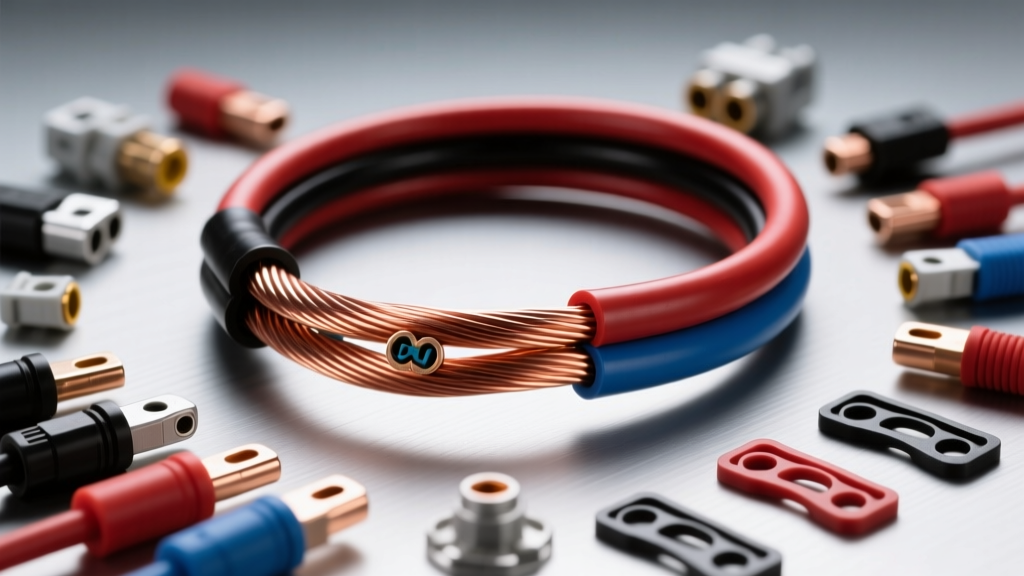
The Exact Dimensions: How Thick is 4 Gauge Wire?
When upgrading high-draw automotive circuits—such as installing a 200-amp alternator for an LS swap, wiring a 12V winch, or routing EV inverter cables—selecting the correct cable size is critical. But how thick is 4 gauge wire exactly? According to the American Wire Gauge (AWG) standard, 4 AWG wire has a solid conductor diameter of 0.2043 inches (5.189 mm). However, automotive wire is rarely solid. It consists of stranded copper to maintain flexibility under hood vibrations and chassis flex.
For automotive applications, you will typically encounter SAE J1128 compliant stranded wire. A standard 4 AWG SGT/SGX battery cable contains roughly 420 strands of 30 AWG wire, while ultra-flexible 4 AWG welding cable contains upwards of 1,330 fine strands. The total cross-sectional copper area remains approximately 21.15 mm², regardless of the stranding class.
| Specification | Measurement / Rating |
|---|---|
| Solid Diameter | 0.2043 in (5.189 mm) |
| Cross-Sectional Area | 21.15 mm² (approx. 20 AWG metric equivalent) |
| Resistance per 1,000 ft (at 20°C) | 0.2485 Ohms |
| Max Ampacity (Chassis Wiring / NEC) | 160A - 200A |
| Max Ampacity (SAE J1128 Under-Hood) | 120A - 150A (temperature derated) |
| Standard Automotive Lug Size | 5/16' or 3/8' Ring Terminal |
Phase 1 Troubleshooting: Verifying True Gauge and Material
The most common failure point in high-amp automotive wiring isn't the gauge itself, but the material masquerading as that gauge. If your 4 AWG wire is overheating or causing a voltage drop, your first troubleshooting step is to verify the conductor material.
Step-by-Step Material Verification
- Perform a Cross-Section Cut: Use flush cutters to snip the wire cleanly. Expose the cross-section to bright light.
- The Scratch Test: Take a utility knife and scratch the edge of a single copper strand. If the wire is Oxygen-Free Copper (OFC), it will be copper-colored all the way through. If you see a silver or white core, you have Copper-Clad Aluminum (CCA).
- Measure the Outer Diameter (OD): Use digital calipers to measure the overall thickness including the insulation. CCA wire is often manufactured with a thicker overall diameter to compensate for aluminum's higher resistance, which can trick installers into thinking they have a heavier gauge. True 4 AWG OFC will measure roughly 0.34 to 0.38 inches OD depending on the insulation thickness (SGT vs. SGX).
- Corrective Action: If you discover CCA wire on a circuit drawing over 100 amps, replace it immediately. CCA has 61% of the conductivity of pure copper. A '4 AWG' CCA wire will perform electrically like a 6 AWG OFC wire, leading to severe voltage drop and potential insulation melting under continuous loads like winching or electric power steering (EPS) usage.
Phase 2 Troubleshooting: High-Amp Voltage Drop Diagnostics
If you have verified that you are using genuine 4 AWG OFC wire, but your high-amp accessories are underperforming (e.g., headlights dimming at idle, winch stalling, or inverter throwing low-voltage codes), you must troubleshoot the circuit for voltage drop. According to Painless Performance Wiring Manuals, a healthy automotive charging circuit should exhibit no more than a 0.1V to 0.2V drop across the main power cables.
The Voltage Drop Decision Tree
Set your digital multimeter (DMM) to DC Millivolts (mV). Do not measure resistance with an ohmmeter; you must measure voltage drop while the circuit is under load.
- Symptom: DMM reads > 0.5V drop across a 10-foot run of 4 AWG wire at 100 Amps.
- Diagnostic Step: Check the connection points. Probe the alternator output post and the battery positive terminal. If the drop is localized at the terminals, the issue is a poor crimp or corrosion, not the wire thickness.
- Fix: Cut off the terminal, strip back to clean copper, and re-crimp using a hex-compression tool.
- Symptom: DMM reads > 0.5V drop, and the voltage drop is evenly distributed along the length of the wire itself (probe the wire jacket at both ends).
- Diagnostic Step: Calculate the actual amperage draw. Referencing the Engineering Toolbox AWG Chart, 4 AWG wire yields 0.2485 ohms per 1,000 feet. A 10-foot run should only drop ~0.25V at 100A. If the drop is higher, the wire is either undersized (mislabelled by the manufacturer) or the ambient under-hood temperature is severely derating the wire's capacity.
- Fix: If the wire is routed near exhaust headers or turbochargers, the heat increases copper resistance. Reroute the cable or upgrade to 2 AWG wire to compensate for thermal derating as outlined in the SAE J1128 Standard for high-temperature under-hood environments.
Phase 3 Troubleshooting: Terminal Fitment and Crimp Failures
A frequent complaint when working with 4 AWG wire is terminal fitment. Because 4 gauge wire is thick and stiff, forcing it into incorrect lugs or using improper crimping methods creates high-resistance hotspots that can melt the insulation and cause an electrical fire.
Corrective Actions for Lug Fitment and Crimping
- Evaluate the Lug Barrel Size: Standard 4 AWG ring terminals feature a barrel inner diameter of approximately 0.25 inches. If you are using marine-grade tinned lugs, the barrel may be slightly larger to accommodate the tin plating and thicker stranding of marine wire. Do not hammer or flatten the wire to make it fit into a 6 AWG lug.
- Verify the Crimp Tool: Pliers and hammer crimpers are unacceptable for 4 AWG wire carrying over 50 amps. You must use a dedicated hex-crimp die or a hydraulic crimper. A proper hex crimp compresses the copper strands into a solid, hexagonal mass, eliminating air pockets where moisture and corrosion can infiltrate.
- Seal the Connection: Once crimped, the termination must be sealed. Use dual-wall, adhesive-lined heat shrink tubing. When heated, the inner wall melts and flows into the wire strands, creating a waterproof barrier that prevents capillary action from drawing moisture under the insulation jacket.
- Torque Specifications: When bolting the 4 AWG ring terminal to a battery post or alternator stud, ensure the hardware is torqued to spec. A standard 5/16' battery terminal bolt should be torqued to roughly 9-12 ft-lbs. Under-torquing causes micro-arcing; over-torquing can snap the stud or warp the copper lug, reducing surface contact area and increasing resistance.
Understanding exactly how thick 4 gauge wire is—and more importantly, how it behaves under high electrical and thermal loads—is the difference between a reliable automotive electrical system and a stranded vehicle. Always verify your copper purity, measure voltage drop under load, and use the correct compression tooling for your terminations.