The Core Question: Is 12 Gauge Wire Safe for a 20 Amp Circuit?
When upgrading vehicle electrical systems, a common question among builders and technicians is whether using 12 gauge wire for 20 amp circuit loads is safe and compliant. The short answer is yes, but with critical caveats regarding insulation type, ambient temperature, and wire bundling. In residential wiring, the National Electrical Code (NEC) strictly limits 12 AWG copper to 20 amps. However, automotive environments operate under the SAE J1128 Low Tension Cable standard, which evaluates ampacity based on cross-linked insulation thermal limits and chassis routing conditions.
A bare 12 AWG copper conductor has a cross-sectional area of 3.31 mm² and a resistance of approximately 1.59 milliohms per foot at 20°C. In free air at standard chassis temperatures, a high-quality automotive 12 AWG wire can safely carry up to 25 amps continuously. However, once you route that wire through a firewall grommet, bundle it with four other current-carrying conductors, or place it near exhaust manifolds, the ampacity derates significantly. This selection guide breaks down the exact wire chemistries, connector requirements, and routing protocols necessary to safely deploy 12 AWG wire for 20A automotive applications.
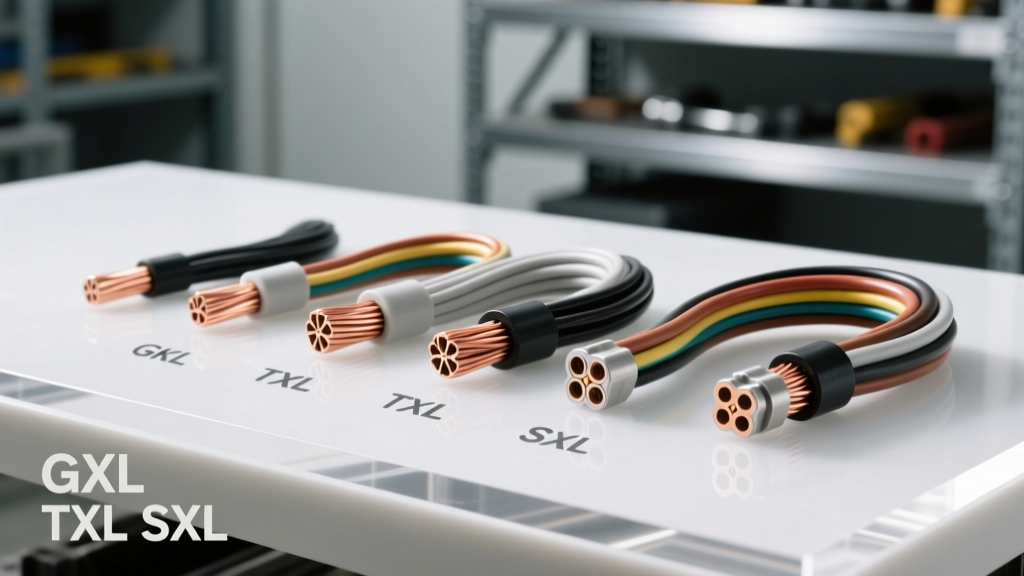
SAE J1128 Automotive Wire Standards: GXL vs. TXL vs. SXL
Never use household THHN or standard PVC-jacketed wire in a vehicle. PVC insulation melts at relatively low temperatures, becomes brittle under hood vibrations, and fails rapidly when exposed to automotive fluids like brake fluid, oil, and coolant. Instead, you must select Cross-Linked Polyethylene (XLPE) wire, which offers superior thermal and chemical resistance. According to Madsen Enterprises EWCS specifications, there are three primary SAE J1128 wire types to consider for your 20A circuits:
| Wire Type | Insulation Thickness | Max Temp Rating | Outer Diameter (12 AWG) | Best Automotive Application |
|---|---|---|---|---|
| GXL (General) | 0.58 mm (0.023") | 125°C (257°F) | 2.92 mm | General engine bay routing, headlight circuits, starter relays. |
| TXL (Thin) | 0.41 mm (0.016") | 125°C (257°F) | 2.59 mm | Interior cabin harnesses, tight firewall pass-throughs, dash clusters. |
| SXL (Special) | 0.79 mm (0.031") | 150°C (302°F) | 3.35 mm | Extreme heat zones (near turbos/exhaust), heavy-duty truck engine bays. |
For a standard 20A circuit, GXL is the industry default. It provides the perfect balance of flexibility, abrasion resistance, and thermal protection. If you are routing the 20A circuit through a congested interior dash harness where space is at a premium, step down the insulation profile to TXL without sacrificing the 12 AWG copper core.
Ampacity Derating and Voltage Drop Calculations
Selecting the right gauge is only half the battle; calculating voltage drop is mandatory for sensitive 20A electronics. The formula for voltage drop in a DC circuit is V = I × R × 2L (where L is the one-way length in feet).
Let's calculate the drop for a 20A electric fuel pump located in the rear of a truck, requiring a 15-foot run from the front-mounted relay (30 feet total round-trip):
- Current (I): 20 Amps
- Resistance (R): 0.00159 ohms/ft
- Length (2L): 30 feet
- Voltage Drop: 20 × 0.00159 × 30 = 0.954 Volts
On a running vehicle with an alternator output of 13.8V, a 0.95V drop leaves 12.84V at the fuel pump. This is well within the acceptable 3% limit for power circuits. However, if you are powering an EFI ECU or a sensitive 20A PWM controller, you must keep voltage drop under 1% (0.138V). In those specific long-run scenarios, you must upgrade to 10 AWG wire, reserving the 12 gauge wire for 20 amp circuit loads that are either short in distance or tolerant of minor voltage fluctuations, such as winch solenoids, cooling fans, or auxiliary lighting.
Connector Selection for 12 AWG / 20A Circuits
A wire is only as good as its termination. Pushing 20 amps through a poorly crimped 12 AWG terminal will cause localized resistance, leading to thermal runaway and melted housings. For 20A automotive circuits, you must use connectors rated specifically for this continuous load. Referencing Aptiv Connector Systems documentation, here are the approved terminations:
1. Aptiv Metri-Pack 280 Series
The Metri-Pack 280 is the gold standard for modern 20A automotive circuits. The "280" refers to the blade width in millimeters (2.8mm). These terminals are rated for up to 20 amps per cavity. They feature a dual-locking mechanism (primary and secondary TPA locks) to prevent terminal back-out under heavy vibration. Use open-barrel crimpers with the correct die size for 12 AWG (typically the 1.5-2.0 mm² die) to ensure a gas-tight crimp without crushing the copper strands.
2. Delphi Weather-Pack Series
Weather-Pack connectors are robust, cylindrical, and feature silicone rubber seals that withstand high-pressure car washes and submersion. The standard Weather-Pack terminals for 12-10 AWG wire are rated exactly at 20 amps. Pro Tip: When assembling a 2-pin Weather-Pack for a 20A cooling fan, always use the tower (male) connector on the chassis side and the shroud (female) connector on the load side to prevent accidental shorting if the harness is dropped.
Real-World 20A Automotive Applications
High-Flow Fuel Pump Upgrades (e.g., Walbro F90000267 / AEM 340)
Aftermarket high-pressure fuel pumps used in forced-induction builds frequently draw between 15A and 18A under peak load (and up to 22A on startup surge). Using 12 gauge wire for this 20 amp circuit is standard practice, provided you utilize a 25A or 30A automotive mini-relay. Route SAE Red 12 AWG wire from the battery to a 30A fuse, then to Pin 30 of the relay. Use SAE Pink or Blue 12 AWG for the switched output (Pin 87) running to the fuel pump hanger. Ground the pump using a dedicated 12 AWG Black wire bolted directly to a clean, bare-metal chassis point with a star washer, torqued to 10-12 ft-lbs.
Electric Cooling Fans (e.g., Spal 16" High Performance)
High-CFM electric cooling fans draw massive current. A Spal 16" fan may pull 18A continuously. Because fans are mounted at the front of the radiator, the wire is subjected to high ambient heat and water ingress. Use SXL 12 AWG wire for the final 24 inches leading to the fan motor to resist radiator heat soak, and seal the ring terminal connection with dual-wall heat shrink containing polyamide adhesive to prevent galvanic corrosion between the copper wire and the steel fan chassis ground.
Troubleshooting Common 20A Circuit Failures
When a 12 AWG / 20A circuit fails, the root cause is rarely the copper wire itself. Look for these specific failure modes:
- Creep Corrosion: If standard PVC wire was used instead of XLPE, capillary action can draw moisture under the insulation, turning the copper black and increasing resistance. Strip back 2 inches of insulation; if the copper is dark, replace the entire run with GXL.
- Terminal Relaxation: If the Metri-Pack 280 terminal was crimped with universal pliers instead of a ratcheting open-barrel crimper, the terminal wings may not have fully folded. This creates a micro-gap that arcs under 20A loads, melting the plastic housing. Always perform a pull-test (minimum 40 lbs of force) on 12 AWG crimps.
- Alternator Ripple Voltage: If a 20A solid-state relay keeps failing, test for AC ripple voltage at the battery. A failing diode trio in the alternator can push AC voltage into the DC harness, causing premature failure of solid-state switching components on 20A circuits.
By strictly adhering to SAE J1128 wire specifications, calculating voltage drop, and utilizing ratcheting crimp tools with Metri-Pack or Weather-Pack housings, your 12 AWG 20A circuits will deliver reliable, fire-safe power for the life of the vehicle.