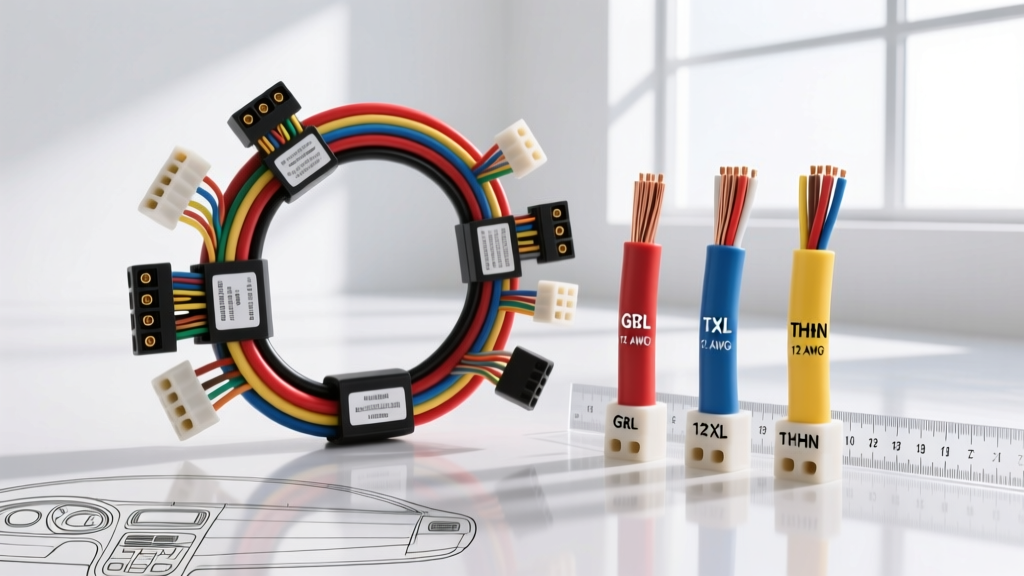
Decoding the Standard Wire Gauge Table for Vehicles
When planning a custom harness, installing a high-output alternator, or repinning an ECU connector, relying on a residential wiring chart can lead to catastrophic electrical failures. The standard wire gauge table used in automotive engineering differs significantly from the National Electrical Code (NEC) tables used in home construction. Automotive environments demand specialized insulation, higher temperature tolerances, and strict voltage drop management due to the 12V-14V DC operating window.
At Autoflowwire, we emphasize that selecting the correct American Wire Gauge (AWG) is only half the battle. You must also match the wire's insulation type (GXL, TXL, SXL) to the specific thermal and chemical hazards under the hood. This guide breaks down the standard wire gauge table for SAE J1128 compliant automotive wire, compares insulation products, and provides actionable selection criteria for real-world vehicle applications.
The Automotive Standard Wire Gauge Table (SAE J1128)
The following table outlines the specifications for standard cross-linked automotive wire (GXL/TXL). Unlike NEC building wire, automotive wire utilizes fine-stranding to withstand constant vibration and high-temperature cross-linked polyethylene (XLPE) insulation to resist engine bay heat and fluid exposure.
| AWG Size | Metric (mm²) | Stranding (Qty/AWG) | Max Ampacity (SAE) | Resistance (Ω/1000ft) | Primary Automotive Application |
|---|---|---|---|---|---|
| 18 AWG | 0.80 mm² | 16/30 | 10A | 6.51 | ECU Sensors, CAN-Bus, Dash Lighting |
| 16 AWG | 1.30 mm² | 26/30 | 15A | 4.09 | Injectors, Ignition Coils, Turn Signals |
| 14 AWG | 2.00 mm² | 41/30 | 25A | 2.57 | Fuel Pump Relays, Headlights, Horns |
| 12 AWG | 3.00 mm² | 65/30 | 35A | 1.62 | Radiator Fans, Power Windows, Cigar Lighter |
| 10 AWG | 5.00 mm² | 105/30 | 50A | 1.02 | ABS Modules, High-Amp Audio Amplifiers |
| 8 AWG | 8.00 mm² | 168/30 | 70A | 0.64 | Alternator Output, Starter Solenoid, EV Battery |
| 4 AWG | 20.0 mm² | 266/27 | 120A | 0.25 | Main Battery Cables, Winch Power, Mega Fuses |
Note: Ampacity ratings are based on single wires in free air at an ambient temperature of 30°C (86°F). Bundling three or more wires in a loom requires a 20-30% derating factor.
Insulation Product Comparison: GXL vs. TXL vs. THHN
A common and dangerous mistake made by amateur fabricators is pulling THHN building wire from a hardware store to wire a vehicle. While the copper gauge might match the standard wire gauge table, the insulation will fail rapidly in an automotive environment. Here is how the primary wire types compare:
GXL (General Cross-Linked)
- Insulation Thickness: Standard (Thickest of the XLPE family)
- Temp Rating: 125°C (257°F)
- Best For: General engine bay wiring, battery cables, and areas where mechanical abrasion from chassis brackets is a concern.
TXL (Thin Cross-Linked)
- Insulation Thickness: Thin (Reduces harness weight and bulk)
- Temp Rating: 125°C (257°F)
- Best For: High-density connector cavities (like Metri-Pack 280 or Deutsch DT), custom ECU harnesses, and tight firewall grommets.
THHN (Thermoplastic High Heat Nylon)
- Insulation Thickness: Thick PVC with Nylon jacket
- Temp Rating: 90°C (194°F) in dry, wet locations lower
- Verdict: NEVER USE IN VEHICLES. The PVC insulation melts on exhaust manifolds, the nylon jacket absorbs oil and degrades, and the coarse stranding breaks under engine vibration.
Application Guide: Matching Gauge to the Circuit
Using the standard wire gauge table effectively requires understanding the specific current draw and duty cycle of your automotive components. Below are three common scenarios and the correct engineering approach.
Scenario A: High-Output Alternator Charging System
Upgrading to a 200A alternator for a high-demand audio or off-road lighting system requires careful gauge selection. While the standard wire gauge table lists 2/0 AWG for 200A, the physical routing length from the alternator B+ terminal to the main battery post dictates the final size. To maintain a voltage drop below 0.2V at peak output, a 1/0 AWG (53mm²) GXL wire is typically required for runs exceeding 4 feet. Always terminate these heavy cables with closed-end copper lugs, crimped with a hydraulic press, and sealed with adhesive-lined marine heat shrink to prevent galvanic corrosion.
Scenario B: EFI Fuel Pump Relay Circuit
Modern in-tank fuel pumps (like the Walbro 450 or Deatschwerks DW300) can draw 15-20 amps continuously under high fuel pressure. A standard 12 AWG wire is rated for 35A, which seems sufficient. However, because the fuel pump operates at a 100% duty cycle under wide-open throttle, and the wire is often routed through the trunk (a bundled environment), you must upsize to 10 AWG TXL for the power feed. Use a standard SAE color code: Pink for the 12V ignition-switched relay trigger, and a heavy Black wire directly to the chassis ground. Undersizing this ground wire is a leading cause of fuel starvation and lean misfires at high RPM.
Scenario C: ECU Analog Sensors (TPS, IAT, MAP)
Sensor circuits carry less than 1 amp, but they are highly sensitive to electromagnetic interference (EMI) and resistance. According to the standard wire gauge table, 22 AWG could technically handle the current. However, automotive OEMs universally standardize on 18 AWG TXL for sensor harnesses. The 18 AWG provides the necessary physical tensile strength to survive engine movement without breaking the copper strands inside the Metri-Pack 150 connector pins. Always use shielded twisted-pair (STP) wire for critical signals like Crankshaft Position Sensors (CKP) to prevent false triggering from alternator noise.
The Hidden Variable: Voltage Drop vs. Ampacity
The most misunderstood aspect of the standard wire gauge table is the difference between ampacity (how much current a wire can carry before the insulation melts) and voltage drop (how much voltage is lost due to copper resistance over distance). In a 120V residential circuit, a 2V drop is negligible (1.6%). In a 12V automotive starter circuit, a 2V drop means the starter motor only sees 10V, resulting in sluggish cranking and potential ECU brown-out resets.
The Voltage Drop Formula:
VD = (2 x L x I x R) / 1000
Where L = one-way length in feet, I = current in amps, R = resistance per 1000ft (from the table above).
Rule of Thumb: Never exceed a 3% voltage drop (0.36V) for sensitive ECU electronics, and never exceed a 10% drop (1.2V) for high-draw resistive loads like starter motors or halogen headlights. If your calculated drop exceeds these thresholds, you must move up one or two sizes on the standard wire gauge table, regardless of the ampacity rating.
Common Failure Modes from Incorrect Selection
- Terminal Mismatch: Attempting to force 12 AWG wire into a Metri-Pack 280 terminal designed for 16 AWG. This results in a crushed copper core, high localized resistance, and eventual thermal melting of the connector housing.
- Ground Loop Noise: Using a single, long 18 AWG wire to ground multiple audio amplifiers to a painted chassis bolt. This creates a ground loop, introducing alternator whine into the audio system. The fix is using a dedicated 4 AWG ground bus bar tied directly to the battery negative terminal.
- Strand Fatigue: Using solid-core wire or coarse-strand building wire on a door hinge loom. The constant opening and closing of the door flexes the wire, causing work-hardening and eventual copper fracture, leading to dead power windows or locked doors.
Expert Sourcing and Standards
For deep-dive engineering specifications, always refer to the SAE J1128 standard for low-tension primary cable. When designing custom harnesses, consult manufacturer tech bulletins from established automotive electrical suppliers like Painless Performance Products to verify circuit breaker sizing and wire routing best practices. Adhering strictly to the automotive-specific standard wire gauge table ensures your vehicle's electrical system remains reliable, safe, and capable of handling the harsh under-hood environment.