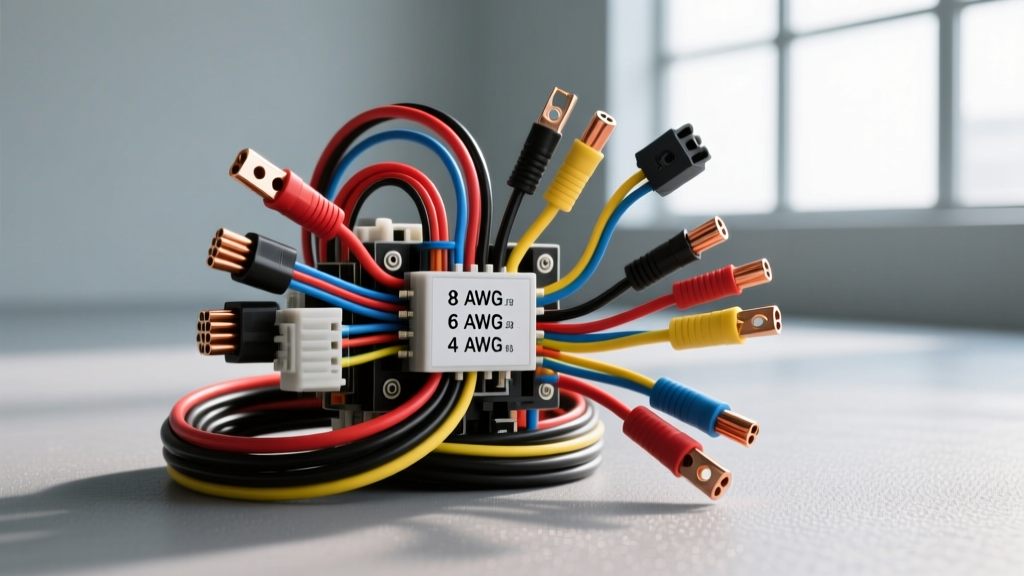
Understanding 220V in Automotive and RV Applications
When automotive enthusiasts and EV owners ask, "what wire gauge for 220v", they are usually crossing the boundary from standard 12-volt DC vehicle wiring into the realm of high-voltage alternating current (AC). In the automotive world, 220V (technically 240V or 120/240V split-phase in North America) is primarily encountered in three scenarios: Level 2 Electric Vehicle (EV) charging, RV and motorhome shore power connections, and heavy-duty truck auxiliary power units (APUs) running large pure sine wave inverters.
Before cutting any wire, it is critical to understand a fundamental electrical principle: wire gauge is dictated by amperage (current) and distance, not just voltage. Because Power (Watts) = Volts × Amps, pushing 7,200 watts through a standard 12V automotive system requires a massive 600 amps of current, necessitating 4/0 AWG welding cables to prevent a fire. However, pushing that exact same 7,200 watts at 240V requires only 30 amps of current, which can be safely handled by a much smaller 10 AWG or 8 AWG copper wire.
The Golden Rule: The 80% Continuous Load Standard
Whether you are wiring a NEMA 14-50 receptacle for an EV charger or hooking up a 50-amp RV pedestal, you must adhere to the National Electrical Code (NEC) and SAE standards regarding continuous loads. A continuous load is defined as any electrical draw that lasts for three hours or more. EV charging and RV air conditioning easily meet this criteria.
The rule states that you must size your wire and breaker at 125% of the continuous load. Therefore, if your Level 2 EV charger draws a continuous 40 amps, you must multiply 40 by 1.25, resulting in a 50-amp circuit requirement. This means you cannot use 8 AWG wire (rated for 40 amps); you must step up to 6 AWG copper wire rated for 55 to 65 amps, depending on the insulation temperature rating.
Wire Gauge Chart for 220V/240V Automotive Applications
The following chart outlines the standard copper wire gauge requirements for common 220V/240V automotive and RV applications. These ratings assume copper wire with THHN or XHHW insulation in an ambient temperature of 30°C (86°F).
| Circuit Breaker Size | Max Continuous Load (80%) | Minimum Copper AWG | Common Automotive / RV Application |
|---|---|---|---|
| 20 Amp | 16 Amps | 12 AWG | Small block heater, trickle charger, light-duty APU |
| 30 Amp | 24 Amps | 10 AWG | 30-Amp RV Shore Power (120V L2), 16A Level 2 EVSE |
| 40 Amp | 32 Amps | 8 AWG | 32-Amp Level 2 EV Charger (Hardwired) |
| 50 Amp | 40 Amps | 6 AWG | NEMA 14-50 EV Receptacle, 50-Amp RV Split-Phase Shore Power |
| 60 Amp | 48 Amps | 6 AWG (or 4 AWG) | 48-Amp Hardwired Level 2 EV Charger |
Step-by-Step: Wiring a NEMA 14-50 for Level 2 EV Charging
The NEMA 14-50 receptacle is the gold standard for home Level 2 EV charging and large RV hookups. It provides 120/240V split-phase power. When wiring this for an EV charger (adhering to SAE J1772 infrastructure guidelines), you must use a 4-wire configuration:
- X (Hot 1): Black wire (120V to Neutral, 240V to Hot 2)
- Y (Hot 2): Red wire (120V to Neutral, 240V to Hot 1)
- W (Neutral): White wire (Required for the 120V internal logic boards in the EVSE)
- G (Ground): Green or Bare Copper (Safety earth ground)
Pro-Tip on Terminal Torque: A leading cause of melted NEMA 14-50 plugs in the EV community is loose terminal connections. Loose wires create high resistance, which generates intense heat under a 40-amp continuous load. Always use a calibrated torque screwdriver. Most 50-amp receptacles require terminal screws to be torqued to roughly 40 to 45 inch-pounds. Check the manufacturer's spec sheet on the back of the receptacle.
RV and Motorhome 220V Shore Power Wiring
Motorhomes with dual air conditioners and electric water heaters utilize a 50-amp, 120/240V split-phase shore power cord. The plug is a NEMA 14-50P. While the RV's internal appliances operate on 120V, the power is delivered via two 120V hot legs that are 180 degrees out of phase, providing 240V across them. The main distribution panel inside the RV splits these legs to balance the load.
For the shore power cable itself, the industry standard is 6 AWG, 4-conductor STW or SEOOW flexible copper cable. The outer jacket must be highly durable, oil-resistant, and rated for wet locations. If you are building a custom extension cord for your RV or mobile detailing truck, never drop below 6 AWG for a 50-amp setup, and keep the cable length under 50 feet to prevent severe voltage drop, which can destroy RV air conditioner compressor motors.
The Inverter Trap: DC Input vs. AC Output Sizing
A massive point of confusion for beginners installing 220V pure sine wave inverters in work trucks, overland rigs, or skoolies is the difference between the DC input side and the AC output side.
The AC Output Side (220V)
If your inverter outputs 220V AC to run a power tool or a microwave, the wiring from the inverter's AC terminals to your AC breaker panel or outlet only needs to handle standard AC amperage. For a 2000W inverter at 220V, the draw is roughly 9 amps. Standard 12 AWG or 10 AWG THHN wire is perfectly adequate here.
The DC Input Side (12V / 24V)
The DC side is where the danger lies. That same 2000W inverter pulling from a 12V battery bank will draw over 180 amps (accounting for inverter inefficiency). You cannot use 12 AWG wire here; it will melt instantly. The DC input requires massive battery cables. For a 2000W 12V inverter, you must use 2/0 AWG or 4/0 AWG fine-strand copper welding cable with heavy-duty lugs crimped using a hydraulic crimper, and protected by a 250-amp Class T fuse within 18 inches of the battery terminal.
Common Failure Modes and Troubleshooting
When working with 220V automotive and mobile applications, keep an eye out for these specific failure modes:
- Thermal Degradation of Receptacles: If the plastic face of your NEMA 14-50 outlet looks brown or warped, the internal contacts have lost tension due to heat cycling. Replace the receptacle immediately with an industrial-grade, EV-rated model (like a Hubbell or Bryant 9450A), which features higher clamping force on the plug blades.
- Aluminum Wire Oxidation: While 6 AWG aluminum wire is sometimes used in residential panels to save money, it is highly discouraged for mobile, RV, or EV applications subject to vibration. Aluminum creeps and oxidizes, leading to loose connections and fires. Always use copper for mobile and EVSE wiring.
- Voltage Drop on Long Runs: If you are wiring a 220V EV charger in a commercial fleet garage and the run from the main panel to the charger exceeds 100 feet, you must upsize your wire from 6 AWG to 4 AWG to keep voltage drop below the recommended 3%. Excessive voltage drop will cause the EVSE to fault out or charge at a significantly reduced speed.
Authoritative References
To ensure your mobile and automotive high-voltage setups are safe and compliant, always cross-reference your work with established standards:
- National Fire Protection Association (NFPA 70 - National Electrical Code): The definitive guide for AC wiring, breaker sizing, and the 125% continuous load rule.
- SAE International J1772 Standard: The governing specification for EV conductive charge couplers and infrastructure requirements.
- Copper Development Association (CDA): Provides the definitive ampacity tables for copper wire gauges across various insulation types and temperature ratings.