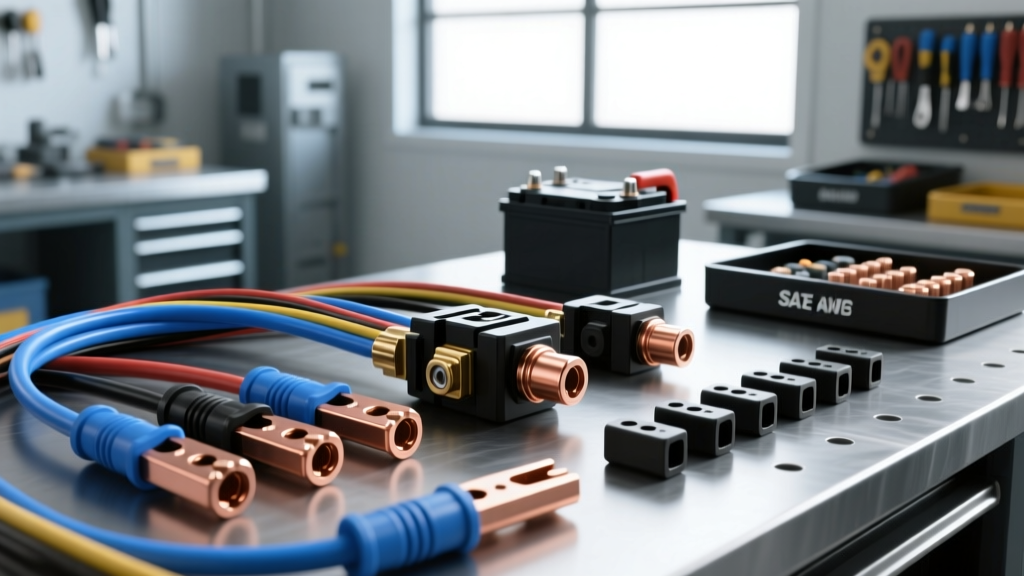
SAE and BCI Standards for Car Battery Wire Connectors
When selecting, repairing, or replacing car battery wire connectors, adherence to established automotive engineering standards is non-negotiable. The physical dimensions, taper angles, and material compositions of battery terminals are strictly governed by the Society of Automotive Engineers (SAE) and the Battery Council International (BCI). The primary governing document is SAE J563, which outlines the precise dimensional requirements for battery terminals and posts.
Under SAE J563, top-post battery connectors feature a standardized taper to ensure a mechanical wedge effect when tightened. The positive post has a larger diameter (17.5 mm at the base) compared to the negative post (15.9 mm at the base). This deliberate asymmetry prevents reverse polarity installation. Side-post connectors, commonly utilized in General Motors vehicles from the 1970s through the early 2000s, rely on an internal threaded insert (typically M8 x 1.25 or 3/8-16 UNC) rather than a clamping taper. Understanding these baseline specifications is critical before attempting any terminal crimping or cable replacement.
Terminal Metallurgy and Galvanic Considerations
The material composition of car battery wire connectors directly impacts conductivity, corrosion resistance, and mechanical clamping force. OEM connectors are predominantly cast from lead-antimony alloys or stamped from high-conductivity brass and copper.
- Lead-Antimony Cast Terminals: These are the most common aftermarket and OEM replacement clamps. Lead is relatively soft, allowing the connector to deform and conform to the battery post under torque, creating a massive surface area contact. However, lead has a lower electrical conductivity than copper, necessitating a larger physical mass to handle high Cold Cranking Amps (CCA) without excessive voltage drop.
- Copper and Brass Terminals: Often found in high-performance or heavy-duty applications. Copper offers superior conductivity (approx. 100% IACS) but lacks the malleability of lead. If used on a standard lead battery post, copper terminals require precise shimming and careful torque application to avoid cracking the battery casing or failing to achieve adequate surface contact.
- Zinc-Plated Steel: Frequently used for side-post terminal bolts and some economy top-post clamps. Steel provides high tensile strength for threading but poor conductivity. These must be heavily plated to resist sulfuric acid vapor corrosion.
Galvanic corrosion occurs when dissimilar metals (e.g., copper cable lugs and lead battery posts) interact in the presence of an electrolyte (battery acid vapor and road salt). Always utilize dielectric grease or specialized anti-corrosion felt washers treated with alkaline neutralizers to interrupt this electrochemical reaction.
AWG Sizing and Ampacity for Battery Cables
The starter motor represents the highest continuous and inrush current draw in a standard 12V automotive electrical system. A typical V8 engine can demand 400 to 800 amps during cranking, while high-compression diesel engines can exceed 1,000 amps. Selecting the correct American Wire Gauge (AWG) for your car battery wire connectors and cables is vital to prevent voltage drop, which starves the starter solenoid and ECU of operating voltage.
| AWG Size | Strand Count (Fine) | Max Continuous Amps | Max Cranking Amps (15 sec) | Typical Application |
|---|---|---|---|---|
| 4 AWG | 133 | 60A | 120A | 4-Cylinder compact cars, motorcycle batteries |
| 2 AWG | 133 | 100A | 200A | Standard V6 passenger vehicles, light trucks |
| 1/0 AWG | 1064 | 150A | 400A | Standard V8 engines, full-size SUVs |
| 2/0 AWG | 1332 | 195A | 600A | Heavy-duty towing, modified high-compression engines |
| 4/0 AWG | 2107 | 260A | 1000A+ | Competition audio systems, diesel dually trucks |
Note: Ampacity ratings assume standard under-hood ambient temperatures (105°C rated insulation like SXL or TXL). Always route positive cables away from exhaust manifolds to prevent insulation melt and subsequent short-circuiting to the chassis.
Top Post vs. Side Post Torque Specifications
Improper torque application is the leading cause of car battery wire connector failure. Overtightening lead terminals causes the clamp to stretch, crack, or crush the internal lead baffle of the battery post, leading to internal acid leaks. Undertightening results in high resistance, arcing, and localized melting of the terminal.
| Connector Type | Hardware Size | Target Torque (in-lbs) | Target Torque (ft-lbs) | Failure Mode if Exceeded |
|---|---|---|---|---|
| Standard Top Post (Lead) | 5/16" or 8mm Bolt | 50 - 70 in-lbs | 4.1 - 5.8 ft-lbs | Strips threads, cracks terminal clamp |
| Heavy Duty Top Post (Brass) | 3/8" or 10mm Bolt | 90 - 120 in-lbs | 7.5 - 10.0 ft-lbs | Cracks battery plastic casing |
| GM Side Post | 3/8-16 UNC Bolt | 144 - 180 in-lbs | 12.0 - 15.0 ft-lbs | Strips internal lead battery insert |
| DIN/EN Euro Top Post | 10mm or 13mm Nut | 60 - 80 in-lbs | 5.0 - 6.6 ft-lbs | Deforms DIN taper, loses clamping force |
According to guidelines referenced by the Battery Council International, side-post connections are particularly vulnerable. The threaded insert inside a side-post battery is cast directly into the lead. If an impact wrench is used, the insert will instantly strip out, ruining the battery casing. Always use a calibrated inch-pound torque wrench for final tightening.
Terminal Crimping and Assembly Protocols
When fabricating custom battery cables or repairing corroded ends, the mechanical and electrical bond between the copper wire and the terminal lug is paramount. Soldering battery cables is highly discouraged in modern automotive applications. The heat required to flow solder into a 1/0 AWG cable can melt the XPE/XLPE cable insulation. Furthermore, solder wicking into the wire strands creates a rigid section that is highly susceptible to fatigue failure from engine vibration.
Hex Crimp vs. Indent Crimp
For car battery wire connectors, a closed-barrel hex crimp is the industry standard for heavy-gauge cables (4 AWG and larger). Hex crimping applies uniform radial pressure around the entire circumference of the terminal barrel, cold-welding the copper strands to the terminal lug. This creates an airtight seal that prevents oxygen and moisture from penetrating the core of the cable, which is the primary cause of internal green corrosion (copper oxide).
Reference the TE Connectivity Terminal Application Specifications for exact die selection. Using an undersized die will cut the copper strands; using an oversized die will leave voids, increasing electrical resistance. After crimping, always seal the joint with dual-wall, adhesive-lined heat shrink tubing (rated IP67). The inner meltable adhesive layer flows into the wire strands, creating a waterproof environmental seal.
Diagnostic Voltage Drop Testing
Visual inspection cannot confirm the electrical integrity of car battery wire connectors. A terminal may look tight and clean but still harbor high resistance due to internal corrosion or a failing internal crimp. The only accurate diagnostic method is a loaded voltage drop test.
- Preparation: Disable the ignition or fuel pump to prevent the engine from starting. Connect a digital multimeter (DMM) set to DC Volts.
- Positive Side Test: Place the red DMM probe directly on the battery positive post (not the clamp). Place the black probe on the starter motor B+ terminal stud.
- Load Application: Have an assistant crank the engine for exactly 10 seconds.
- Evaluation: The maximum acceptable voltage drop across the entire positive cable and its connectors is 0.2V (200mV). If the drop is 0.5V or higher, the car battery wire connectors or the cable itself must be replaced.
- Negative Side Test: Repeat the process from the battery negative post to a clean, unpainted metal point on the starter motor casing. The acceptable drop for the ground side is also 0.2V.
By adhering to these technical specifications, utilizing proper AWG sizing, and following strict torque and crimping protocols, you ensure the vehicle's primary electrical distribution network remains robust, reliable, and capable of handling modern automotive electrical loads.