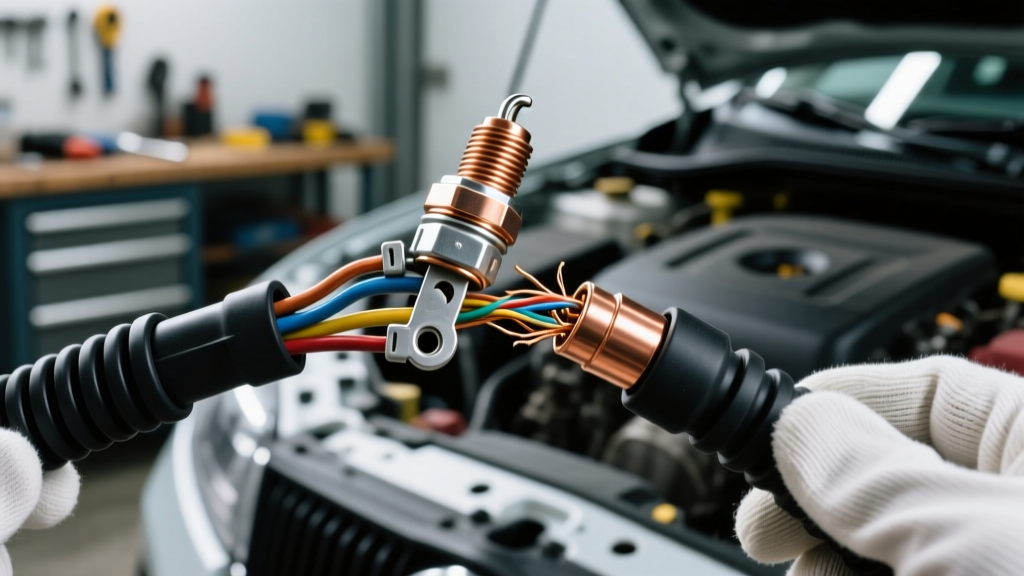
The High-Voltage Reality: Why Splicing is Dangerous
When a secondary ignition cable breaks or burns against an exhaust manifold, the temptation to perform a quick spark plug wire splice is high, especially for beginners looking to save time and money. However, as a fundamental rule of automotive electrical repair, you must never splice a high-tension spark plug wire. Unlike standard 12-volt accessory wiring, secondary ignition cables carry between 20,000 and 100,000 volts to jump the spark plug gap under extreme cylinder compression.
Attempting to splice these cables using standard butt connectors, solder, or basic heat shrink tubing will result in catastrophic failure. Standard automotive heat shrink and PVC wire insulation possess a dielectric breakdown rating of roughly 600 to 1,000 volts. When subjected to 40,000 volts of ignition energy, the voltage will instantly punch through standard insulation, arcing to the nearest grounded metal surface (such as the engine block or cylinder head). This causes severe misfires, melted wiring harnesses, and potential engine bay fires.
Primary vs. Secondary Ignition Wiring Specifications
To understand why a spark plug wire splice fails, beginners must first understand the difference between the primary (low-voltage) and secondary (high-voltage) sides of the ignition system. The table below outlines the critical engineering differences.
| Parameter | Secondary Ignition (Spark Plug Wire) | Primary Ignition (Coil Feed / Sensors) |
|---|---|---|
| Voltage Range | 20,000V to 100,000V+ | 5V to 14.4V (DC) |
| Core Material | Carbon-impregnated fiberglass or Spiral-wound stainless steel | Stranded Copper (TXL or GXL insulation) |
| Measurement | Outer Diameter (7mm, 8mm, 8.5mm, 10mm) | AWG (Typically 18 AWG to 20 AWG) |
| Resistance | 500 to 15,000 ohms per foot (suppression) | ~0.005 ohms per foot (conductive) |
| Spliceable? | NO - Replace Entire Assembly | YES - Crimp & Seal |
The Physics of Failure: Core Disruption and EMI
Modern spark plug wires are not simple copper conductors; they are complex electromagnetic suppression devices. According to NGK Technical Bulletins, the majority of OEM ignition cables utilize either a carbon core or a spiral-wound (mag) core to suppress Radio Frequency Interference (RFI).
Carbon Core Disruption
Carbon core wires consist of a fiberglass strand impregnated with conductive carbon latex, wrapped in a copper-nickel alloy tracing wire. This design provides high resistance (typically 10,000 ohms per foot) to dampen electrical noise. If you attempt a spark plug wire splice by twisting two carbon cores together, the point-contact resistance at the splice junction will spike unpredictably. This localized resistance creates a massive voltage drop, resulting in a weak spark that will fail to ignite the air-fuel mixture under heavy throttle loads.
Spiral Core Inductance Destruction
Spiral core wires feature a flat stainless-steel wire wound tightly around a ferrite or Kevlar core. This helical winding creates an inductor that cancels out EMI. Cutting the wire and attempting to splice it destroys the continuous geometric pitch of the winding. The splice point acts as an inductive choke and an unintended antenna, broadcasting high-frequency RFI directly into the engine bay.
The Hidden Threat: ECU and Sensor Damage
The most expensive consequence of a botched spark plug wire splice is Electromagnetic Interference (EMI). Modern engine control units (ECUs) rely on highly sensitive, low-voltage square-wave signals from the Crankshaft Position Sensor (CKP) and Camshaft Position Sensor (CMP). An arcing, improperly spliced ignition wire will flood the engine bay with electromagnetic noise. This noise can induce parasitic voltages in adjacent sensor wiring, causing the ECU to misread engine timing. The result is often limp-mode activation, erratic fuel injector pulsing, or in severe cases, the frying of the ECU's internal driver circuits due to voltage back-feed.
The Correct Repair: Secondary Wire Replacement
Instead of a spark plug wire splice, the only technically sound repair is replacing the entire secondary wire or ignition coil assembly. Follow these beginner-friendly fundamentals for a proper replacement:
- Remove the Old Wire Safely: Never pull on the wire body. Grasp the silicone or EPDM rubber boot firmly, twist it 90 degrees to break the seal, and pull straight off the spark plug or coil tower. Use dedicated spark plug boot pliers if access is tight.
- Clean the Terminals: Inspect the spark plug terminal and coil tower for white/green corrosion. Clean with electrical contact cleaner and a nylon brush.
- Apply Dielectric Grease: Apply a small dab of silicone dielectric grease to the inside lip of the new boot. This prevents moisture intrusion and prevents the boot from bonding to the ceramic insulator due to extreme heat cycles. Never use copper anti-seize or chassis grease, as these are conductive and will cause voltage tracking.
- Route Away from Heat: Ensure the new wire is seated firmly in the OEM wire loom. Keep at least 2 inches of clearance from exhaust manifolds. If the OEM loom is broken, replace it with a high-temperature fiberglass sleeve or split-loom tubing rated for 300°F+.
When Splicing IS Allowed: Primary Ignition Circuits
While splicing the high-voltage secondary side is forbidden, beginners must know how to properly splice the primary ignition wiring. The primary circuit includes the 12V power feed to the ignition coil, the ground circuits, and the low-voltage signal wires connecting the ECU to the coil packs. These circuits typically use 18 AWG or 20 AWG stranded copper wire.
According to the SAE J1128 Low Tension Primary Cable Standard, automotive primary wiring must withstand extreme engine bay temperatures and chemical exposure. To properly repair a broken primary ignition wire:
- Wire Selection: Use only SAE-rated TXL (cross-linked polyethylene) or GXL wire. Never use household THHN or standard PVC wire, which will melt against engine components.
- Stripping and Crimping: Strip exactly 5mm (1/4 inch) of insulation. Use an open-barrel U-grip crimp terminal and a proper ratcheting crimp tool to achieve a gas-tight mechanical bond.
- Adhesive Heat Shrink: Seal the splice using dual-wall, adhesive-lined polyolefin heat shrink tubing. As detailed in Delphi Automotive Tech Resources, the inner layer of this tubing contains a meltable thermoplastic adhesive that flows into the wire strands when heated, creating a 100% watertight seal against road salt, oil, and humidity.
Summary for Beginners
The search for a quick spark plug wire splice usually stems from a desire for a cheap, fast fix. However, the physics of high-voltage ignition systems simply do not allow for field splices without introducing massive resistance, arcing hazards, and EMI interference that will damage modern vehicle computers. Respect the dielectric limits of your ignition system: replace secondary high-tension cables entirely, and reserve your crimping and heat-shrinking techniques exclusively for the low-voltage primary circuits.