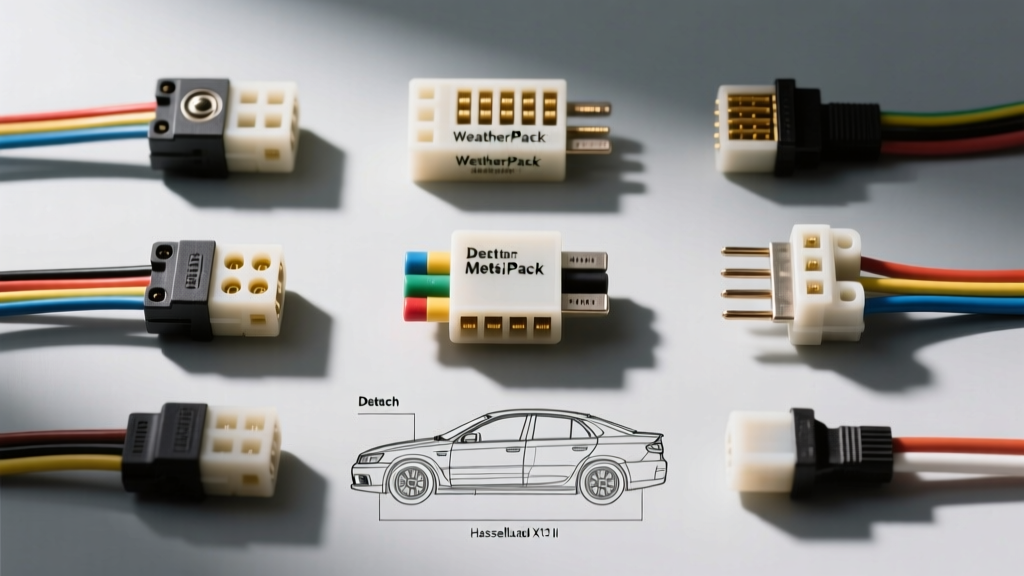
The Foundation of Automotive Wiring: Why Connectors Matter
When beginners dive into automotive electrical work, they often obsess over wire gauge and fuse sizing while completely ignoring the connection points. However, over 80% of all vehicle electrical failures occur at the connector, not the wire. Vibration, thermal cycling, and moisture intrusion can turn a poor connection into a high-resistance bottleneck, causing voltage drops, melted housings, and erratic sensor data.
Understanding the specific car electrical connector types used by OEMs and aftermarket manufacturers is critical. You must know not only how to identify them but also how their terminal locking mechanisms, environmental seals, and current ratings function. This guide breaks down the three most critical connector families every automotive DIYer and technician must master.
1. Delphi Weather-Pack: The Classic Standard
Introduced in the 1970s, the Weather-Pack series became the gold standard for General Motors and countless aftermarket accessories. Despite being older technology, its robust design keeps it relevant for high-current, low-pin-count applications like headlights, relays, and winch controls.
Anatomy and Specifications
- Cavities: 1, 2, 3, 4, 5, and 6-pin configurations.
- Wire Gauge: Accommodates 10 AWG to 20 AWG.
- Current Rating: Up to 20 amps per circuit.
- Sealing Mechanism: Uses individual silicone tower seals for the wire and a large shroud seal for the mating face.
The Beginner's Confusion: Terminals vs. Housings
The most common mistake beginners make with Weather-Pack connectors is confusing the housing gender with the terminal gender. A female Weather-Pack housing (the shroud) actually holds male pin terminals. Conversely, the male housing (the tower) holds female socket terminals. Always order your terminals based on the housing type, not the wire's destination.
Seal Color Coding
Weather-Pack seals are color-coded by wire insulation diameter, not AWG. Using the wrong seal will result in moisture ingress or crushed wire insulation.
- Green: 18-20 AWG (Thin insulation)
- Red: 14-16 AWG (Standard insulation)
- Blue: 10-12 AWG (Thick insulation)
2. Aptiv Metri-Pack: The Modern OEM Architecture
If you are repairing a modern vehicle's engine management system, OBD-II port, or transmission harness, you are working with Metri-Pack connectors. Developed to meet strict metric dimensional standards, these connectors feature a 'pull-to-seat' or 'push-to-seat' terminal design with integrated Terminal Position Assurance (TPA) locks.
Decoding the Series Numbers
Metri-Pack connectors are categorized by the width of the male terminal blade in hundredths of an inch. Understanding this nomenclature is vital for selecting the correct crimp tool and replacement pigtail.
| Series | Blade Width | Wire Range (AWG) | Max Current | Common Applications |
|---|---|---|---|---|
| 150 | 1.5 mm | 18 - 22 | 14 Amps | ECU sensors, injectors, CAN bus |
| 280 | 2.8 mm | 10 - 18 | 30 Amps | O2 sensors, ABS modules, ignition coils |
| 480 | 4.8 mm | 8 - 14 | 40 Amps | Fuel pumps, starter relays |
| 630 | 6.3 mm | 6 - 12 | 46 Amps | Main power feeds, heavy-duty grounds |
The Importance of the TPA Lock
Modern Metri-Pack housings utilize a secondary lock, often a bright red or yellow plastic insert known as the Terminal Position Assurance (TPA). When a terminal is crimped and pushed into the housing, the primary plastic tang on the terminal clicks into place. However, under high vibration, this tang can fail. The TPA must be snapped down after all terminals are inserted to physically block the terminals from backing out. Never skip installing the TPA.
3. Deutsch DT Series: Heavy-Duty and Off-Road
For commercial trucks, marine applications, and off-road vehicles, standard plastic connectors fail under extreme thermal shock and vibration. The TE Connectivity Deutsch DT series uses a thermoplastic housing with a solid rear silicone grommet rather than individual wire seals.
Key Technical Features
- Contact Size: Almost exclusively uses Size 16 contacts (rated for 13 amps continuous, accommodating 14-20 AWG wire).
- Wedge Locks: Instead of metal tangs on the terminals, Deutsch connectors use an internal plastic wedge lock. Once the metal pin is pushed through the rear grommet, the wedge is inserted from the front mating face to lock the pin radially.
- Crimp Style: Requires a specialized open-barrel or closed-barrel indenter crimp tool. Standard Weather-Pack crimpers will destroy Deutsch terminals.
Real-World Application: Rebuilding a 4-Wire O2 Sensor Pigtail
Let's apply this knowledge to a common repair. A heated oxygen (O2) sensor on a late-model V8 engine typically uses a Metri-Pack 280 series 4-cavity female housing. If the pigtail is melted or corroded, you must rebuild it using the correct specifications.
Standard Bosch O2 Sensor Pinout & Wire Colors
- Pin A (Heater Power): White wire (14 AWG) - Requires a Metri-Pack 280 female terminal.
- Pin B (Heater Ground): White wire (14 AWG) - Requires a Metri-Pack 280 female terminal.
- Pin C (Signal Output): Black wire (18 AWG) - Requires a Metri-Pack 150 female terminal (Note the mixed series in some OEM harnesses, or use 280 if the harness dictates).
- Pin D (Signal Ground): Grey wire (18 AWG) - Requires a Metri-Pack 150 female terminal.
Expert Tip: Always strip the wire to exactly 3.5mm for Metri-Pack 280 terminals. Stripping too much exposes bare copper to corrosion; stripping too little causes the crimp barrel to bite into the wire insulation, leading to an open circuit.
Troubleshooting: The Voltage Drop Test
Never use an ohmmeter to test a connector for resistance. Ohmmeters do not apply a load, meaning a connector with only one strand of copper touching might read 0.0 ohms but will fail completely under a 10-amp load. Instead, follow SAE standards and perform a live voltage drop test.
Step-by-Step Diagnostic Flow
- Turn the circuit ON (engine running or key on).
- Set your digital multimeter to DC Volts.
- Place the red probe on the wire before the connector (harness side).
- Place the black probe on the wire after the connector (component side).
- Interpret the Data: A healthy connection should drop less than 0.10V (100mV). If you read 0.5V or higher, the connector suffers from pin fretting, corrosion, or a loose terminal crimp.
The Dielectric Grease Myth
A pervasive myth in beginner circles is that packing the inside of an electrical connector with dielectric grease improves conductivity. This is entirely false. Dielectric grease is an electrical insulator. If you force it into the pin cavity, it will block the metal-to-metal contact, causing a voltage drop and intermittent failures.
As noted by Aptiv Connection Systems engineering guidelines, dielectric grease should only be applied sparingly to the outer rubber mating seals (like the Weather-Pack shroud seal) to prevent the rubber from drying out and tearing during assembly. Modern OEM connectors like Metri-Pack and Deutsch already feature specialized plating (gold or tin over nickel) that resists oxidation without the need for internal greases.
Summary
Mastering car electrical connector types elevates your wiring repairs from temporary hacks to permanent, OEM-quality solutions. By matching the correct Metri-Pack series to your current draw, respecting the sealing mechanics of Weather-Pack towers, and utilizing proper voltage drop testing, you ensure the vehicle's electrical architecture remains reliable for years to come.