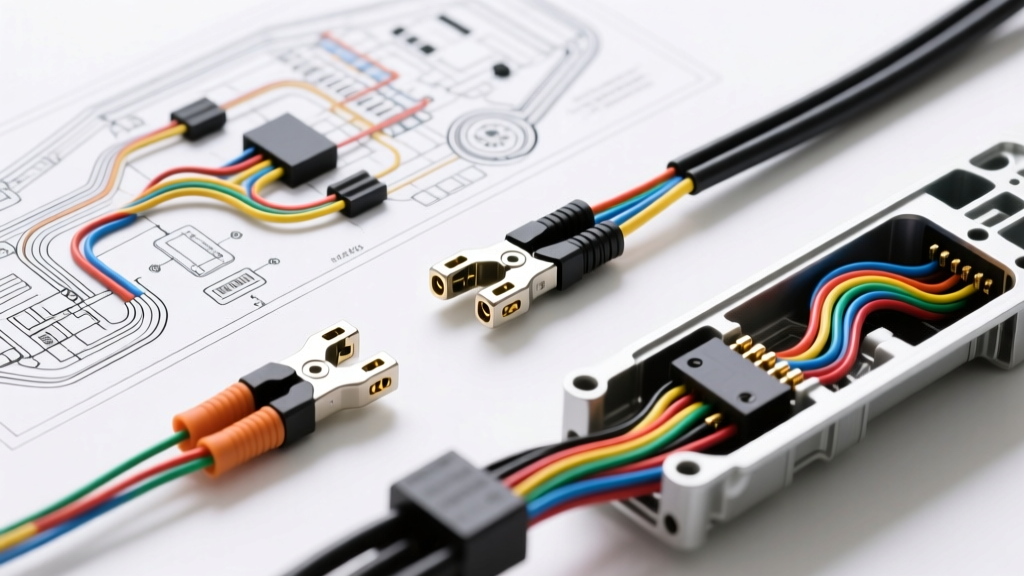
Benchmarking Dagos Auto Electric: The Cost of Show-Quality Wiring
When builders, hot-rodders, and classic car restorers reference Dagos auto electric standards, they are talking about the pinnacle of bespoke, show-quality vehicle wiring. Unlike mass-produced chassis harnesses that rely on generic PVC wire and basic tape wraps, a professional custom harness requires meticulous routing, aerospace-grade materials, and flawless terminal crimps. For DIYers, independent fabrication shops, and restomod builders looking to replicate this elite level of auto electrical craftsmanship, understanding the true cost and tool requirements is critical. This comprehensive analysis breaks down the capital investment, material costs, and technical specifications required to fabricate a custom 18-circuit automotive wiring harness from scratch, ensuring reliability and show-car aesthetics.
Phase 1: Professional Tooling Requirements & Capital Investment
You cannot achieve professional-grade terminal retention and low-resistance connections with cheap, non-ratcheting crimpers. The foundation of any high-end auto electrical build is the tooling. Ratcheting crimpers ensure that the tool will not release until the exact predetermined crimp force and geometry have been achieved, preventing loose connections that lead to arcing and electrical fires. Furthermore, stripping cross-linked polyethylene (XLPE) insulation requires precision wire strippers that do not nick the copper stranding, which would reduce the wire's ampacity and create a failure point under vibration.
Essential Tooling Bill of Materials
| Tool Type | Specification / Brand Standard | Estimated Cost | Purpose |
|---|---|---|---|
| Ratcheting Crimper | Delphi Weather-Pack / Metri-Pack 280 Die Set | $140 - $220 | Proper bellmouth crimping on sealed OEM-style terminals. |
| Deutsch Crimper | DT/DTM/ATP Ratcheting Tool (AWG 12-20) | $180 - $250 | Solid core and stranded pin/socket crimping for sealed engine bay connections. |
| Wire Strippers | Precision Self-Adjusting (10-22 AWG) | $45 - $80 | Clean removal of GXL/TXL insulation without nicking copper strands. |
| Heat Torch | Butane Micro-Torch with Flame Deflector | $35 - $60 | Shrinking dual-wall adhesive heat shrink without scorching adjacent wires. |
| Digital Multimeter | True RMS, Auto-Ranging, Min 10A fused | $120 - $180 | Voltage drop testing and parasitic draw diagnostics. |
Total Initial Tooling Investment: Approximately $520 to $790. While this is a steep entry cost compared to a $20 blister-pack crimper from a hardware store, it is mandatory for meeting professional auto electrical safety standards.
Phase 2: Material Selection and SAE J1128 Compliance
A common and dangerous mistake in amateur auto electrical work is using THHN or standard PVC wire. PVC insulation melts at relatively low temperatures, becomes brittle when exposed to under-hood UV and ozone, and will wick moisture via capillary action if the end is not perfectly sealed. Professional shops strictly adhere to SAE J1128 standards, utilizing GXL (General Cross-Linked) or TXL (Thin-wall Cross-Linked) wire. These wires feature cross-linked polyethylene insulation that withstands continuous temperatures up to 125°C (257°F) and resists abrasion, chemicals, and moisture.
Wire Gauge and Application Matrix
| AWG Size | Max Ampacity (Engine Bay) | Standard Color Code | Typical Application |
|---|---|---|---|
| 8 AWG | 50A - 60A | Red / Black | Main battery feeds, alternator output, high-amperage starter solenoid feeds. |
| 10 AWG | 30A - 40A | Red / Blue | Electric radiator fans, fuel pumps, main ignition power feeds. |
| 12 AWG | 20A - 25A | Yellow / Green | Headlight high/low beams, horn, power windows, A/C compressor clutch. |
| 14 AWG | 15A - 18A | Brown / White | Tail lights, dash illumination, wiper motors, turn signals. |
| 18 AWG | 5A - 7A | Violet / Gray | ECU sensor grounds, 5V reference signals, low-draw LED indicators. |
Phase 3: Connector Ecosystems and Terminal Costs
High-end custom wiring relies heavily on sealed connector ecosystems to prevent galvanic corrosion and moisture ingress, particularly in the engine bay and undercarriage. The two dominant systems used in professional builds are the TE Connectivity (formerly Delphi) Weather-Pack/Metri-Pack series and the TE Deutsch DT series.
Weather-Pack connectors are excellent for high-current, bulkhead connections and are the standard for GM-style engine harnesses. However, for modern sensor connections, fuel injection harnesses, and tight-pack ECU plugs, the Metri-Pack 150 and 280 series offer superior terminal retention and a smaller physical footprint. For heavy-duty, completely waterproof connections in harsh environments (such as external fuel pumps, winches, or off-road lighting), the Deutsch DT (up to 13A per pin) and DTP (up to 25A per pin) connectors are the undisputed industry standard. Expect to pay between $0.40 and $1.20 per pin/socket when factoring in the terminal, the cavity seal, and the connector housing.
Phase 4: Complete 18-Circuit V8 Harness Cost Breakdown
To understand the true cost of fabricating a custom harness that rivals top-tier show cars, we must look at a complete Bill of Materials (BOM) for a standard 18-circuit V8 hot rod, including engine management, lighting, and accessories. This does not include the cost of the ECU or the alternator, but rather the wiring infrastructure itself.
| Material Category | Specification Details | Estimated Cost |
|---|---|---|
| GXL / TXL Wire | 500 ft spool assortment (10, 12, 14, 16, 18 AWG) | $280 - $350 |
| Sealed Connectors | Deutsch DT (4x), Weather-Pack (6x), Metri-Pack (10x) | $180 - $240 |
| Terminals & Seals | Bulk loose pieces, silicone cavity plugs, ring terminals | $120 - $160 |
| Relays & Fuses | 10x Bosch ISO Mini 5-pin relays, ATO fuse block, Maxi fuses | $90 - $130 |
| Loom & Wrapping | Raychem DR-25 heat shrink, Tesa 51036 fleece tape, split loom | $110 - $150 |
| Misc. Hardware | Adel clamps, dual-wall adhesive heat shrink, zip ties, grommets | $80 - $110 |
| Total Material Cost | Complete 18-Circuit Custom Harness BOM | $860 - $1,140 |
When you combine the material costs ($860 - $1,140) with the initial tooling investment ($520 - $790), the total out-of-pocket cost for a first-time professional-grade custom harness build ranges from $1,380 to $1,930. While pre-terminated universal kits from brands like Painless Performance cost between $400 and $800, they often require significant modification, lack custom routing lengths, and do not offer the bespoke aesthetic or exact circuit optimization of a hand-built harness.
Phase 5: Relay Logic and High-Current Routing
A hallmark of professional auto electrical design is keeping high-current loads out of the cabin switches. Cabin switches should only carry the low-amperage trigger signal (typically 1A to 3A) to the coil side (Pins 85 and 86) of a Bosch-style ISO Mini relay. The heavy current (Pins 30 and 87) is then routed directly from the battery or a high-amperage fuse block to the load (e.g., radiator fans or headlights).
For a dual electric fan setup drawing 25A each, you must use a minimum of 10 AWG wire from a 60A Maxi fuse directly to Pin 30 of two separate 40A relays. Pin 87 routes to the fan positive terminal. The fan ground must be secured to the chassis or engine block using an M8 or M10 ring terminal, torqued to 12-15 Nm, with all paint and powder coating removed from the mating surface to ensure a zero-resistance ground path.
Critical Failure Modes in Custom Auto Electrical Builds
Even with the best materials, poor technique will lead to catastrophic failure. The most common failure modes in custom builds include:
- Improper Crimp Geometry: A proper crimp must exhibit a 'bellmouth' at the rear of the conductor crimp (0.5mm to 1mm of wire visible). If the wire is crimped flush or pushed too far forward, the insulation crimp will bite into the copper strands, creating a severe stress riser that will snap under engine vibration.
- Voltage Drop Due to Undersized Grounds: Many builders focus on the positive feed wire but use undersized ground wires. The ground wire must always be equal to or one gauge thicker than the positive feed to account for the resistance of the chassis return path.
- Capillary Action Moisture Wicking: If standard heat shrink is used instead of dual-wall adhesive (marine-grade) heat shrink, moisture can enter the harness at the firewall and wick down the inside of the wire insulation via capillary action, eventually corroding the ECU pins from the inside out.
Conclusion
Achieving the benchmark set by top-tier custom shops requires a significant investment in specialized tooling and SAE-compliant materials. By utilizing GXL/TXL wire, ratcheting crimpers, sealed connector ecosystems, and strict relay logic, builders can fabricate a harness that is not only visually stunning but electrically bulletproof for decades of reliable service.