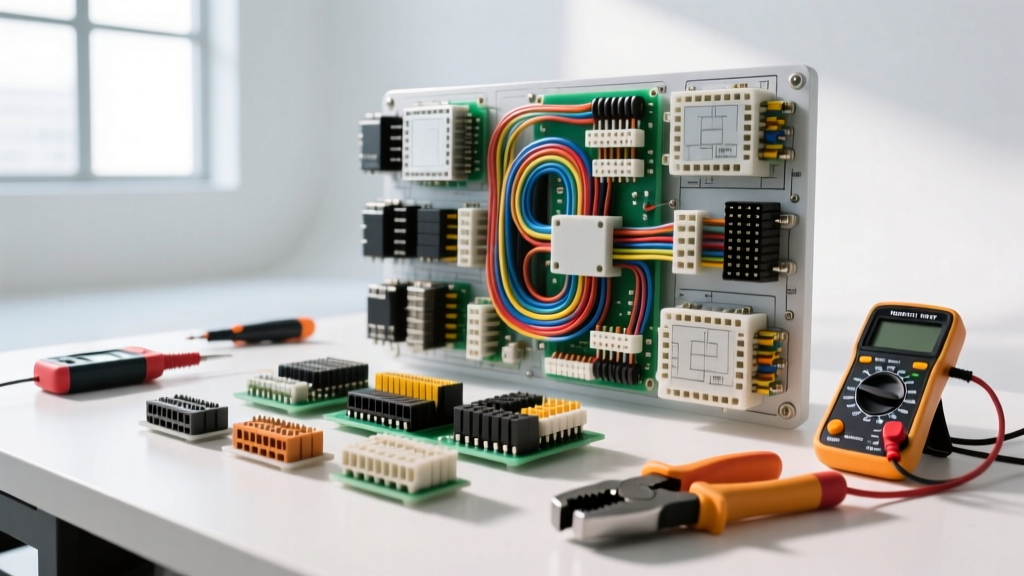
Defining the Auto Electrico Specialty
The transition from a general automotive technician to a dedicated auto electrico (automotive electrical specialist) requires a highly strategic investment in diagnostic hardware, specialized hand tools, and premium wiring consumables. Unlike mechanical repairs, where failures are often visible or audible, electrical diagnostics rely on interpreting invisible electron flow, pulse-width modulated (PWM) signals, and high-speed multiplexed data networks. This cost and tool requirements analysis breaks down the exact financial and technical investments required to operate a modern auto electrical diagnostic bay, categorized by diagnostic tiers.
Tier 1: Foundational Wiring & Circuit Repair
Entry-level auto electrico work focuses on physical circuit integrity, connector repair, and basic voltage-drop testing. The goal here is to eliminate high-resistance faults caused by corrosion, improper splicing, or undersized wiring.
Essential Hand Tools & Crimpers
- Digital Multimeter (DMM): A true-RMS meter with low-impedance (LoZ) capability to eliminate ghost voltages. The Fluke 87V (approx. $450) remains the industry benchmark due to its MIN/MAX recording and millisecond response times for capturing intermittent open circuits.
- Terminal Crimpers: Generic crimpers will destroy delicate automotive terminals. An auto electrico must invest in ratcheting crimpers specific to connector families. For Delphi Weather-Pack and Metri-Pack 280 series, the IWISS IWS-1424 or equivalent ratcheting dies are mandatory. Cost: $80 - $120.
- Wire Strippers: Precision strippers that do not nick the copper strands. Nicking 18 AWG wire reduces its cross-sectional area, increasing resistance and causing voltage drop under load. Knipex ErgoStrip ($45) is highly recommended.
Wiring Standards & Material Costs
Never use standard PVC hardware store wire in a vehicle. An auto electrico must stock SAE J1128 compliant primary wire. GXL (General Cross-Linked) wire features a thin-wall, cross-linked polyethylene insulation rated for 125°C, making it ideal for tight engine bay harnesses. A 500-foot spool of 12 AWG GXL wire costs approximately $140, while 18 AWG costs around $85. Maintaining an inventory of OEM color codes (e.g., Dark Green, Orange/Black, Light Blue) is a recurring consumable cost of roughly $500 annually for a busy shop.
Tier 2: Advanced Network & CAN Bus Diagnostics
Modern vehicles utilize Controller Area Network (CAN) buses to allow modules to communicate. Diagnosing these networks requires moving beyond basic multimeters into the realm of automotive oscilloscopes and dedicated circuit testers.
The Automotive Oscilloscope
A multimeter cannot read the microsecond voltage transitions of a CAN bus. An auto electrico requires a 4-channel automotive oscilloscope, such as the PicoScope 4425A (approx. $2,100). When probing the OBD-II Data Link Connector (DLC), the technician must understand the exact pinout and waveform architecture:
- Pin 6 (CAN High): Typically Orange with a Black tracer. Resting voltage is 2.5V, spiking to ~3.5V during a dominant bit.
- Pin 14 (CAN Low): Typically Orange with a Brown tracer. Resting voltage is 2.5V, dropping to ~1.5V during a dominant bit.
- Pin 4 & 5 (Grounds): Chassis and Signal grounds, critical for providing a clean reference for the differential signal.
By using differential math channels on the PicoScope software, the auto electrico can view the combined differential signal, easily spotting shorts to battery, shorts to ground, or corrupted waveforms caused by failing module transceivers. For a complete diagnostic setup including Pico Technology BNC-to-banana test leads, current clamps, and back-probes, expect an investment of $2,800.
Circuit Load Testing
The Power Probe IV (approx. $650) is indispensable for applying simulated power and ground to components like fuel injectors, idle air control valves, and cooling fan relays. It allows the technician to verify component integrity and wiring harness continuity simultaneously without relying on the vehicle's PCM to command the circuit.
Tier 3: Module Programming & Parasitic Draw Analysis
The highest tier of auto electrico work involves dealing with module sleep states, parasitic battery draws, and pass-thru flashing.
Parasitic Draw Testing Equipment
Modern vehicles with complex infotainment and telematics modules can take up to 45 minutes to enter 'sleep' mode. Disconnecting the battery to insert a traditional ammeter often resets the modules, creating an endless loop of wake-ups. The professional solution requires a low-amp current clamp (e.g., Fluke i410, $350) or a dedicated shunt resistor. By measuring the voltage drop across a known 10-amp shunt placed in series with the negative battery cable, the auto electrico can monitor the current draw remotely. A normal sleep state should read below 50mA. If a draw persists, the technician must perform a voltage drop test across individual fuses (using a millivolt scale on a DMM) to isolate the offending circuit without physically pulling the fuse and waking the network.
Thermal Imaging
A thermal camera like the FLIR C5 ($550) is a secret weapon for the auto electrico. When a module refuses to sleep or a short circuit is melting a harness, the thermal camera instantly identifies the exact component or wire generating excess heat due to high resistance or internal diode failure, saving hours of manual probing.
Auto Electrico Consumables & Inventory Costs
Professional electrical repair demands OEM-equivalent consumables. Improper splicing leads to wicking corrosion and eventual circuit failure. The initial consumable inventory for an auto electrico should include:
- Adhesive-Lined Dual-Wall Heat Shrink: 3M or equivalent. The inner melamine adhesive melts and seals the connection against moisture. Cost: $120 for an assorted kit.
- Deutsch DT Connectors: Essential for heavy-duty and off-road applications. Requires 2-pin and 3-pin housings, solid copper crimp pins, and the specific grey plastic wedgelocks. Cost: $250 for a master kit.
- Tesa 51036 PET Fleece Tape: Standard vinyl electrical tape will unroll in engine bay heat. Tesa fleece tape provides high-temperature resistance and eliminates harness rattles. Cost: $12 per roll.
- Braided Nylon Loom & Split Loom: For harness reconstruction and chafing protection. Cost: $80.
Comprehensive Tool Investment & ROI Table
| Equipment Category | Specific Tool / Brand | Estimated Cost (USD) | Primary Auto Electrico Application |
|---|---|---|---|
| Diagnostic Scope | PicoScope 4425A Master Kit | $2,800 | CAN bus differential signaling, sensor waveform analysis |
| Circuit Tester | Power Probe IV | $650 | PWM testing, relay actuation, instant ground/power supply |
| Digital Multimeter | Fluke 87V Industrial | $450 | Voltage drop testing, resistance, MIN/MAX glitch capture |
| Current Clamp | Fluke i410 Low-Amp Clamp | $350 | Non-intrusive parasitic draw and alternator ripple testing |
| Thermal Imaging | FLIR C5 Compact Camera | $550 | Locating shorted diodes, high-resistance harness splices |
| Crimping Tools | IWISS Ratcheting Die Set | $120 | Weather-Pack, Metri-Pack, and open-barrel terminal crimping |
| Consumables | Initial Wire, Tape, & Shrink Kit | $800 | GXL wire, Tesa fleece, dual-wall heat shrink, Deutsch kits |
| Total Estimated Entry Investment | $5,720 | Complete Tier 1 & Tier 2 Diagnostic Capability | |
Return on Investment (ROI) for the Auto Electrico
While a $5,720 initial investment may seem steep compared to standard mechanical tooling, the ROI for an auto electrico is exceptionally high. General mechanics frequently 'parts-cannon' electrical issues, replacing alternators, PCMs, and sensor harnesses based on generic OBD2 codes. An auto electrico charges diagnostic time (typically $150 - $225 per hour) to definitively prove a circuit failure using voltage drop tests and oscilloscope captures. By accurately identifying a $12 corroded Metri-Pack terminal instead of condemning a $1,200 engine wiring harness, the auto electrico builds immense customer trust and secures high-margin diagnostic labor hours that parts-changers simply cannot access.