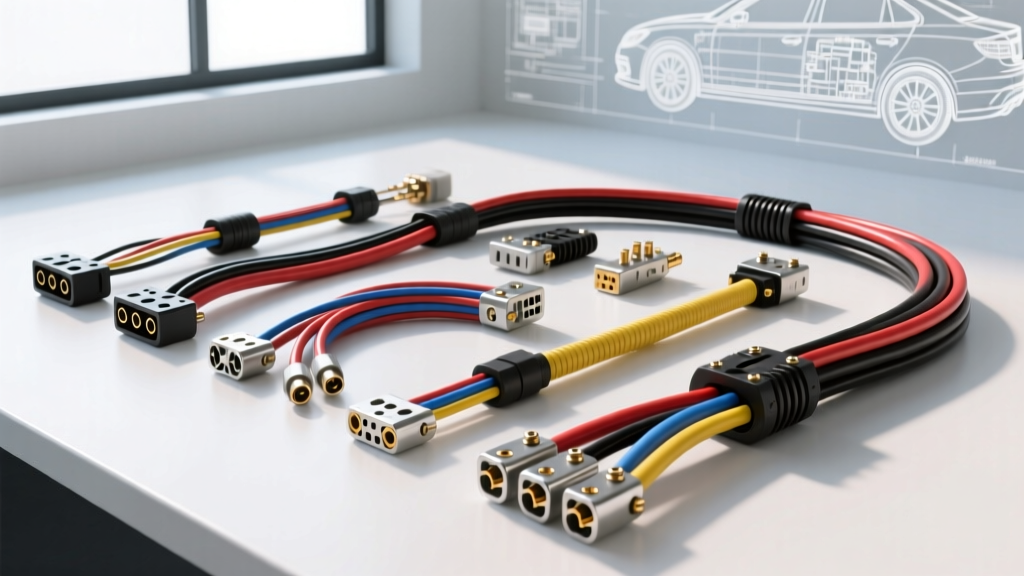
The Economics of Automotive Harness Fabrication
When evaluating cable assembly wiring harness types, lengths, and standards, automotive engineers and custom fabricators must navigate a complex matrix of material costs, tooling investments, and strict SAE compliance. Whether you are building a bespoke engine swap harness for a Gen IV LS3 or manufacturing OEM replacement pigtails, the financial footprint of your project is dictated by copper weight, insulation chemistry, and crimp tooling capital. This comprehensive cost and tool requirements analysis breaks down the exact expenditures required to produce reliable, SAE-compliant automotive electrical systems.
Decoding SAE Standards and Wire Material Costs
The foundation of any automotive harness is the primary wire. In North America, the governing specification for low-tension automotive cable is the SAE J1128 Standard. This standard dictates the physical dimensions, insulation thickness, and thermal ratings of cross-linked polyethylene (XLPE) wire.
Wire Type Cost Breakdown: TXL vs. GXL vs. SXL
Choosing the right insulation type directly impacts both your material budget and the physical routing constraints of the harness.
- TXL (Thin Wall): The industry standard for modern EFI and ECU harnesses. An 18 AWG TXL wire has an outer diameter (OD) of just 1.40mm and weighs roughly 1.1 lbs per 1,000 feet. Cost: $12 to $16 per 100ft spool.
- GXL (General Wall): Slightly thicker insulation for abrasion resistance. 18 AWG GXL has an OD of 1.65mm. Cost: $15 to $19 per 100ft spool.
- SXL (Special Wall): Thickest insulation, used in high-heat zones near exhaust manifolds. Cost: $22 to $28 per 100ft spool.
For a standard V8 EFI swap harness requiring roughly 150 feet of 18 AWG sensor wire and 50 feet of 12 AWG power wire, expect to spend between $45 and $85 on raw copper and XLPE insulation alone. However, specialty colors (like GM-specific Dark Green for EVT signals or Pink for 12V switched ignition) often carry a 15% premium over standard black or red spools.
Tooling Capital Expenditure: Manual vs. Automated Crimping
The intersection of cable assembly wiring harness types, lengths, and standards is most visible in the tooling required to terminate them. A proper SAE-compliant crimp must pass a strict pull-test (e.g., 15 lbs of force for 18 AWG) without the wire slipping from the terminal barrel. Achieving this requires precision ratcheting tooling.
Hand Tooling ROI Analysis
For low-volume custom shops or one-off engine swap builds, manual ratcheting crimpers are the most economical choice. Brands like TE Connectivity (formerly AMP) and Molex dominate this space.
- TE Connectivity CERTI-CRIMP (Part #58496-1): Essential for Metri-Pack and Weather-Pack terminals. Features a ratcheting mechanism that ensures the crimp cycle is complete before releasing. Cost: $350 - $450.
- Molex Hand Crimp Tool (Part #63819-0000): Ideal for MX150 and standard blade terminals. Cost: $280 - $320.
- Economy Alternatives (e.g., IWISS): While budget-friendly ($40 - $60), they often lack the precise die tolerances required for aerospace or high-end motorsport applications, leading to higher failure rates and voltage drop issues.
Ultrasonic Welding and Automated Stripping
For production runs exceeding 1,000 units, manual crimping becomes a labor bottleneck. Automated cut-and-strip machines (like the Komax Alpha series) cost upwards of $15,000 but reduce wire prep time by 90%. Furthermore, ultrasonic metal welders (costing $8,000 to $25,000) are increasingly used to splice multiple ground wires into a single heavy-gauge eyelet terminal, eliminating the mechanical resistance and potential corrosion points inherent in traditional brass crimp barrels.
The Economics of Wire Lengths and Voltage Drop
Wire length is the primary variable that forces engineers to upsized AWG ratings, exponentially increasing copper costs. According to Ohm's Law, longer runs increase resistance, leading to voltage drop. In modern automotive applications, a voltage drop exceeding 0.5V on a 12V circuit can cause ECU sensor faults or fuel pump starvation.
Length vs. AWG Cost Penalty Matrix
Consider a 20-foot positive run to a Holley Dominator EFI in-tank fuel pump drawing 15 Amps. Using standard 14 AWG wire results in a voltage drop of roughly 0.76V, which is unacceptable for PWM-controlled pump modules. You must upsize to 10 AWG.
| Wire Gauge (AWG) | Copper Area (mm²) | Voltage Drop (20ft @ 15A) | Cost per 100ft (TXL) | Weight per 100ft |
|---|---|---|---|---|
| 14 AWG | 2.00 | 0.76V (Fail) | $18.00 | 2.2 lbs |
| 12 AWG | 3.00 | 0.48V (Marginal) | $26.00 | 3.3 lbs |
| 10 AWG | 5.00 | 0.30V (Pass) | $42.00 | 5.5 lbs |
By upsizing from 14 AWG to 10 AWG to meet the length requirement safely, the material cost for that single circuit increases by 133%. This is why accurate harness length measurement during the prototyping phase is critical to budget forecasting.
Connector Cavity Costs: Weather-Pack vs. Metri-Pack vs. Deutsch
Termination hardware represents a massive portion of the Bill of Materials (BOM) for custom harnesses. The TE Connectivity and Aptiv connector ecosystems offer varying levels of environmental sealing and cost-per-cavity.
- Aptiv Weather-Pack (150/280 Series): The legacy standard for GM vehicles. Excellent sealing but bulky. Cost: ~$0.15 per cavity.
- Aptiv Metri-Pack (150/280/630 Series): The modern OEM standard. Much higher density, allowing smaller ECU footprints. Requires specific tang-bending tools for depinning. Cost: ~$0.22 per cavity.
- Deutsch DT / DTM Series: The gold standard for motorsport and off-road environments. Features a secondary locking wedge and silicone rear grommet. Cost: $1.20 to $2.50 per cavity.
For a 120-cavity ECU harness, using Weather-Pack connectors will cost roughly $18 in housings and seals. Upgrading the entire ECU interface to Deutsch DTM connectors will push the connector cost alone past $180, not including the specialized insertion tools required.
Real-World Fabrication Case Study: Gen IV LS3 EFI Harness
To illustrate how these costs and standards converge, let us analyze a custom-fabricated engine-side harness for a GM Gen IV LS3 (E67 ECU). This harness must handle high-current injector loads and sensitive 5V reference signals.
Critical Pinout and Material Specifications
| ECM Connector / Pin | Function | Wire Color | AWG / Type | Terminal Series |
|---|---|---|---|---|
| C1 / Pin 1 | Ignition 12V Switched | Pink | 18 AWG TXL | Metri-Pack 150 |
| C1 / Pin 73 | ECM Main Ground | Black/White | 14 AWG TXL | Metri-Pack 280 |
| C1 / Pin 34 | 5V Reference (TPS) | Dark Blue | 20 AWG TXL | Metri-Pack 150 |
| C2 / Pin 12 | INJ 1 Control | Yellow/Black | 18 AWG TXL | Metri-Pack 280 |
Project BOM and Labor Estimate
- Wire (150ft mixed 18/20 AWG, 40ft 14 AWG): $65.00
- Terminals & Seals (140 pieces): $35.00
- ECM Housings (OEM GM replacement): $85.00
- Deutsch DT Pigtails (Injectors/Coils): $110.00
- Loom, Tesa Tape, & Heat Shrink: $40.00
- Total Material Cost: $335.00
- Labor (12 hours @ $85/hr fabrication rate): $1,020.00
Total Project Cost: $1,355.00. While off-the-shelf generic swap harnesses can be found for $400, they often utilize non-OEM bulk wire, non-ratcheted crimps, and incorrect pin drag seals. By adhering strictly to SAE J1128 standards and utilizing proper Metri-Pack tooling, the custom harness guarantees long-term reliability, zero voltage drop anomalies, and perfect ECU communication.
Conclusion: Investing in Compliance
Understanding the nuances of cable assembly wiring harness types, lengths, and standards is not just an academic exercise; it is the difference between a vehicle that runs flawlessly for 100,000 miles and one that suffers from intermittent parasitic draws and ECU faults. Investing in high-quality XLPE wire, precision ratcheting crimpers, and OEM-spec connector housings yields a massive return on investment by eliminating the hidden costs of electrical troubleshooting and warranty claims.