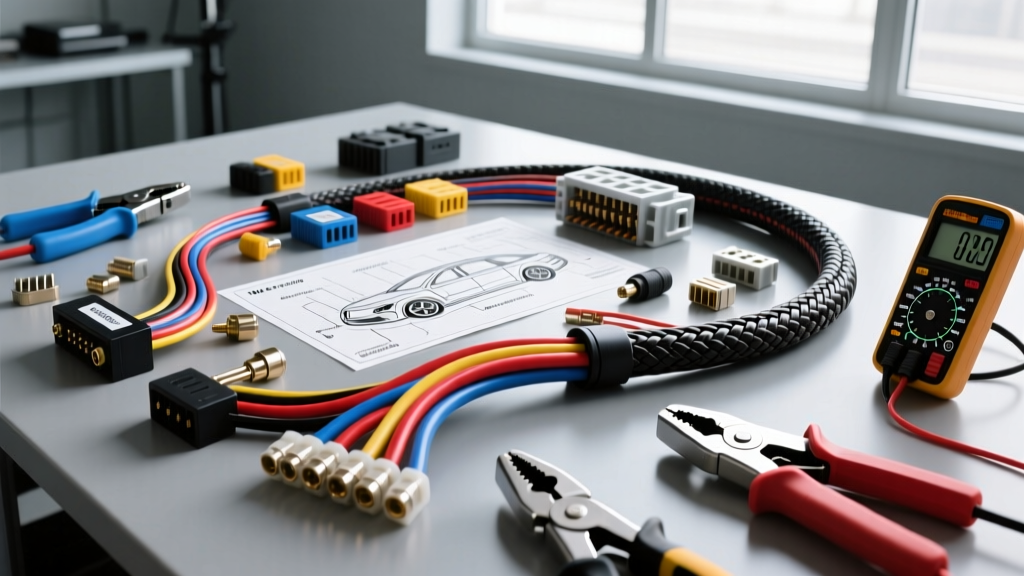
Bridging the Railway Wiring Harness Market and Extreme Automotive Builds
When engineering electrical systems for expedition vehicles, rock crawlers, and heavy-duty commercial fleet swaps, standard automotive wiring often falls short of the environmental and vibrational stresses encountered in the field. To solve this, elite custom fabricators are increasingly looking toward the railway wiring harness market for inspiration, materials, and validation protocols. The railway sector operates under stringent directives like EN 50343, which dictate extreme resistance to moisture, continuous high-temperature exposure, and severe mechanical shock.
Adapting these heavy-rail standards for automotive applications—such as a Cummins 4BT/6BT engine swap harness or a military-style LMTV expedition build—requires a fundamental shift in both tooling and material procurement. This cost and tool requirements analysis breaks down the capital expenditure (CapEx) and operational expenditure (OpEx) necessary to fabricate railway-spec wiring harnesses for the automotive aftermarket.
Capital Expenditure: Tooling Requirements Analysis
Entering the realm of railway-spec harness fabrication requires abandoning standard $40 automotive crimpers. The railway wiring harness market demands gas-tight, cold-weld crimps that will not oxidize or loosen under years of high-frequency vibration. This necessitates precision ratcheting tools, automated wire strippers, and cavity insertion instruments.
| Tool Category | Automotive Standard | Railway/MIL-Spec Equivalent | Est. Cost | Application & Justification |
|---|---|---|---|---|
| Precision Crimper | Manual Ratcheting (e.g., IWISS) | Daniels AFM8 or TE 59958-1 | $450 - $850 | Ensures exact crimp depth to 0.001" tolerances; non-releasing ratchet guarantees full cycle. |
| Wire Stripping | Manual Thermal/Mechanical | Eraser Company M-Strip or Ideal 45-151 | $300 - $600 | Prevents nicking of Tefzel insulation and fine 19x29 stranding on MIL-W-22759/16 wire. |
| Crimp Pull-Tester | Visual Inspection | Digital Force Gauge (e.g., Mark-10) | $800 - $1,200 | Required to validate minimum 45 lb pull-strength on 16 AWG terminals per SAE and rail specs. |
| Insertion Tool | Flathead Screwdriver | TE Connectivity Cavity Plug Tool | $25 - $45 | Prevents damage to connector housings and ensures wedgelocks are fully seated. |
Tooling CapEx Summary: To properly outfit a workbench for railway-grade automotive harness building, expect an initial tooling investment between $1,575 and $2,695. While steep, this eliminates the primary failure mode in off-road harnesses: terminal back-out and fretting corrosion.
Material Science: MIL-Spec vs. Standard Automotive Wire
Standard TXL or GXL wire (per SAE J1128) is excellent for street vehicles, featuring a thin-wall cross-linked polyethylene insulation rated to 125°C. However, the railway wiring harness market frequently utilizes MIL-W-22759/16 Tefzel (ETFE) wire. Tefzel is rated for 150°C continuous use, 600V dielectric strength, and is virtually impervious to diesel fuel, hydraulic fluid, and brake cleaner.
Cost Comparison: 16 AWG Primary Wire
- Standard Automotive TXL (16 AWG): ~$0.25 to $0.35 per foot.
- MIL-W-22759/16 Tefzel (16 AWG): ~$1.10 to $1.60 per foot.
For a comprehensive 12-circuit engine swap harness requiring roughly 80 feet of primary wire, the material cost jumps from $24.00 (TXL) to $112.00 (Tefzel). This 400% premium is justified in expedition builds where a single chafed wire near the exhaust manifold or fuel injection pump could result in a catastrophic failure miles from civilization.
Component Cost Breakdown: 12-Circuit Expedition Harness
Let us analyze the Bill of Materials (BOM) for a 12-circuit engine management and sensor harness designed for a Cummins swap, utilizing Deutsch DT series and DTM connectors, which bridge the gap between automotive availability and railway-level environmental sealing (IP67/IP69K).
| Component | Specification / Part Number | Qty | Unit Cost | Total Cost |
|---|---|---|---|---|
| Connector Housing (ECM) | Deutsch DTM06-12SA (12-Cavity) | 2 | $14.50 | $29.00 |
| Wedgelocks | DTM-12S (Secondary Lock) | 2 | $1.20 | $2.40 |
| Socket Contacts | DTM-16-20-10S (Nickel Plated) | 24 | $0.85 | $20.40 |
| Wire (Power/Ground) | 20 ft | $2.80 | $56.00 | |
| Wire (Signal/CAN) | 18 AWG MIL-Spec Tefzel (Yel/Wht/Blu) | 60 ft | $1.30 | $78.00 |
| Backshells & Boots | DMC-12S (Strain Relief) | 2 | $6.50 | $13.00 |
| Looming & Tape | DR-25 Heat Shrink & Tesa 51036 | 1 Lot | $45.00 | $45.00 |
Total Material Cost: ~$243.80. By comparison, a standard automotive weather-pack harness using PVC wire and basic inject-molded connectors would cost approximately $65.00. The railway-spec approach represents a 3.5x multiplier in raw materials, yielding a harness capable of surviving submersion, extreme thermal cycling, and high-G impacts.
Fabrication Protocols: Crimping, Sealing, and Torque Specs
The railway wiring harness market does not rely on solder for primary terminations; solder wicks into the wire strands, creating a rigid point that fractures under vibration. Instead, gas-tight cold-weld crimping is mandatory.
Step-by-Step Fabrication Standards
- Stripping: Strip exactly 3.17mm (1/8") of Tefzel insulation. Do not score the 19x29 copper stranding. A single nicked strand reduces the tensile strength of the wire by up to 30%.
- Crimping: Insert the wire into the DTM-16-20-10S contact. Use the Daniels AFM8 crimper set to the blue selector dial (position 4 for 16-20 AWG). The tool will not release until the precise crimp depth is achieved, ensuring the terminal barrel deforms into a hexagonal shape that squeezes out all oxygen, preventing internal corrosion.
- Insertion: Push the crimped contact into the DTM housing until an audible 'click' is heard, indicating the internal brass retention tang has engaged the contact shoulder.
- Wedgelock Engagement: Insert the DTM-12S wedgelock. This secondary locking mechanism pushes the contacts forward, ensuring they cannot back out when the mating connector is separated.
- Backshell Torque: If utilizing threaded backshells for DR-25 heat shrink integration, torque the coupling ring to exactly 15 in-lbs. Over-torquing will crack the glass-filled nylon housing.
Testing and Validation: Meeting Railway Market Standards
In the automotive aftermarket, a simple multimeter continuity test is often deemed sufficient. The EN 50343 standard governing the railway wiring harness market requires rigorous mechanical and dielectric validation before a harness is cleared for deployment.
Required Validation Matrix
- Pull-Testing: Every 10th crimp must be subjected to a destructive pull-test. For 16 AWG MIL-W-22759/16 wire in a Deutsch terminal, the wire must break before the crimp yields, typically requiring a minimum force of 45 lbs (200 Newtons).
- Insulation Resistance (Megger Testing): Apply 500V DC between the harness conductors and the outer shielding/loom for 60 seconds. Insulation resistance must read >100 Megohms to ensure the Tefzel was not compromised during stripping or routing.
- Voltage Drop Analysis: Pass the rated continuous current (e.g., 10A for 16 AWG) through the harness. Measure voltage drop across the crimped joints. A proper gas-tight crimp will exhibit a voltage drop of less than 5 millivolts per connection.
Conclusion: Is the Railway-Spec Investment Worth It?
Transitioning to the standards of the railway wiring harness market is not cost-effective for a weekend trail rig or a standard street-driven LS swap. However, for professional fabricators building expedition vehicles, military contract trucks, or high-stakes competition rock crawlers, the CapEx in precision tooling and the OpEx in MIL-Spec materials pays for itself in absolute reliability. By utilizing Tefzel wire, ratcheting cold-weld crimpers, and EN 50343 validation protocols, automotive builders can engineer wiring harnesses that will outlast the vehicles they are installed in.