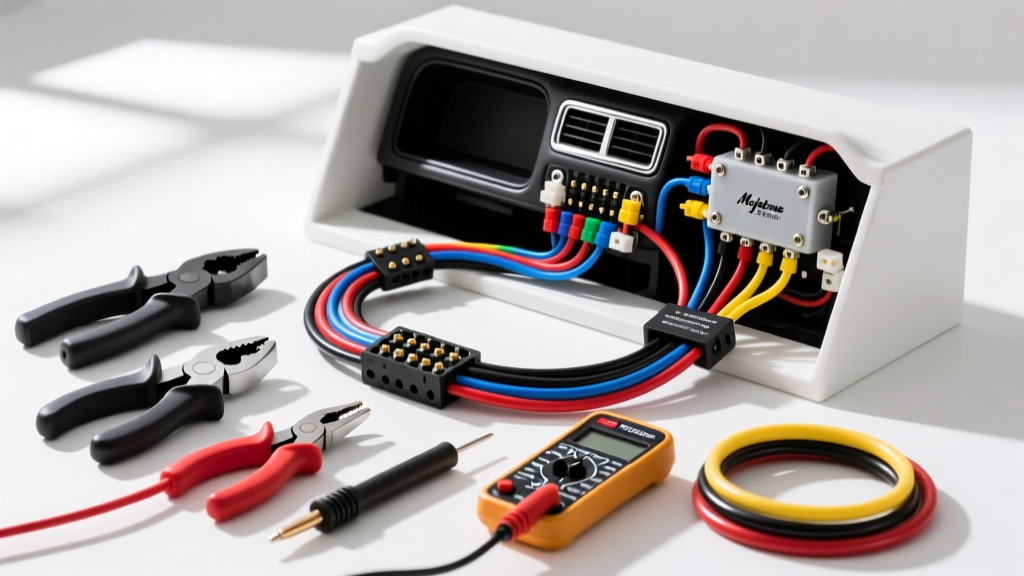
The Crossover: Why a Mojotone ES 335 Wiring Harness Matters in Automotive
When custom automotive fabricators seek the ultimate blueprint for noise rejection in low-voltage signal circuits, they often look outside the garage. The architecture of a premium Mojotone ES 335 wiring harness—originally designed to eliminate 60-cycle hum and microphonic feedback in semi-hollow body electric guitars—provides a masterclass in shielding, point-to-point soldering, and star-grounding. In the automotive world, these exact techniques are the gold standard for building custom, noise-free analog gauge clusters, high-end car audio volume controllers, and sensitive sensor harnesses.
Modern vehicle cabins are hostile electromagnetic environments. Alternator whine (typically 100Hz to 400Hz depending on engine RPM), ignition coil EMI, and PWM (Pulse Width Modulation) noise from LED lighting can easily infiltrate unshielded 22 AWG signal wires. By adapting the meticulous tooling and material selection found in boutique audio harnesses, automotive electricians can achieve a Signal-to-Noise Ratio (SNR) exceeding 100dB, compliant with CTA-2006 mobile audio standards.
Phase 1: Tooling Investment & The Point-to-Point Fabrication Station
Replicating the reliability of a boutique harness requires abandoning cheap, high-wattage soldering irons that scorch wire insulation. The focus is on precision thermal control, essential when working with 22 AWG stranded tinned copper and delicate PTFE (Teflon) dielectrics.
Essential Tool Checklist & Cost Breakdown
| Tool Category | Recommended Specification | Est. Cost (USD) | Automotive Application |
|---|---|---|---|
| Soldering Station | Hakko FX-888D or Weller WE1010 (70W, Digital Temp) | $110 - $140 | Prevents melting PVC/PTF dielectrics on 22-18 AWG shielded wire. |
| Solder Alloy | 63/37 Eutectic Rosin-Core (0.031" dia) | $25 | Instant wetting; prevents cold joints in high-vibration dash environments. |
| Wire Strippers | Knipex 12-42 AWG Precision Micro-Stripper | $45 | Strands outer braid shield without nicking the inner signal conductor. |
| Heat Gun | Dual-Temp Mini Heat Gun (250°C / 500°C) | $30 | Shrinking 3:1 ratio adhesive-lined heat shrink for under-dash moisture sealing. |
| Flux | No-Clean Tacky Flux (Syringe) | $15 | Ensures capillary action on oxidized automotive chassis ground points. |
Total Initial Tool Investment: ~$225 - $255. While higher than standard crimp-tool kits, this investment eliminates the need for costly EMI troubleshooting and ensures aerospace-grade joint reliability.
Phase 2: Material Costs & Wire Specifications
Standard automotive primary wire, governed by SAE J1128 (Low Tension Primary Cable), utilizes cross-linked polyethylene (TXL/GXL) insulation. While excellent for 12V power distribution, standard TXL lacks the electrostatic shielding required for analog audio or sensitive thermocouple signals. The Mojotone ES 335 wiring harness standard utilizes pushed-back cloth-braided, shielded wire. For automotive adaptation, we use a modern equivalent: Mil-Spec PTFE shielded cable with an outer waxed cotton sleeve for vintage aesthetics and abrasion resistance.
Material Comparison: OEM TXL vs. Boutique Shielded
| Parameter | Standard Auto TXL (18 AWG) | Boutique Shielded (22 AWG w/ Braid) |
|---|---|---|
| Conductor | Stranded Bare Copper | Stranded Tinned Copper (Oxidation resistant) |
| Dielectric | Cross-Linked Polyethylene | PTFE (Teflon) - High melting point |
| Shielding | None | 38 AWG Tinned Copper Braided Shield |
| Outer Jacket | PVC / Nylon | Waxed Cotton Braid (Vintage/Hot Rod) |
| Cost per Foot | $0.15 - $0.25 | $1.80 - $2.50 |
| EMI Rejection | Poor (Requires twisted pair) | Excellent (>90% coverage) |
Phase 3: Fabricating the Auto Audio Controller Harness
Building a custom harness for an under-dash audio controller or analog gauge pod using these boutique techniques requires strict adherence to point-to-point routing and star grounding.
Step 1: Shield Preparation and 'Pigtail' Avoidance
The most common failure mode in custom shielded harnesses is the 'pigtail' ground, where the braided shield is twisted into a single wire and soldered. This creates an inductive loop, effectively turning the shield into an antenna for alternator whine. Instead, use a shield-drain wire technique or terminate the braid directly into a 360-degree shielded ring terminal. If using point-to-point (like the ES-335 harness), fan the braid out evenly and solder it flat against the grounded chassis lug to maintain continuous Faraday cage integrity.
Step 2: The Star Ground Bus
In a Mojotone ES 335 wiring harness, all potentiometer grounds converge on a single, isolated ground lug to prevent ground loops. In an automotive application, you must create a dedicated Star Ground Bus for your audio/dash harness. Do not share this ground with high-current devices like fuel pumps or cooling fans.
- Hardware: Use a brass or copper bus bar, isolated from the chassis via nylon standoffs.
- Wire Gauge: Run a dedicated 10 AWG OFC (Oxygen-Free Copper) ground wire from the bus bar directly to the vehicle's main battery negative terminal or a verified clean chassis node (sanded to bare metal, treated with No-Ox-Id A-Special).
Step 3: Point-to-Point Soldering on Potentiometers
When wiring volume pots or gauge dimmer switches under the dash:
- Pre-tinning: Pre-tin both the 22 AWG signal wire and the brass pot lug using 63/37 eutectic solder at 350°C (662°F).
- Mechanical Bond: Pass the wire through the lug eyelet and crimp it slightly with micro-pliers before applying heat. Automotive vibration will shatter a solder-only joint; a mechanical wrap is mandatory per Bosch Automotive Electrics standards.
- Thermal Protection: Use a hemostat as a heat sink on the wire between the lug and the insulation to prevent the waxed cotton or PTFE from melting back.
Phase 4: EMI Troubleshooting & Real-World Failure Modes
Even with premium materials, improper routing can compromise the harness. Use this diagnostic matrix if noise infiltrates your custom build:
Symptom-Cause-Fix Decision Tree
- Symptom: High-pitched whine that rises with engine RPM.
- Cause: Capacitive coupling. Signal wires are routed parallel to the vehicle's main 12V+ power harness or ignition coil wires.
- Fix: Reroute signal harnesses at a strict 90-degree angle to high-current power wires. Maintain a minimum 4-inch separation.
- Symptom: Low-frequency 'pop' or static when turning on interior LED dome lights.
- Cause: PWM dimmer noise from the LED circuit bleeding into a shared ground path.
- Fix: Isolate the gauge/audio ground bus. Ensure the shield braid is only grounded at the source (controller), not at the destination (amplifier/gauge), to prevent a ground loop.
- Symptom: Intermittent signal drop-out over bumps.
- Cause: Cold solder joint or fractured 22 AWG strands due to improper strain relief.
- Fix: Apply 3:1 adhesive-lined heat shrink over the termination point, extending 1/2 inch onto the wire jacket to create a flexible strain relief boot.
Conclusion: The ROI of Boutique Harness Techniques
Adapting the methodologies of a Mojotone ES 335 wiring harness to automotive applications is not merely an exercise in aesthetics; it is a calculated engineering decision. While the material cost per foot increases by roughly 10x compared to standard TXL wire, the total material cost for a typical custom dash or audio controller harness (usually under 15 feet of wire) adds less than $30 to the overall project budget. When weighed against the hours of labor required to chase parasitic EMI, alternator whine, and ground loops in a completed vehicle interior, the investment in shielded wire, precision soldering tools, and star-grounding topology yields an immediate and measurable return on investment. For high-end restomods, concours builds, and audiophile vehicle cabins, this standard is non-negotiable.