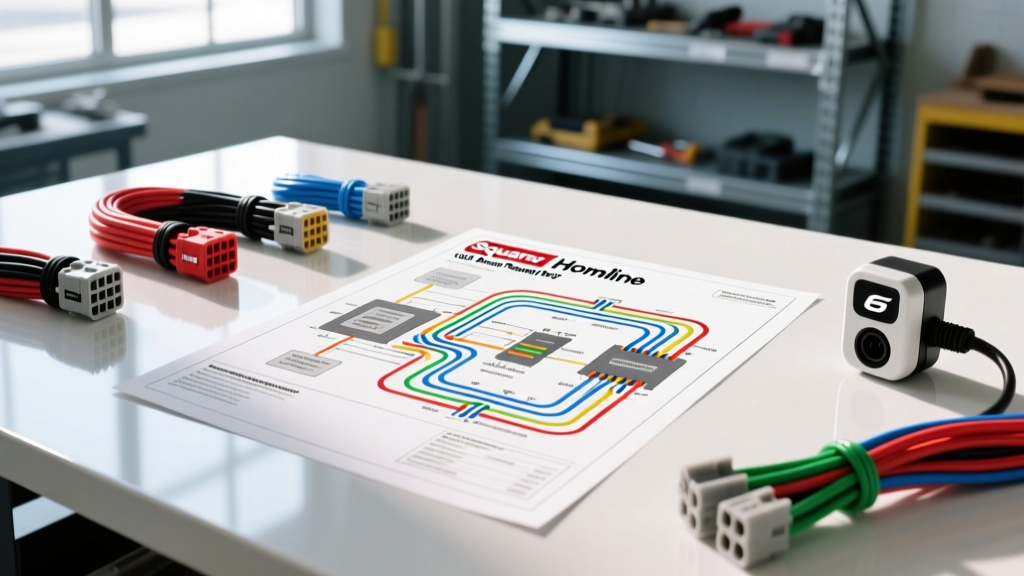
Bridging Automotive Power Needs with the Square D Homeline 100A Panel
Modern automotive shops, RV parks, and residential EV charging setups frequently utilize the Square D Homeline 100-amp load center as a dedicated subpanel. This panel isolates the massive continuous draws of EV Level 2 chargers and RV 50-amp shore power systems from the main household or commercial electrical service. Referencing the official Square D Homeline 100 amp panel wiring diagram PDF ensures that the bus bar stab limits, neutral/ground bar separation, and main breaker lug torques are configured correctly for high-cycle vehicle charging environments.
Unlike a standard vehicle alternator output that maxes out around 150-200 amps at 14.2V DC, a 100A 240V AC subpanel delivers up to 24,000 watts of continuous power. This is sufficient to simultaneously run a 50-amp RV air conditioning system and a 40-amp hardwired EVSE (Electric Vehicle Supply Equipment) unit, provided the branch circuits are balanced across the L1 and L2 bus bars.
Feed Wire Sizing and Voltage Drop for Vehicle Subpanels
The most common failure in DIY RV pedestal and EV garage builds is undersizing the feeder wire, leading to severe voltage drop. When an EV charger pulls a continuous 40A load for 8 hours, or an RV runs dual A/C units in the summer heat, undersized wires overheat and trip breakers prematurely. According to the NFPA 70 National Electrical Code (NEC), a 100A subpanel feed requires specific AWG sizing based on the conductor material and insulation type.
| Conductor Material | AWG / kcmil Size | Insulation Type | Max Ampacity (75°C Column) | Voltage Drop @ 100ft (240V) |
|---|---|---|---|---|
| Copper | 2 AWG | THHN / THWN-2 | 115 Amps | ~1.9% (Excellent) |
| Aluminum | 1/0 AWG | XHHW-2 | 100 Amps | ~2.4% (Acceptable) |
| Copper | 3 AWG | THHN / THWN-2 | 100 Amps | ~2.4% (Acceptable) |
Note: For runs exceeding 100 feet to a detached garage or RV pad, always upsize by one AWG tier to maintain voltage drop below the NEC recommended 3% threshold for branch and feeder circuits combined.
Branch Circuit Configuration: NEMA 14-50R for RVs and EVSE
The most versatile receptacle to install on a Square D Homeline 100A subpanel for vehicle applications is the NEMA 14-50R. This 4-prong, 240V/120V 50-amp receptacle is the universal standard for RV shore power (ANSI/RVIA LV standard) and the plug-in connector for popular EV chargers like the Tesla Mobile Connector and ChargePoint Home Flex. The SAE International J1772 standard for EV conductive charging relies on the stable 240V split-phase power provided by this exact receptacle configuration.
NEMA 14-50R Pinout and Wire Color Codes
| Pin Designation | Function | Standard Wire Color | Breaker Connection |
|---|---|---|---|
| X (Right Slot) | Hot Leg 1 (120V to Neutral) | Black | L1 Bus Bar Stab |
| Y (Left Slot) | Hot Leg 2 (120V to Neutral) | Red | L2 Bus Bar Stab |
| W (Bottom Semi-Circle) | Neutral (Return Path) | White | Isolated Neutral Bar |
| G (Top Round Pin) | Equipment Ground | Green or Bare Copper | Grounding Bar (Bonded to Enclosure) |
For the branch circuit feeding the 14-50R, you must use 6 AWG copper wire (or 4 AWG aluminum) protected by a 50-amp double-pole breaker. In a subpanel, the neutral bar must remain isolated from the panel enclosure and the ground bar. Bonding the neutral and ground in a subpanel creates a parallel neutral path, which can cause stray AC current to flow through the RV's chassis or the EV's grounding pin, leading to severe shock hazards and GFCI tripping.
The "Floating Neutral" Catastrophe in RVs and EV Setups
One of the most devastating failure modes in vehicle power infrastructure is the "floating" or lost neutral. If the 100A main neutral lug on the Homeline bus bar is not torqued to the manufacturer's specification, the connection can loosen due to thermal expansion and contraction from heavy, continuous EV charging loads.
In a 120/240V split-phase system, a lost neutral turns your two 120V RV legs into a series circuit. If the RV's L1 leg is drawing 15A (microwave and lights) and the L2 leg is drawing 2A (phone charger and TV), the voltage will divide inversely to the resistance. The lightly loaded L2 leg can experience a voltage spike up to 220V+, instantly frying the RV's ECU, entertainment system, and appliance control boards. This is why referencing the official Square D Homeline 100 amp panel wiring diagram PDF and using a calibrated torque screwdriver is non-negotiable for automotive and RV electricians.
Torque Specifications for Square D Homeline Panels
- Main Breaker Lugs (2 AWG Copper): 45 in-lbs (inch-pounds)
- Main Breaker Lugs (1/0 AWG Aluminum): 45 in-lbs
- Branch Breaker Lugs (6 AWG to 14 AWG): 20 in-lbs
- Neutral/Ground Bar Set Screws: 35 in-lbs
Always verify these values against the specific wiring diagram PDF printed on the inside of your Homeline panel door, as specifications can vary slightly by manufacturing year and exact model number (e.g., HOM1224L100PC vs. HOM48M100C).
Grounding Electrodes for Detached Vehicle Subpanels
If you are installing this 100A panel in a detached garage for an EV charger or at the end of a driveway for an RV pedestal, NEC Article 250.32 requires a local grounding electrode system. You must drive two 5/8-inch copper-clad ground rods, spaced at least 6 feet apart, and bond them to the subpanel's ground bar using a continuous 6 AWG bare copper grounding electrode conductor (GEC). This ensures that in the event of a lightning strike or a primary utility fault, the vehicle's chassis remains at earth potential, protecting both the vehicle's sensitive CAN-bus networks and the human occupants.
Summary and Authoritative Resources
Mastering the Square D Homeline 100 amp panel wiring diagram PDF is essential for any automotive electrical professional expanding into the EV and RV space. By adhering to strict AWG sizing, maintaining isolated neutrals in subpanels, and applying precise torque to all terminations, you ensure that high-draw vehicle systems operate safely and efficiently for years to come.
Authoritative References: