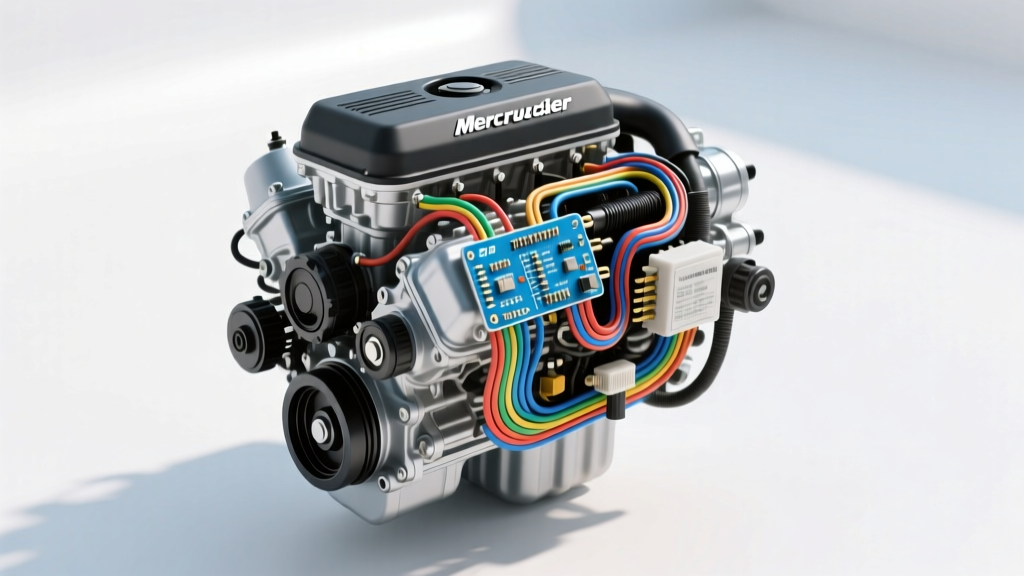
The Foundation of a Mercruiser 5.7L EFI Repower
Upgrading a classic carbureted Mercruiser 5.7L (350 CID) to a modern Multi-Port Electronic Fuel Injection (MEFI) system or integrating a digital SmartCraft dash is one of the most rewarding marine modification projects you can undertake. However, marine electrical environments are notoriously hostile. When planning an EFI swap or digital dash integration, securing an accurate wiring diagram Mercruiser 5.7 owners trust is the critical first step. Unlike automotive small-block Chevy (SBC) harnesses, marine harnesses must adhere to strict ABYC (American Boat and Yacht Council) standards, utilizing tinned copper, specialized ignition shielding, and specific safety interlocks like the oil pressure fuel cutoff.
This guide provides the technical schematics, pinout tables, and wire gauge specifications required to successfully convert a Thunderbolt IV/V carbureted 5.7L to a MEFI 4B or MEFI 5B EFI system, while ensuring your vessel remains safe, compliant, and reliable on the water.
Decoding the OEM Mercruiser Marine Wire Color Codes
One of the most common mistakes DIY boaters make when repowering is assuming automotive wire color codes apply to marine engines. Mercury Marine utilizes a distinct color palette for its instrumentation and engine harnesses. Misinterpreting these colors during an EFI bulkhead connector swap can result in fried ECMs or dead gauges.
| Wire Color | Marine Function | Automotive Equivalent | Typical AWG Size |
|---|---|---|---|
| Purple | Ignition Switched 12V+ (Run) | Pink / Red | 10 - 14 AWG |
| Red | Battery 12V+ (Constant Heavy) | Red | 4/0 - 8 AWG |
| Yellow | Starter Solenoid Signal | Yellow / Purple | 10 - 12 AWG |
| Tan | Tachometer Signal | White / Green | 18 AWG |
| Dark Blue | Alternator Excite / Choke | Brown / Blue | 14 AWG |
| Gray | Instrument Sender Feed / 5V Ref | Gray | 18 AWG |
| Black | System Ground | Black | 10 - 4/0 AWG |
Note: Always use marine-grade, UL 1426 listed tinned copper wire. Standard automotive wire will oxidize rapidly in a bilge environment, leading to voltage drop and ECM sensor faults. For more on marine wire insulation standards, refer to the SAE J1128 Low Tension Primary Cable specifications.
Project Execution: Carbureted to MEFI 4B/5B Conversion
When swapping from a Thunderbolt V ignition and Holley/Merlin carburetor to a MEFI 4B (Multi-Port EFI) system, the engine-side harness changes drastically. The MEFI system requires a dedicated 80-way ECM connector (often split into two 40-pin connectors on later 5B models) and high-current fuel pump circuits.
Upgrading Main Power and Ground Infrastructure
The MEFI ECM draws significantly more amperage than a Thunderbolt ignition module. The OEM 10-pin round "cannon plug" used on older Mercruiser 5.7L engines cannot safely handle the combined load of the ECM, fuel injectors, and electric fuel pump.
- Starter to Battery: Upgrade to 2/0 AWG (or 4/0 AWG for runs over 10 feet) tinned copper. Use adhesive-lined marine heat shrink terminals.
- ECM Main Power (Pin 1 & 2): Run a dedicated 10 AWG fused circuit directly from the starter solenoid battery post to the ECM harness relay.
- Engine Block Ground: The MEFI ECM relies on the engine block for sensor grounding. Install a 2 AWG grounding strap from the rear of the cylinder head to the transom shield, and ensure the mating surfaces are bare metal, treated with conductive anti-seize.
MEFI 4B Core ECM Pinout Reference
Below is a critical reference for the primary power, ground, and tachometer outputs on the MEFI 4B 80-pin ECM. This is essential when merging the new EFI engine harness with the boat's existing dashboard and key switch harness.
| ECM Pin | Function | Wire Color | Connection Point |
|---|---|---|---|
| Pin 1 | Battery 12V+ (Constant) | Red | Starter Solenoid (via 30A Maxi Fuse) |
| Pin 2 | Main ECM Ground | Black | Engine Block / Cylinder Head |
| Pin 3 | Ignition 12V+ (Switched) | Purple | Key Switch "I" Terminal |
| Pin 12 | Tachometer Output | Tan | Dash Tachometer "SIG" Post |
| Pin 20 | Fuel Pump Relay Control | Dark Green | Fuel Pump Relay Pin 85 |
| Pin 30 | Malfunction Indicator (Check Engine) | Yellow/Black | Dash Warning Lamp |
Integrating SmartCraft Digital Gauges & NMEA 2000
Modernizing a Mercruiser 5.7L isn't just about fuel delivery; it's about data. Upgrading to Mercury's SmartCraft digital gauges or integrating an NMEA 2000 gateway requires tapping into the ECM's CAN-bus (Controller Area Network) data lines.
The MEFI 5B and later ECMs feature a dedicated CAN-bus output. To integrate a SmartCraft System Monitor or a third-party display (like Garmin or Lowrance via a Mercury gateway), you must wire the CAN-H and CAN-L twisted pair.
- CAN-High: White with Blue tracer (18 AWG)
- CAN-Low: White with Green tracer (18 AWG)
- Shield Drain: Bare copper (Grounded at ECM only to prevent ground loops)
Crucial Modification Rule: Never splice into CAN-bus wires using standard crimp connectors or solder. The high-frequency data requires continuous twisted-pair geometry. Use Deutsch DT series environmental splices or replace the harness segment entirely. Terminate the CAN-bus network with a 120-ohm resistor at each end of the backbone to prevent signal reflection and data dropouts.
Troubleshooting Decision Tree: EFI Swap Fuel Delivery
A common issue during a Mercruiser 5.7L EFI upgrade is the fuel pump failing to prime or shutting off immediately after cranking. Use this diagnostic tree to isolate the fault without throwing parts at the problem.
Symptom: Fuel pump runs for 2 seconds at key-on, dies, and engine cranks but won't start.
- Branch A: Oil Pressure Interlock Fault
- Cause: Mercruiser utilizes a safety interlock that cuts fuel pump power if oil pressure is lost. During initial cranking, if the sensor reads low, the ECM kills the pump.
- Fix: Verify continuity on the Purple/White wire from the 12V ignition source to the fuel pump relay Pin 86. Ensure the oil pressure sending unit is properly grounded and outputting >4 PSI during cranking.
- Branch B: ECM Ground Floating
- Cause: The ECM cannot complete the circuit to ground the fuel pump relay coil (Pin 20) due to poor block grounding.
- Fix: Measure resistance between ECM Pin 2 (Black wire) and the bare engine block. It must read less than 0.05 ohms. Clean the ground stud with a wire wheel and apply marine-grade dielectric grease over the tightened terminal.
- Branch C: Inertia / Lanyard Switch Voltage Drop
- Cause: Running the EFI ignition feed through an undersized OEM emergency cutoff (lanyard) switch causes a voltage drop below 10.5V, resetting the ECM.
- Fix: Bypass the old 14 AWG lanyard feed. Install a heavy-duty 10 AWG marine relay triggered by the lanyard switch to deliver full battery voltage to the ECM's Purple ignition wire.
Marine-Grade Best Practices for Harness Routing
When executing your Mercruiser 5.7 wiring diagram modifications, physical routing is just as critical as electrical continuity. The marine environment introduces constant vibration, bilge water, and extreme heat from the exhaust manifolds.
- Adhesive-Lined Heat Shrink Only: Every crimp made in the engine bay must use 3M or equivalent adhesive-lined (dual-wall) heat shrink. The inner meltable liner seals the wire strands against capillary action, preventing moisture from wicking under the insulation and turning the copper into green oxide.
- Exhaust Clearance: Maintain a minimum 9-inch clearance between any wiring harness and the cast-iron exhaust manifolds or risers. Use high-temperature fiberglass sleeving (rated to 1000°F) where the harness must cross near the rear of the cylinder heads.
- Drip Loops: When routing wires into the ECM connectors or the main bulkhead cannon plug, always form a "drip loop" (a U-shaped bend below the connector). This ensures that any water condensing on the wire drips off the bottom of the loop rather than running directly into the connector cavity.
- Ratcheting Crimpers: Abandon cheap plier-style crimpers. Use a calibrated ratcheting crimper with the correct die for Metri-Pack 150 and Weather-Pack terminals. A proper crimp should pass a 15 lb pull-test without the wire slipping from the terminal barrel.
By strictly adhering to the OEM Mercruiser schematics and upgrading the infrastructure to modern ABYC standards, your 5.7L EFI repower will deliver automotive-level reliability and throttle response on the water. For further technical documentation and service bulletins, always consult the official Mercury Marine service portals or your local certified marine technician.